


The air at the training facility was a damp, abrasive sheet of Pacific Northwest fog that clung to the skin like a shroud. It was barely dawn, the kind of gray morning that feels less like a beginning and more like a lingering hangover. I stood in the middle of the courtyard, the weight of my canvas pack familiar and heavy, watching the condensation bead on the rusted hood of the transport trucks.
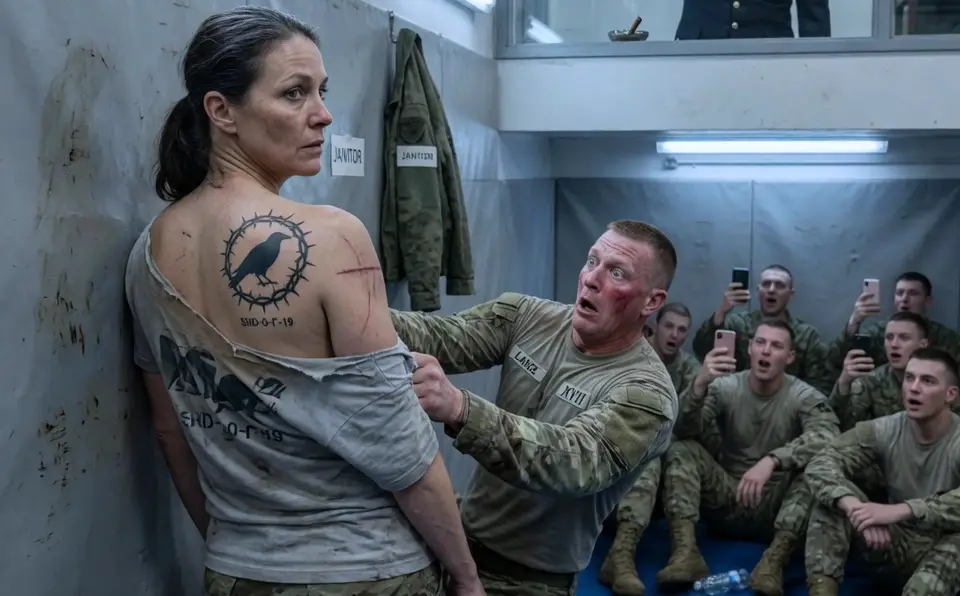
“Get out of the way, Logistics!”
The voice was a jagged blade, cutting through the low hum of the base. Before I could shift my weight, a heavy shoulder slammed into mine. I stumbled, my worn boots—scuffed to a dull charcoal and long past their prime—skidding across the slick concrete. I didn’t fall. I had learned a long time ago how to find my center even when the world tried to tilt it. I simply exhaled, adjusted the fraying strap of my bag, and waited for the vibration of the impact to fade from my bones.
Lance Morrison didn’t even look back. He moved with the practiced, aggressive swagger of a man who believed the world was a series of doors meant to be kicked open. He was the quintessential golden boy of the elite recruits—broad-chested, teeth a shade of white that looked expensive, and an ego that required its own zip code.
Around him, a ripple of laughter broke out among the other cadets. It was a sharp, predatory sound, the kind of noise people make when they’ve found something they consider beneath them.
“Seriously, who let the janitor in?” Madison Brooks leaned against a stack of supply crates, her blonde hair pulled back into a ponytail so tight it seemed to sharpen her features. She looked like a recruitment poster—crisp, pristine, and entirely untouched by the grit of reality. She gestured toward my faded, oversized t-shirt and the sneakers that had seen better decades. “This isn’t a soup kitchen, honey. The motor pool is two miles that way, if you can even drive.”
I didn’t answer. I looked at her, really looked at her, and saw the insecurity masked by the designer-brand attitude. According to the roster, I was Olivia Mitchell, a non-entity, a ghost in a worn windbreaker. I let the silence hang between us, thick and uncomfortable. It was a weapon I’d mastered years ago.
I picked up my backpack, my movements precise and economical. Every gesture was a calculated exercise in being unremarkable. I walked toward the barracks, the laughter following me like a persistent itch. They thought they were watching a victim. They had no idea that in exactly eighteen minutes, when the physical reality of the training took hold and the layers began to peel away, they would realize they had made the most profound mistake of their lives. Even the commander, a man who thought he’d seen everything the theater of war could offer, would freeze. He would see a mark on my skin that shouldn’t exist—a symbol of a lineage that was supposed to have been buried in the ash of classified history.
But for now, I was just a woman in a beat-up pickup truck.
I had arrived at the gate in a ’94 Ford F-150 that smelled of stale coffee and damp pine needles. The paint was peeling in jagged flakes, and the engine groaned like it was carrying a heavy secret. To anyone watching, I was a woman from the fringes, someone who had scraped together enough credits or favors to get a shot at the most prestigious boot camp in the country.
Nobody would have guessed I had been born into a world of marble floors and private tutors, where “summering” was a verb and your last name carried more weight than your character. My family’s estate featured a library larger than most public schools, and I had been groomed for a life of soft hands and strategic marriages. But I didn’t carry that world in my posture. There were no designer labels in my pack, no manicured edges to my personality. I had traded the silk for abrasive cotton and the gated estates for the cold, hard reality of the field.
I stood there, hands tucked into the pockets of my faded jeans, watching the chaos of the camp. The other recruits were posturing, measuring each other’s shadows, performing the ritual dance of dominance that comes with youth and unearned privilege. I simply observed. I was waiting for a signal only I was trained to hear, a shift in the wind that told me the games were truly beginning.
Captain Harrow was the first real hurdle. He was a mountain of a man, his face a roadmap of scars and sun-leathered skin. He paced the yard with the heavy, rhythmic tread of a predator. His voice didn’t just carry; it vibrated in your chest.
“You,” he barked, his finger snapping toward me like a gunshot. “What’s the story? Supply crew get lost, or did you wander away from the tour group?”
The cadets around us snickered. Madison whispered something to a neighbor, her smile thin and cruel. “Bet she’s here to check a diversity box,” she murmured, loud enough to ensure the insult landed. “Gender quotas are getting desperate.”
I didn’t blink. I looked into Harrow’s eyes—eyes that had seen the worst of humanity and survived it—and felt nothing but a cool, professional distance. “I’m a cadet, sir,” I said. My voice was flat, like a stone skipped across a frozen lake.
Harrow snorted, a sound of pure derision, and waved me off. “Get in line, then. Just try not to slow us down when the real work starts.”
The mess hall that evening was a theater of testosterone and fragile egos. The air was thick with the smell of institutional gravy and the roar of a hundred conversations. I carried my tray to a corner table, a small island of quiet in a sea of noise. I didn’t want to be noticed, but in a room full of people desperate to prove they were “elite,” my silence was an unintentional spotlight.
Derek Chen, a man whose cocky grin seemed permanently etched into his face, spotted me. He had a buzz cut that looked like it had been measured with a ruler and an attitude to match. He grabbed his tray and sauntered over, dropping it onto my table with a deliberate, echoing clatter.
“Yo, lost girl,” he said, pitching his voice for the benefit of the surrounding tables. “This isn’t a charity ward. You sure you wouldn’t be more comfortable washing the dishes? You look like you’ve got the experience.”
The group behind him erupted. I paused, my fork halfway to my mouth, and looked at him. My brown eyes were steady, showing nothing of the fire that usually burned behind them. “I’m eating,” I said simply.
Derek leaned in, his shadow falling over my tray. “Yeah, well, eat faster. You’re taking up space that real soldiers need to fuel up. You’re a placeholder, Mitchell. A ghost.”
Without warning, he reached out and flicked the edge of my tray. A spoonful of mashed potatoes splattered across the front of my shirt, the pale yellow mass sliding down the faded fabric.
The room howled. Several phones were already out, the glow of their screens capturing the moment for whatever social media audience they were desperate to impress. I didn’t jump. I didn’t yell. I reached for a paper napkin and began to wipe the mess with slow, methodical movements. I cleaned the shirt with the same precision I would use to field-strip a weapon in total darkness. I took another bite of my food, looking right through Derek as if he were made of glass.
The silence of my response seemed to infuriate him more than any clever comeback ever could. His face flushed, his jaw tightening as he realized that he hadn’t managed to provoke a single tremor of fear.
“Whatever,” he spat, turning away to rejoin his laughing pack. “Tomorrow morning is going to break you.”
I watched him go, my pulse remaining at a steady, resting rhythm. Tomorrow was physical training—the gauntlet designed to separate the wheat from the chaff. They thought they were the wheat. They had no idea they were just the dust…
To read the rest of the story – CLICK the NEXT button 👇👇👇