


Somewhere out past the jagged canyon ridges, out where the endless scrubland stretches until the horizon blurs, the wind doesn’t carry rain. It carries only dust and the dry whisper of isolation. I had moved to this unforgiving stretch of territory seeking exactly that. I wasn’t looking for redemption, and I certainly wasn’t looking for company. But on an unforgiving afternoon, the desert surrendered something I never expected to find.
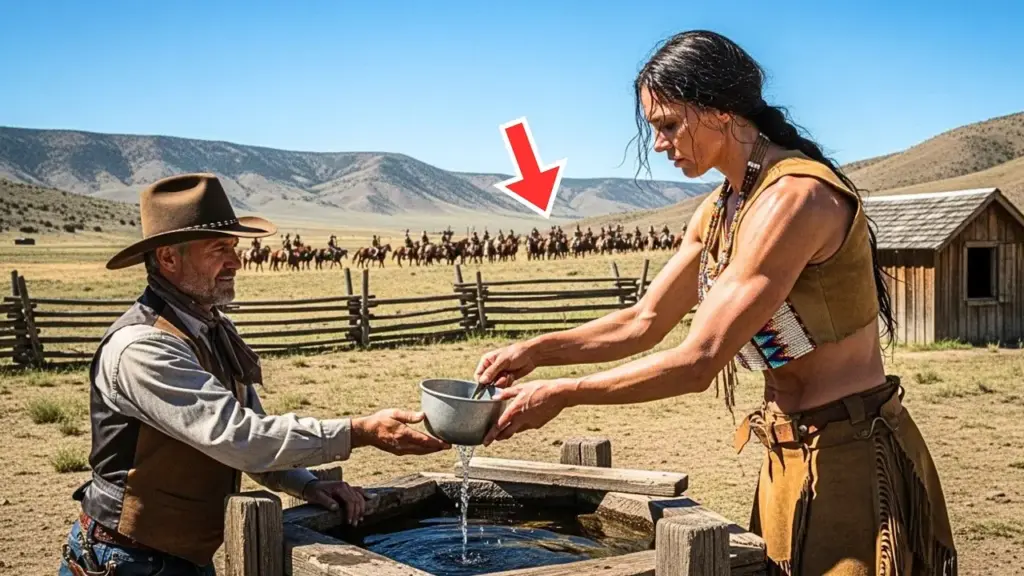
I was walking toward my stone-lined well, the midday sun beating down like a physical weight against my shoulders, when I saw her. She was collapsed against the weathered wooden slats of my corral fence, looking like she had fallen straight out of the sky. As I rushed over, the first thing that struck me was her sheer size. She was a young woman, yet taller and broader-shouldered than any I had ever encountered in my life. Her dark hair was heavily matted, crusted with desert dirt and dried blood from some unseen, harrowing ordeal.
She wore garments of soft, sun-bleached deerskin. The intricate beadwork stitched into the leather immediately marked her as Apache. Her head slumped forward, but as my boots crunched against the hard-packed earth, she shifted. Her lips were cracked open, parched to a devastating, chalky white. I quickly lowered the wooden bucket into the deep well, listening to the echoing splash, and hauled up the coolest water the earth could offer.
When I extended the dripping metal ladle toward her, she didn’t grab it with the desperate frenzy of a dying animal. Instead, she raised her chin and looked at me. Her eyes were dark, incredibly sharp, and filled with a profound suspicion that vastly outweighed any hint of gratitude. She didn’t trust my skin, my fence, or the metal cup in my hand.
But the desert thirst is a cruel master. She drank. She pulled from the ladle once, breathing heavily through her nose. Then she drank a second time, closing her eyes as the cold water hit her throat. Finally, she took a third long draft, draining the ladle completely.
When she was finished, she didn’t collapse back into the dirt. She gathered her limbs and stood up. She towered before me in total silence, her shadow stretching long across the dusty yard. For a breathless moment, she simply stared at me, her dark eyes mapping every line and contour of my face as if she were carving my likeness into her memory.
Then, without uttering a single syllable, she turned her back to me. She walked away from the well, away from my fence, and marched straight toward the rugged eastern hills. I stood there, the empty dripping ladle still in my hand, and watched her tall silhouette dissolve into the wavering heat shimmer. I genuinely thought that would be the absolute end of it.
I was entirely wrong.
I had lived on this harsh parcel of land long enough to develop a sixth sense for when the atmosphere shifted toward trouble. My ranch sat tucked inside a shallow, bowl-like valley where the wild grass grew desperately thin. My nearest neighbor was a grueling two days’ ride to the south. I had chosen this profound isolation entirely on purpose. I wanted no questions asked of my past, and I wanted no part in the endless trouble of civilization. I just wanted my cattle, my small string of horses, and the kind of heavy, blanketed silence that allows a man to finally forget the life he left behind.
I wasn’t running from the law or any specific ghost. I was just exhausted by the relentless noise of people who always believed they knew how to run the world better than they actually did.
That evening, after the towering Apache girl had vanished into the rocky landscape, I forced myself to go about my daily work as if the afternoon had been entirely ordinary. I hauled grain and fed the horses. I walked the long perimeter of the fence line, making mental notes of where the dry wood had begun to rot and splinter. I finally took a hammer and grease to a heavy corral gate hinge that had been squeaking like a dying bird for three weeks.
But no matter how hard I worked my hands, my mind kept circling back to her. I couldn’t shake the memory of the way she had looked at me over the rim of that metal ladle. She hadn’t been afraid. She hadn’t been particularly grateful, either. She was simply, terrifyingly aware. It felt as though she had taken my full measure in a matter of seconds and decided something about my character that I wasn’t even privy to myself.
I kept telling myself it simply didn’t matter. People passed through this brutal territory all the time. Prospectors chasing phantom riches, rootless drifters, native hunting parties heading to or from the trading posts situated further west. She had gotten lost, she had gotten injured, she had found water, and now she was gone. That was the logical end of the narrative.
But that night, lying flat on my back on the narrow, creaking cot inside my log cabin, I couldn’t sleep. I couldn’t shake the deep, primal feeling that the very pressure of the air in the valley had changed.
Outside, the horses were intensely restless. I could hear them shifting their heavy weight in the corral, their hooves anxiously scraping and pawing at the packed dirt. Somewhere around midnight, my big bay gelding let out a sharp, panicked whinny that sliced right through the pitch-black silence.
I sat bolt upright, throwing the thin wool blanket off my chest, and listened. I held my breath.
Nothing followed. There was only the low moan of the night wind pushing hard against the thick timber walls of my cabin, and the distant, mournful call of something hunting high up in the canyon ridges.
I lay back down, resting my hands on my stomach, and stared up at the rough-hewn wooden beams of the ceiling. I told myself that tomorrow I would saddle up, ride out to the expansive north pasture, and meticulously check on the cattle herd. Tomorrow, everything would return to its quiet, predictable rhythm.
I was still quietly feeding myself that comforting lie when the sun finally rose.
I stepped outside right at first light. The morning air was biting and crisp. I pulled my heavy canvas suspenders over my shoulders, snapping them against my shirt, and squinted into the rising glare. The sky was a flawless, pale morning blue that bled into a blinding white at the eastern edges. The shallow valley stretched out peacefully in front of me, with dry scrubgrass and jagged rock formations dotting the familiar landscape.
And then I saw them.
At first glance, I honestly thought my tired eyes were playing morning tricks on me. I thought they were just long, dark shadows cast against the northern ridgeline. But shadows don’t breathe. Shadows don’t sit on the backs of painted horses with terrifying, perfect stillness.
My breath caught in my throat as I began to count. Ten. Twenty. Fifty. I stopped counting when my mind couldn’t process the sheer volume.
They lined the high ridge to the north. They covered the hillside dropping to the east. They blanketed the steep slope that ran all the way down to the dry, cracked creek bed on the west. Everywhere I turned my head, there were more of them.
Hundreds of Apache warriors on horseback. Even from this distance, the morning sun caught the glint of sharpened spear tips and the dark steel barrels of repeating rifles. They weren’t kicking up dust. They weren’t advancing. They weren’t making a single, solitary sound.
They were just existing there, surrounding my ranch completely, like a brutal rope noose that had already been pulled tight around my neck.
My right hand moved on pure instinct, twitching back toward the heavy Winchester rifle I kept leaning just inside the cabin doorframe. But I stopped myself. My hand froze in mid-air. What earthly good would one rifle do against an entire army? If I raised a weapon, I would be cut down before I could chamber a second round.
I stepped slowly away from the door and into the center of the yard, my leather boots crunching loudly on the hard dirt. The horses in the corral behind me were absolutely frantic, pressed hard against the farthest fence rail. Their heads were thrown high, their eyes rolling white, and their nostrils widely flared. They could smell it, too. They could smell the raw, concentrated danger pouring down from the hills.
I scanned the surrounding ridgeline again, my mind racing to understand the impossible geometry of what I was looking at. This wasn’t a raiding party. I knew how raiders operated. Raiders moved fast in the dark, struck with overwhelming violence, took what they wanted, and disappeared before the dust even settled…
To read the rest of the story – CLICK the NEXT button 👇👇👇