


In the house where I grew up, silence was not merely the absence of sound; it was a sanctuary. The rule that governed our lives was absolute, carved into the very foundation of our daily existence by an unyielding parental obsession: you either spoke six languages with flawless, native precision, or you did not open your mouth at all.
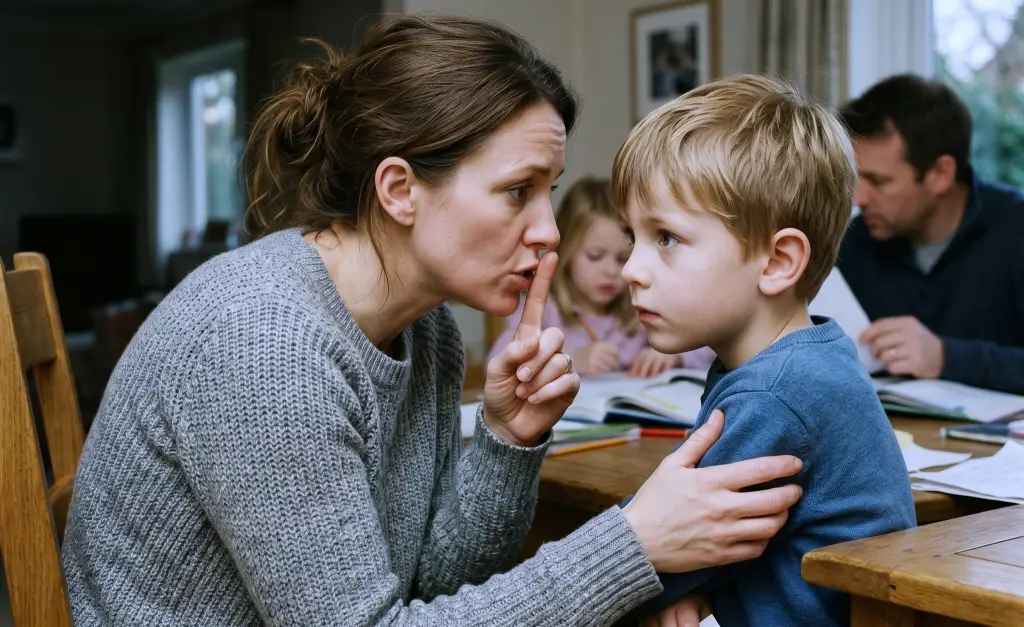
I learned the true weight of that law when I was eight years old. We were seated around the heavy oak dining table for dinner, an evening that was strictly designated for Spanish. My childhood brain, already buckling under the weight of endless vocabulary lists, tripped over a single, treacherous syllable. Instead of the correct Spanish word, a stray French noun slipped past my lips. The reaction was instantaneous. My mother’s hand cut through the air, striking my cheek with a sharp, echoing crack that sent me tumbling backward off my chair. I landed hard on the linoleum floor, my face throbbing, the taste of salt and copper rising in my mouth.
The grand, bitter irony of our lives was that neither of my parents could speak a single word of any language other than English. They were entirely monolingual, trapped in a cage of their own perceived inadequacy. They had convinced themselves that multilingual people belonged to a higher echelon of humanity, a sophisticated global elite to which they could never belong. They looked back on their own lives with a profound sense of failure, genuinely believing that their inability to speak foreign languages had ruined every opportunity they might have had.
On quiet evenings, my mother would sit at the kitchen table, her face illuminated by the harsh glow of a laptop screen. She watched videos of polyglots shifting effortlessly between European and Asian tongues, and she would literally weep. She cried over the sheer beauty of the cadence, mourning the life she felt she had missed, whispering about how painfully stupid and uncultured she felt in comparison. My father handled his regret with aggression. He would come home from his grueling shifts at the shipping warehouse, open a bottle, and launch into alcohol-fueled tirades. He ranted to anyone who would listen—or rather, to the walls—insisting that if someone had only forced him to learn languages when he was a boy, he would be an important man, an international businessman or a diplomat, instead of a broken-down laborer shifting crates in a drafty warehouse.
When my older sister, Louise, was born, they looked into her crib and saw a clean slate. They determined that their children would not inherit their provincial limitations. By the time I was old enough to understand the concept of a calendar, our entire existence had been mapped out into a rigid, seven-day linguistic gauntlet. Every morning brought a psychological pivot. Monday was reserved exclusively for the crisp, nasal tones of French. Tuesday demanded the sharp, guttural precision of German. Wednesday plunged us into the complex, tonal realm of Mandarin. Thursday required the deep, resonant cadences of Arabic. Friday was Italian, full of rolling vowels and rapid inflections. Saturday belonged to the polite, disciplined structures of Japanese. Sunday was our only variation, a relentless review day where we were forced to rotate through all six languages, practicing transitions under our parents’ watchful eyes.
The enforcement of this schedule was draconian. If either my siblings or I accidentally let slip an English word, or if we mixed up the syntax of two different languages during a transition, the punishment was immediate and severe. There were nights when we were sent to bed without dinner, our stomachs aching in the dark. Other times, we were locked in our bedrooms for hours, isolated with nothing but dictionaries for company. Most frequently, my mother would hand us a lined yellow legal pad and force us to write lines—hundreds of iterations of the correct grammatical rule or vocabulary word, written entirely in the language we had desecrated.
To facilitate this grand experiment, an endless parade of private tutors marched through our front door every single afternoon the moment the school bell rang. My parents lacked the education to comprehend a single sentence of what these professionals were teaching us, but they refused to leave the room. They would sit on the living room sofa like hawks, their eyes tracking the movement of our pencils, searching our faces for any sign of hesitation or laziness.
The psychological toll on us was immense. My older brother, Wyatt, who was only eleven at the time, was already unraveling under the pressure. Long before the clock struck four and the daily tutor arrived, he would succumb to severe panic attacks. He would sit on the edge of his bed, his face pale, his hands trembling violently as he gasped for air. We lived in perpetual fear of the tutors’ progress reports, because any indication that our learning had plateaued was treated by our parents as an act of defiance.
Yet, to the outside world, my parents curated an image of domestic perfection. They would hold up digital recorders and smartphones during our sessions, capturing snippets of our forced conversations. They sent these videos to distant relatives and broadcasted them across social media platforms, accompanied by captions boasting about their genius, prodigy children. Whenever a family member or an acquaintance offered a compliment on our extraordinary abilities, my mother and father would beam with pride, accepting the praise as if they had personally achieved something monumental. They basked in a reflected glory they couldn’t actually understand, completely oblivious to the quiet desperation breaking their children from the inside out.
When I celebrated my thirteenth birthday, the illusion of choice was permanently stripped away. My parents called me into the living room, instructing me to sit on the sofa opposite them. My father reached into his pocket and placed a glossy brochure on the coffee table between us. It was for an elite, highly restrictive boarding school located deep in the European countryside, a facility that specialized in total, high-intensity linguistic immersion.
“You have exactly two years,” my mother said, her voice completely devoid of warmth. “Two years to achieve absolute, unassailable fluency in all six languages.”
My father leaned forward, his eyes boring into mine. “If you fail to prove your proficiency by your fifteenth birthday, you will be on a plane to this institution. We have already initiated the enrollment process, and they are expecting you. The choice is yours.”
I picked up the brochure with trembling fingers. The photographs depicted stone buildings surrounded by high walls, students dressed in austere, identical uniforms sitting in completely silent classrooms. The text explicitly stated that for the entire first academic year, students were permitted no telephone calls home and absolutely no family visits. It did not look like a school; it looked like a beautifully manicured prison designed to erase a child’s identity.
By that point, my daily routine was already a crushing burden. I was spending upwards of four hours every evening huddled over foreign textbooks after finishing my regular middle school assignments. I existed in a state of chronic, bone-deep exhaustion. My performance in my standard school subjects was tanking because my brain simply lacked the cognitive bandwidth to focus on algebra or American history when every spare calorie was dedicated to memorizing foreign vocabulary. Wyatt was falling apart right alongside me, his nights plagued by recurring nightmares from which he would wake up screaming, convinced the tutors were standing over his bed, demanding translations he couldn’t provide…
To read the rest of the story – CLICK the NEXT button 👇👇👇