


There is a particular kind of silence that only exists in a house that has been abruptly hollowed out. It is different from the quiet of an empty room or the stillness of a late night; it is an echoing, heavy vacuum that vibrates with sudden absence. I was seventeen years old when I walked through our front door into that specific silence. The afternoon sun was cutting sharp, dusty angles across the hardwood floors of the living room, illuminating the square patches where our furniture used to stand. There were no couches, no framed prints on the walls, no stray shoes by the door. Everything was gone.
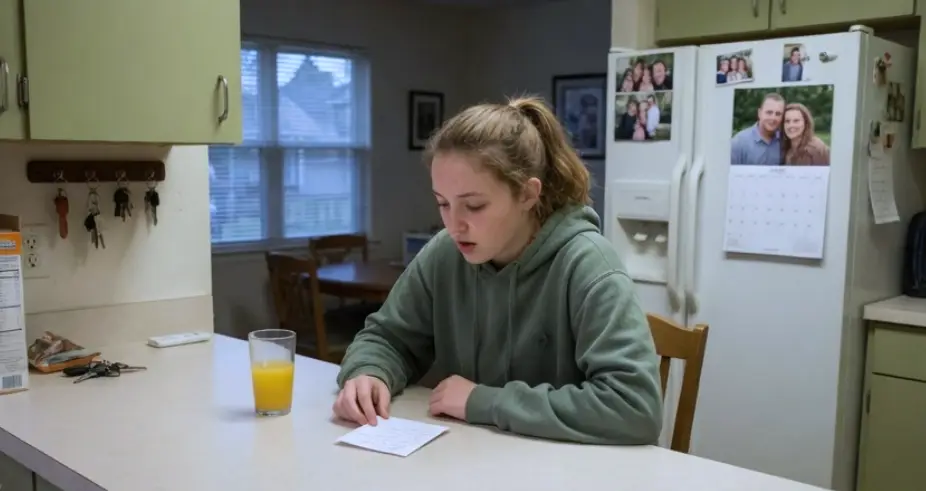
I walked into the kitchen, my sneakers squeaking against the linoleum, a strange tightness gripping my chest. There, sitting dead center on the bare granite island, was a single sheet of lined paper. It wasn’t folded. It didn’t have my name written on the back. It was just an artifact left behind in a wasteland. I picked it up, the paper crisp between my fingers, and read the four words written in my mother’s hurried, elegant cursive: “You’ll figure it out.”
No explanation followed. No forwarding address, no phone number, no emergency cash. It took me days to fully understand that my parents and my younger brother had packed up every single remnant of our lives, loaded it into a truck, and moved two entire states away without uttering a single word to me. Now, twelve years later, sitting in an apartment I own, looking at a bank account that holds security they could never fathom, those four words still carry the exact same chill. They wanted me to figure it out, and I did. But now that the struggle is over, they have suddenly decided they want a piece of the person I became.
Looking back, the signs were always there, buried beneath the surface of what I foolishly thought was a normal, if distant, family dynamic. I spent my childhood believing that if I just performed well enough, worked hard enough, and anticipated their needs, I would eventually earn the right to be loved. I assumed they were simply tired of pretending, but the harsher reality was that they had never even bothered to try.
I still remember my thirteenth birthday with excruciating clarity. I had spent the entire morning in the kitchen, meticulously measuring flour and sugar to bake a vanilla layer cake for my mother, hoping to surprise her when she came home from work. I had even attempted to whip up a homemade buttercream, though my hands were small and we didn’t own a proper mixer. When she finally walked through the door, she barely glanced at the uneven layers or the candles I had carefully arranged. She took one small bite, let out a sharp, disappointed sigh, and pushed the plate away, calling the texture clumpy and unpalatable before retreating to her bedroom.
Two years later, when I was fifteen, my brother Michael was on the verge of failing his high school freshman finals. I stayed up with him every night for three weeks, ignoring my own assignments to drill him on algebra formulas and history dates, patiently re-explaining the concepts until his eyes cleared with understanding. He passed those exams with room to spare. Yet, his only token of appreciation was to call me a suffocating know-it-all, slamming his bedroom door hard enough to rattle the drywall every time I tried to speak to him.
By sixteen, my role in the household had shifted from an inconvenient resident to a financial resource. I had managed to get a job working twenty hours a week at a local hardware store, balancing the register and stocking shelves until midnight. When my father claimed he couldn’t cover the monthly utility bills, I handed over my entire paycheck without a second thought, proud to help keep our heads above water. Weeks later, when I gently asked if we were caught up on the accounts, he erupted into a terrifying rage, slamming his fist on the dining table and screaming that I was an ungrateful, useless child who contributed nothing to the spirit of the home. I was always useful when there was a gap to be filled, but I was never allowed to be a daughter.
A week after they vanished, the finality of my situation truly set in when the landlord knocked on the door. He looked at me with a mixture of confusion and pity, holding a clipboard against his chest. He informed me that my parents had broken the lease early, paying a penalty fee to sever the contract immediately. He gave me exactly seven days to clear out what little belongings I had left before the locks would be changed.
For the first three nights, I relied on the strained hospitality of a high school classmate, sleeping on a cramped futon in her basement while pretending I was just housesitting for my parents while they looked for a new property. But hospitality carries an unspoken expiration date when you are seventeen and have nowhere to go. By the fourth day, I could feel the palpable discomfort of her parents, and I knew I had run out of places to hide my reality.
With the remaining ninety dollars from my final hardware store paycheck, I walked into a self-storage facility on the edge of town and rented a small, windowless concrete unit. It became my sanctuary and my secret. I dragged a few old blankets inside, pulling the heavy, corrugated metal door down until the padlock clicked shut from the inside, plunging me into absolute darkness.
My daily routine became a masterclass in invisible survival. Every morning at five, before the facility staff arrived, I would slip out of the unit and walk two miles to the YMCA. I learned how to move through the communal showers with absolute anonymity, washing my hair with cheap liquid soap and dressing in the single clean outfit I kept in my backpack. Breakfast, lunch, and dinner were identical: a jar of store-brand peanut butter eaten slowly with a plastic spoon to stretch the calories as far as possible.
During the afternoons, I would sit in the back corner of the public library, the gentle hum of the free computers providing a background rhythm to my desperation. I applied for every single entry-level opening within a five-mile radius, filling out digital forms with a dead prepaid phone number I couldn’t afford to activate. I wore a practiced, bright smile every time I interacted with the librarians, desperately terrified that someone would look closely enough to see the exhaustion etched into my face.
The break I needed arrived in the form of a night-shift server position at a greasy, neon-lit diner off the main highway. The manager, a woman named Martha who wore her silver hair in a tight bun and smelled permanently of menthol cigarettes, was notoriously gruff, but she possessed an innate sense of justice. She looked at my mismatched clothes and my lack of proper identification, then nodded slowly. She agreed to pay me cash under the table at the end of every week, under the strict condition that I never missed a shift and kept the coffee pots full.
One rainy Tuesday morning, after I had worked a double shift and gone nearly thirty-six hours without closing my eyes, my knees simply gave out while I was restocking the condiment station. Martha didn’t yell. She caught my arm, dragged me into the tiny break room, and pointed toward the worn vinyl sofa in the corner. She told me to shut my eyes for two hours, promising to cover my tables herself.
That small act of human decency gave me the strength to keep clawing my way forward. I bought a cheap prepaid phone, bought a small plastic accordion folder, and began saving every single receipt, tracking every penny that passed through my hands. At night, when the diner was empty, I used the spotty employee Wi-Fi to watch free educational tutorials on personal finance, tax structures, and goal setting. The first year was nothing short of a brutal war against poverty, but against every conceivable statistic, I survived…
To read the rest of the story – CLICK the NEXT button 👇👇👇