


To the casual observer, I was completely invisible—just another anonymous face blending into the crowded cabin from the quiet sanctuary of seat 14A. I was a solitary woman deeply absorbed in the dog-eared pages of a paperback novel, minding my own business and disappearing into the background hum of the aircraft. None of the souls sharing that metal tube with me had the slightest inkling of my real identity, let alone the intense life I led when my feet were firmly on the ground.
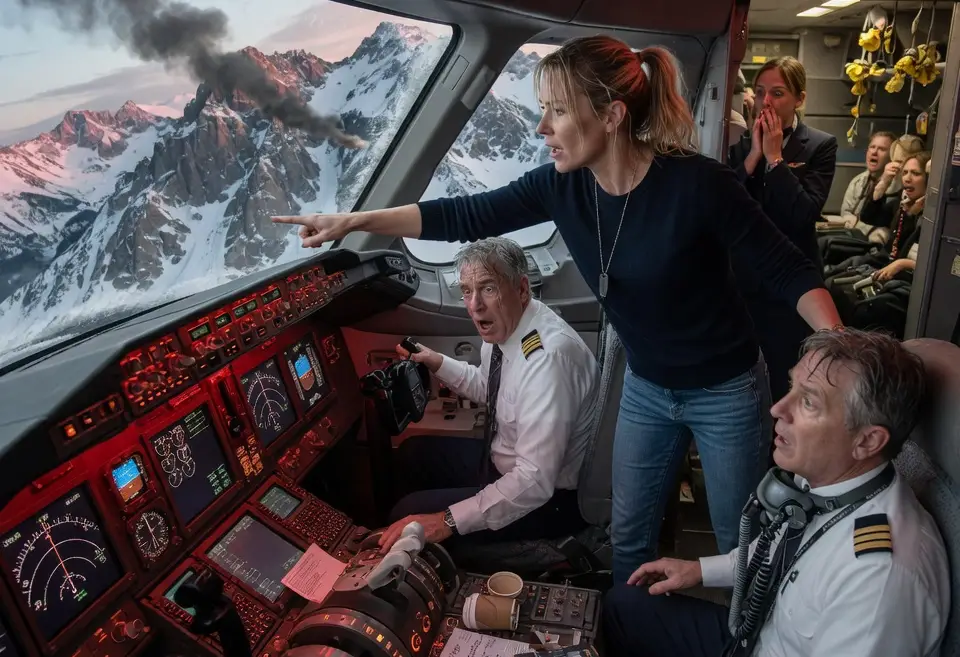
But that carefully guarded anonymity was destined to shatter into a million pieces the moment both massive turbofan engines flamed out, dying completely over the jagged, unforgiving granite peaks of the Rocky Mountains. In a single heartbeat, one hundred and eighty-five unsuspecting lives were cast into a terrifying countdown, mere minutes away from a violent, catastrophic end.
It was in that exact crucible of panic that I stood up, overrode every standard safety protocol, and deliberately walked straight into the chaos of the cockpit to help guide a heavy, dying machine back down to the earth. Far above the desperate drama, sweeping through the thin air like predatory birds, a pair of F-22 fighter jets would soon circle our crippled vessel, broadcasting a singular military call sign over the emergency frequencies that demanded instant, absolute respect: Viper.
Before our world fractured, Flight 831 was cruising with effortless grace at an altitude of 37,000 feet, suspended safely above the majestic, snow-capped spine of the Rockies. The afternoon sky outside my small window was a brilliant, piercing shade of blue, casting a serene glow over a landscape that looked entirely peaceful from our lofty vantage point. The Boeing 777, en route from the damp, pine-scented forests of Seattle to the sprawling, sun-baked plains of Dallas, carried a heavy logistical load of one hundred and eighty-five passengers alongside a dedicated, highly trained crew of twelve.
It was a completely typical Thursday afternoon operation, the kind of routine, entirely unmemorable journey that occurs thousands of times every single day across the vast network of the American airspace. Inside the passenger cabin, the atmosphere was thick with the comforting, mundane rhythms of modern travel. People were dozing off comfortably with their heads tilted back and their mouths slightly open, completely engrossed in the flashing screens of the latest inflight movies, or losing themselves in the quiet worlds of their personal books. Flight attendants moved with practiced efficiency up and down the narrow aisles, dispensing cold beverages, plastic cups of ice, and polite, reassuring smiles to the weary travelers.
Everything about the environment felt perfectly secure, utterly normal, and entirely predictable. Snug in the window seat of row 14, I turned another page of my novel, deeply savoring the rare, uninterrupted luxury of absolute solitude. I was in my late twenties, dressed casually for comfort in a pair of well-worn denim jeans and a thick, navy blue cable-knit sweater that shielded me from the standard, biting cabin chill. My blonde hair was swept back tightly into a practical, no-nonsense ponytail, framing a tired face that was entirely devoid of makeup.
To the complete strangers packed into the rows around me, I probably looked like an exhausted graduate student returning to campus after a break, or perhaps a mid-level young professional heading back home after a grueling corporate business trip. There was absolutely nothing in my quiet demeanor, my posture, or my plain civilian appearance to suggest that I was capable of anything extraordinary. By that point, I had been navigating the commercial air travel system for over six long hours, having caught a tightly timed connection in Seattle to make my way back to my familiar roots in Texas.
I was thoroughly exhausted, but it was a deeply satisfying kind of tired—a peaceful, content weariness that settles into your muscles after hard physical exertion. This journey marked the conclusion of my very first vacation in two long, demanding years, a precious week spent hiking the pristine, pine-scented trails of Washington state. Now, my only lingering ambition in life was to finally unlock my front door, throw my arms around my family, and collapse gratefully into the familiar comfort of my own bed.
What none of those sleeping passengers or the busy cabin crew could have guessed was that the woman in 14A was actually Captain Kate “Viper” Morrison, one of the most elite and respected aviators currently serving in the United States Air Force. My professional military résumé was the kind of legendary record that young academy cadets spoke about with wide-eyed reverence. I had piloted F-16 Fighting Falcons in high-stakes environments and commanded the incredibly advanced F-22 Raptor within active, hostile combat zones around the globe. Over my career, I had logged more than 3,000 intense flight hours and earned a formal dress uniform that was heavy with polished medals awarded for exceptional valor and technical precision under fire.
Within the tightly knit military aviation community, my call sign, Viper, was always spoken with a quiet, distinct respect, recognized as belonging to one of the sharpest, most tactically proficient pilots of my generation. But on this specific Thursday, I was officially on leave, stripped of authority and rank. Clad in my ordinary civilian clothes, I was trying my absolute best to just be an ordinary passenger on an ordinary flight. I had even gone out of my way to deliberately omit my military rank during the initial ticket booking and boarding process.
I wanted nothing more than a peaceful, uneventful flight, entirely devoid of the endless questions and intense, wide-eyed conversations that inevitably followed whenever people discovered what I did for a living. The novelty of explaining how a woman ended up flying supersonic stealth fighters had worn off many years ago, and today, I just wanted to blend in.
I was deep into the third chapter of my book, completely immersed in the narrative, when I felt a very subtle, distinct shudder run directly through the heavy airframe. It wasn’t the familiar, rhythmic bump or jostle of standard atmospheric turbulence. My instincts, which had been sharply honed by years of flying highly unstable, fly-by-wire aircraft at blistering supersonic speeds, immediately registered the anomaly with a sudden jolt of adrenaline. The vibration felt deeply wrong—too mechanical, too deep within the structure of the plane.
I glanced up from the page, my senses instantly heightened as I began to analyze the specific frequency of the motion, though I initially tried to force myself to dismiss it as just a temporary rough patch of high-altitude air. The aircraft seemed to stabilize for a fleeting moment, and I consciously forced my eyes back down to the printed text, trying to relax. Five minutes later, however, the sensation returned, but this time it was incredibly violent. The massive airliner lurched sideways with a terrifying force, shaking the entire length of the cabin and causing loose items to slide off tray tables.
A sickeningly loud, metallic bang reverberated directly from the rear portion of the fuselage, echoing through the enclosed space. Passengers gasped in unison, the collective intake of air sharp and panicked, and somewhere a few rows behind me, a woman let out a piercing scream. The seatbelt sign suddenly illuminated above us with a sharp, electronic chime that sounded far too cheerful and robotic for the darkening circumstances. Almost immediately, the captain’s voice crackled over the overhead intercom system; his delivery remained highly professional, but to my trained ears, it was laced with an underlying, unmistakable current of tight-leashed tension.
“Ladies and gentlemen, we are experiencing some technical difficulties,” he announced, his voice steady but strained. “Please return to your seats and fasten your seatbelts immediately. Flight attendants, take your stations.”
I snapped my paperback book shut, shoving it into the seatback pocket, and clicked my metal seatbelt buckle firmly into place. My mind was already racing at a hundred miles an hour, systematically running through complex diagnostic checklists. That explosive noise hadn’t been weather-related; it was undeniably mechanical, the distinct sound of a catastrophic failure occurring somewhere deep within the aircraft’s critical propulsion systems. I leaned my shoulder against the cold plastic paneling, peering out the window to scan the left wing. A dark, thick trail of gray smoke was streaming steadily from the housing of the left engine, marring the perfect blue of the afternoon sky…
To read the rest of the story – CLICK the NEXT button 👇👇👇