


I stood in the shadowed periphery of a fluorescent-lit gas station, staring down at the crumpled bills resting in my palm. Eight dollars. It was a pathetic sum, barely enough to buy a decent cup of coffee in some parts of the city, but to me, it was the exact weight of my daughter’s breakfast for the next morning.
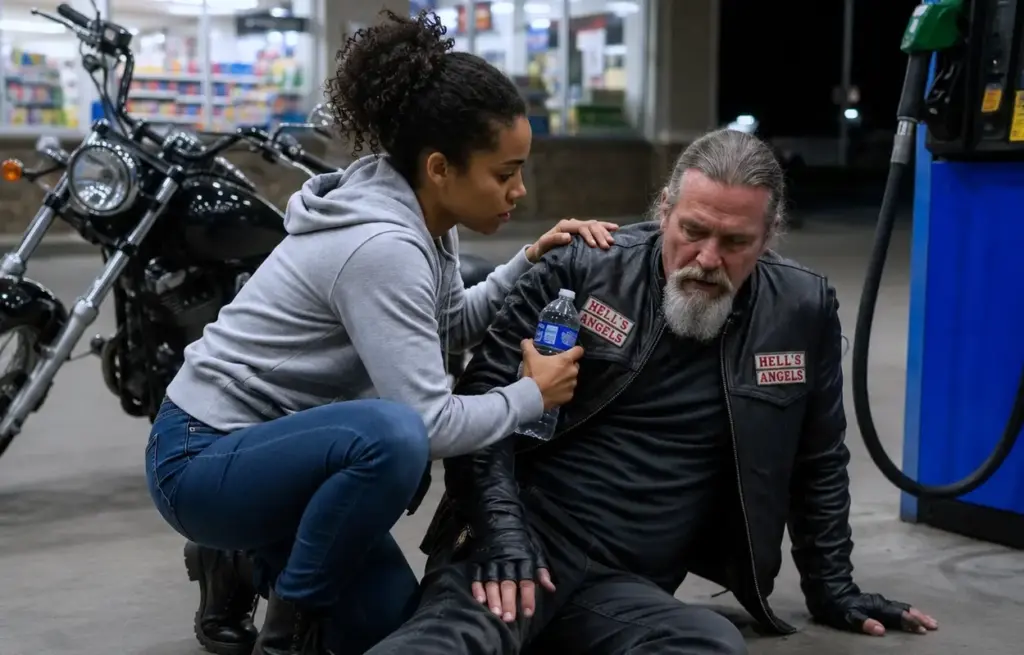
The night air was thick and humid, carrying the faint, metallic scent of impending rain mixed with exhaust fumes. I was exhausted to my marrow, my feet throbbing inside worn sneakers, but then I heard it. It was a desperate, wet gasping sound, the unmistakable noise of a human being fighting for air.
I looked up and saw him. He was a mountain of a man, clad in worn denim and heavy boots, leaning heavily against the gleaming chrome of a massive motorcycle. Even in the dim, buzzing light of the parking lot, I could see the color draining from his face, leaving behind a terrifying, ashen gray. He clutched his chest with a massive, tattooed hand, his knees buckling beneath him.
He was dying right there on the oil-stained pavement, and the lot was practically deserted.
“Don’t get involved!” a voice shouted.
I turned and saw the gas station attendant standing in the glass doorway, leaning out just far enough to be heard.
“Those guys are nothing but trouble,” the attendant yelled, waving a dismissive hand toward the biker before stepping back into the safety of the brightly lit store.
I looked down at the man, who had now collapsed completely against the asphalt, and then back down at my eight dollars. To understand the gravity of that choice, to understand why those soft, torn bills felt like a physical anchor holding me back, you have to understand what my life looked like twenty-four hours earlier.
My alarm had gone off at five in the morning, a jarring electronic shriek that pierced the dark of our tiny, drafty apartment. I had dragged myself out from under the thin blanket, shivering in the early morning chill. The neighborhood had been steadily declining for years, the kind of place where sirens were a nightly lullaby, but it was the only roof I could afford to keep over my six-year-old daughter’s head.
I shuffled into the narrow kitchen and opened the pantry cabinet. The hinges whined, echoing in the quiet room. Inside sat a single box of generic cereal, the cardboard completely bent, holding only a handful of crumbs. I opened the refrigerator and pulled out a carton of milk that was agonizingly light.
I poured the last few drops into a plastic bowl, coaxing out every bit of moisture to soften the dry cereal. As I set the spoon down, I heard the soft padding of bare feet on the linoleum. Maya emerged from the hallway, wrapped in her oversized pink pajamas, rubbing sleep from her dark eyes.
“Morning, Mommy,” she murmured, her voice thick with sleep.
“Morning, baby,” I said, leaning down to press a kiss into her soft curls.
I set the bowl at her place at the small, wobbly table. I didn’t make anything for myself because the math of our existence simply didn’t allow for it. My stomach tightened with a familiar, dull ache, but I ignored it. This was my reality now, a relentless daily calculus of stretching every penny, praying against unexpected disasters because we lived entirely without a safety net.
I worked two jobs just to keep us breathing. My mornings were spent at a humid, windowless laundromat, standing on hard concrete floors and folding the lives of strangers for eleven dollars an hour. By late afternoon, I transitioned to a roadside diner. I spent my evenings serving plates of heavy food to weary truckers and boisterous late-night crowds, smiling until my cheeks cramped, hustling for loose change that might add up to twenty dollars on a good night.
To make matters worse, my ancient sedan had finally given up three weeks prior, leaving me with an repair estimate I couldn’t even dream of paying. Now, I walked everywhere. I walked miles to the laundromat, miles to the diner, and miles back to our apartment. My sneakers were so worn that a distinct hole had formed in the left sole, letting in the damp chill of the pavement with every step.
The financial walls were closing in tight. Rent was due in exactly three days, and my envelopes were still a hundred and fifty dollars short. Our landlord had already slipped one eviction warning under the door. Maya’s asthma inhaler was nearly empty, a prescription that required sixty dollars I did not possess, and the electric company had recently resorted to mailing notices printed on aggressively bright pink paper.
Yet, I never let Maya see me crack. My grandmother, the woman who had raised me, had instilled a rigid philosophy in my bones.
She used to hold my face in her hands and say, “Kindness costs absolutely nothing, baby. And when the world strips you bare, sometimes it’s the only wealth you have left to give.”
So, I brought my grandmother’s wealth to work with me. I smiled warmly at my exhausted coworkers. I asked my diner customers about their travels and their families, even when the arches of my feet felt like they were splintering. I even kept a small, frayed notebook on my nightstand where, every single night, I forced myself to write down three things I was grateful for.
That Tuesday had been a grueling marathon. I had dropped Maya at our neighbor’s apartment before the sun was even up, then marched to the laundromat. For eight solid hours, my hands worked on autopilot, smoothing wrinkles out of denim, sorting endless piles of towels, and folding stiff linen sheets.
When I finally clocked out at two in the afternoon, I walked straight to the diner. My shift didn’t officially start until three, but I cherished that quiet hour. I liked to slide into the worn vinyl of the back booth, wrap my hands around a mug of bitter black coffee, and just let my muscles stop vibrating for a moment.
Linda, a veteran waitress who had been walking these checkerboard floors for two decades, slid into the booth across from me. She wiped her hands on her stained apron and looked at me with soft, knowing eyes.
“You look bone-tired, honey,” Linda said softly.
“I’m always tired, Linda,” I replied, managing a weak, self-deprecating smile.
“You’re working yourself into an early grave for that little girl,” she said, reaching across the laminate table to pat my knuckles.
“She’s worth every second of it.”
“I know she is, sweetheart,” Linda sighed. “But you have to carve out a little grace for yourself, too. Do you hear me?”
I nodded, though we both silently acknowledged the lie. Grace was a luxury reserved for people who could afford to pay their light bill.
My evening shift was a blur of chaos. The diner was packed with transient families and restless teenagers demanding endless refills of fries and sodas. I navigated the narrow aisles, balancing heavy trays, pouring coffee, and absorbing the ambient noise until my head pounded.
When ten o’clock finally rolled around, I retreated to the cramped back office to tally my survival. I spread the crumpled tips out under the harsh overhead light. Twenty-three dollars in loose bills and quarters. I pulled out the small handful of cash I had left over from the previous day: eight dollars and forty-seven cents.
I added it up in my head. Thirty-one dollars and forty-seven cents to my name.
I meticulously separated forty-seven cents to cover my bus fare to the laundromat the following morning. I took twenty-three dollars and tucked it into the hidden zippered pocket of my purse for the rent fund. That left precisely eight dollars. Eight dollars to buy Maya milk and a cheap loaf of bread, maybe some eggs if they were on sale.
I folded those specific bills until they were a tight, dense square and slid into the front pocket of my jeans. Then, I began the long, two-mile trek back to my neighborhood.
The streets were desolate and quiet, bathed in the sickly amber glow of the streetlights. My legs felt like lead, but I kept my chin tucked against the damp wind and forced my feet forward. Knowing I had a long stretch of unlit road ahead, I decided to cut across the asphalt of the all-night gas station to use their restroom.
I pushed through the heavy metal door of the restroom, splashed cold water on my face, and stepped back out into the muggy night.
That was the exact moment the heavy thud echoed across the pavement.
That was the moment I saw the massive man with the skull patched onto his black leather vest drop to his knees, his hands clawing uselessly at his own chest.
Every single biological instinct I possessed screamed at me to turn away and keep walking into the shadows. I had my own desperate life to manage. I had a little girl waiting for me who needed her mother alive and employed, not tangled up with a known criminal enterprise in the middle of the night.
But then the man’s chest stopped moving entirely.
“Hey!” I screamed, turning toward the brightly lit glass of the convenience store. “Hey! Someone call 911!”
The young attendant stepped out from behind the register, pushing the door open with his shoulder. He held an unlit cigarette between his fingers, looking from the motionless giant on the ground to me.
“Lady, are you out of your mind?” the attendant scoffed. “That’s a Hell’s Angel. Leave him right where he is. He’s probably just high on something bad.”
“He’s having a massive heart attack!” I shouted, the panic finally bleeding into my voice.
The attendant offered a lazy shrug. “Not our problem. Those guys are nothing but trouble. Trust me, you do not want to invite that into your life.”
Just then, an older man wearing a faded trucker hat pushed past the attendant, a bag of chips tucked under his arm. He paused, taking in the terrifying scene, and shook his head slowly. He walked over and gently caught my elbow.
“Miss, you need to listen to him,” the trucker warned in a low, serious tone. “People like that, they operate by different rules. They are dangerous. You look like you’ve got a family to get home to. Just walk away.”
I yanked my arm out of his grasp. “A human being is dying on the ground!”
The older man shook his head, muttering something dark under his breath, and marched straight to his rig. He fired up the engine and pulled out of the lot without ever looking back in his rearview mirror. The attendant slipped back inside the store, letting the heavy door click shut, leaving me completely alone in the buzzing dark with a man who was rapidly slipping out of this world…
To read the rest of the story – CLICK the NEXT button 👇👇👇