


The steady, cold rain began just before dusk, descending not as a dramatic autumn squall, but as a relentless, heavy mist that slowly saturated the rolling hills of Brayfield, Pennsylvania. It was the kind of November downpour that bled the color out of the landscape, turning the world into varying shades of charcoal and slate. By nearly eight o’clock, the two-lane state highway stretching past the perimeter of the defunct military outpost was entirely deserted, swallowed by a thick, suffocating darkness.
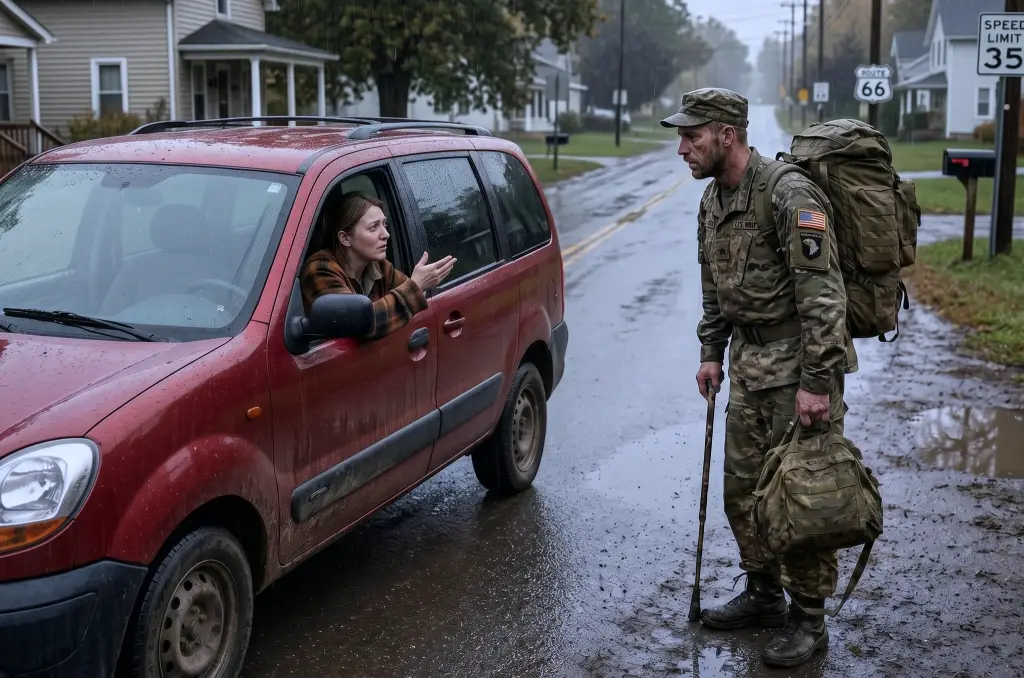
Sarah Whitmore kept her hands locked tightly at the ten-and-two positions on the worn steering wheel of her aging pickup truck. Her gaze narrowed, focusing intently on the narrow ribbon of asphalt illuminated by the dull, yellowed glow of her headlights. The windshield wipers maintained a rhythmic, agonizing scrape against the glass, barely managing to clear the sheets of water. She had just finished a grueling twelve-hour shift at the local commercial bakery—her second double shift that week—and every muscle in her neck throbbed with a deep, persistent ache.
She hadn’t complained when the floor manager asked her to stay late; that simply wasn’t in her nature. At forty-two, Sarah had learned that survival required moving forward quietly, carrying whatever weight was handed to her without expecting someone else to shoulder the burden. She was a single mother, her life entirely defined by the margins of utility bills, grocery lists, and the quiet comfort of her nine-year-old son, Liam. Right now, her mind was anchored to the image of her boy asleep in his small bedroom, likely tucked beneath his favorite faded blue blanket, the soft amber glow of his fox-shaped nightlight casting shadows against the wall.
Then, a sudden shift in the darkness caught her eye.
It was nothing more than a fleeting silhouette captured in the periphery of her high beams—a distinct, tall shape moving haltingly along the waterlogged shoulder of the road. Sarah’s foot instinctively eased off the accelerator. As the truck rolled closer, the details crystallized through the driving rain. It was a man, broad-shouldered but severely hunched against the wind, dragging his right leg in a heavy, agonizing limp. He wore a dark, oversized canvas field jacket, the hood pulled so far forward that his features were completely eclipsed by the shadow of the fabric. A massive, military-style rucksack hung unevenly off his left shoulder, its straps cutting deeply into the soaked material of his coat.
One of his leather combat boots was clearly waterlogged, emitting a visible spray of mud with every uneven stride he took. He was completely unprotected out here, miles from town, walking through a freezing downpour that had already dropped the temperature into the low forties.
Sarah’s fingers tightened on the wheel until her knuckles turned a stark, bloodless white. Her instincts, honed by years of living alone on the rural edges of a small town, flared into a sharp, immediate warning.
“Don’t stop,” she told herself quietly.
The voice in her head wasn’t entirely her own; it was an echo of communal caution accumulated over a lifetime. It was past eight at night. She was a woman alone on an unlit back road. This was a massive stranger walking in the dark. A Black man, completely alone, in a county that didn’t always look kindly on outsiders.
She hated the cold spike of fear that shot through her, and she hated even more that the town’s implicit biases had found a voice inside her own mind without her permission. The truck kept rolling forward. The mechanical groan of the wipers filled the cabin. Her jaw set firmly as she forced her eyes back onto the empty pavement ahead.
Yet, as the figure receded into her rearview mirror, something deeper than caution pulled at her chest. She recognized that specific posture—the rigid, defensive tilt of the shoulders, the deliberate, exhausting effort to keep moving when every sinew in the body was screaming for rest. It was the precise gait of someone who had learned to carry far too much weight for far too long, someone who expected absolutely nothing from the world around him.
Suddenly, her late father’s voice cut through the silence of her memories, clear as a bell. “If nobody else stops, Sarah, maybe it’s because you’re the one who was put there to do it.”
Her father had served in the Army during a time he never spoke about, but until the day he died, he had kept a heavy wool thermal blanket in the tool box of his truck. Whenever he saw a broken-down vehicle or a traveler stranded on the highway, he would pull over without a second thought. “You never know what kind of war a man has just walked out of,” he would tell her.
Sarah let out a sharp, decisive breath through her nose. She eased her foot off the gas and guided the heavy pickup onto the gravel shoulder, the stones crunching loudly beneath her tires. The rain hammered against the metal roof like a volley of small stones. Engaging the reverse gear, she backed up slowly, carefully monitoring her side mirrors until the tall stranger came back into view, framed against the red glow of her taillights and the rising mist of the wet asphalt.
She rolled the passenger-side window down halfway, immediately letting in a gust of frigid air, the scent of damp earth, decaying leaves, and the faint, bitter metallic tang of exhaust.
“Hey!” she called out, her voice projecting firmly over the wind, keeping her tone measured, calm, and deliberately non-threatening. “Are you alright out there?”
The man froze. He didn’t turn toward her immediately. He simply stood perfectly still in the downpour for several seconds, the water cascading off the brim of his hood in steady rivulets. Then, with a slow, cautious movement, he turned his head just enough for the faint light from her dashboard to illuminate the profile of his face.
He was younger than Sarah had initially estimated—perhaps his early thirties—but there was an old, heavy stillness in his features that made him seem timeless. A thick, raised, jagged scar ran vertically down the right side of his face, beginning near his temple, tracing the edge of his cheekbone, and disappearing into the line of his jaw. His eyes were dark, sharp, and intensely guarded, scanning the truck with the analytical precision of someone who looked at every situation as a potential threat.
He took a single step toward the cab, his movements slow and deliberate, keeping his hands visible. “I’m not looking for any trouble, ma’am,” he said. His voice was a low, gravelly baritone, rough from the cold but entirely controlled.
Sarah looked past the scar, looking directly into his exhausted eyes, and answered without a single tremor of doubt. “I didn’t say you were.”
For a long moment, neither of them moved. The silence between them stretched, punctuated only by the heavy patter of rain against the truck’s hood. Then, without another word, Sarah reached across the bench seat and pushed the heavy plastic lock on the passenger door outward.
“I can give you a lift as far as the old base road if that’s the direction you’re heading,” she offered.
The man didn’t immediately climb inside. Instead, his eyes moved through the interior of the truck, noting the empty coffee mug in the cup holder, the faded plastic dashboard, and the absence of any other passengers. It wasn’t the behavior of a criminal checking for a trap; it was the clinical vigilance of a soldier measuring risk in an unfamiliar territory. It was the kind of deep-seated caution that didn’t simply turn off because a deployment had ended.
Finally, he gave a single, tight nod. “Yeah. Thank you.”
He opened the door and climbed into the cab with extreme care, placing one large, calloused hand on the dashboard to steady himself. Sarah caught the sharp wince that crossed his face as he shifted his weight, pulling his right leg into the footwell with a stiffness that spoke of an old, poorly healed injury.
As he settled into the fabric seat, the scent of the storm flooded the small cabin—the sharp smell of wet wool, old canvas, rusted iron, and the faint, unmistakable aroma of dried leather. His heavy coat was saturated, and beneath the layer of water, Sarah could see a faded, dark green patch stitched onto the sleeve—a worn military insignia, its edges frayed from years of service.
She shifted the truck back into drive and pulled onto the dark highway, the transmission clunking softly. “You served,” she stated quietly, keeping her eyes fixed on the road ahead, offering the observation as a fact rather than an interrogation.
“Yeah,” he replied after a long pause, his eyes staring straight out the windshield. “Discharged about two weeks ago. Honorable. The only way they’d let me leave after everything.”
They drove through the gloom in an intense, heavy silence. Sarah didn’t flip on the radio; the quiet between them felt too deliberate to disturb with commercial jingles or local news. The only soundtrack was the rhythmic, hypnotic slap of the wipers against the glass and the wet, heavy squelch of the tires rolling over the waterlogged asphalt…
To read the rest of the story – CLICK the NEXT button 👇👇👇