


Peggy Ann Morrison paused at the threshold of the master bedroom, the silver tray resting familiar and heavy against her palms. For forty years, the morning ritual had never varied. Seven o’clock sharp, a cup of black coffee in the thin white porcelain Richard preferred. At eighty-four, his habits were the foundation upon which their entire household operated. She expected to hear the rustle of the morning paper, the clearing of his throat, the command to adjust the thermostat.
Instead, the Brookline mansion was entirely silent.
Richard lay on his back, the heavy duvet pulled up to his chest. He looked exactly as he always did—authoritative, perfectly composed, not a gray hair out of place. But the stillness was absolute.
Peggy stood frozen by the doorway for a long moment. She did not drop the tray. She did not scream. Forty years of training as his secretary, and then as his wife, had taught her that panic was unproductive. She walked to the nightstand, set the tray down with a soft click, and watched the steam curl into the cold morning air. Only then did she reach out to touch his wrist. The skin was cool.
Later, the coroner would confirm it had been a massive heart attack in his sleep. Instantaneous. Painless. Sitting on the edge of the mattress while the paramedics moved quietly around the room, Peggy searched herself for the crushing weight of grief a widow was supposed to feel. She felt shock, certainly. Her hands trembled violently enough that she had to grip her knees to steady them. But beneath the tremor was a quiet, deeply buried sensation that felt uncomfortably close to relief. She pushed the thought down before it could fully form, ashamed of herself.
A week later, the funeral filled one of Boston’s oldest and largest stone churches. Richard had been a senior partner at a formidable law firm, and the pews were packed with judges, corporate clients, local politicians, and generations of old money. The air smelled thick with lilies and damp wool overcoats.
As Peggy walked up the center aisle, listening to the muffled hush of the crowd, an usher in a dark suit stepped gently into her path.
Before she could correct him, her eldest stepson’s hand fell lightly on her shoulder. At sixty, Stephen possessed his father’s imposing height and absolute certainty.
“We’ve arranged the seating a bit differently, Peggy,” Stephen murmured, his voice pitched to a respectful, carrying baritone. “Catherine and Michael need their children close to the front. You understand. For space. We saved you a lovely spot right behind us, in the second row, in case you have any family members joining you.”
Peggy had no family. Her parents were gone, she had been an only child, and four decades of managing Richard’s social calendar had systematically alienated her from the few friends she’d had before 1984. Stephen knew this perfectly well.
The second row was not a logistical necessity. It was a public boundary.
She took her seat without a word, watching the backs of her stepchildren’s heads. Stephen, Catherine, and Michael sat shoulder-to-shoulder with their spouses, presenting a flawless, unified front of generational grief. They had never forgiven her for marrying their father when she was twenty-eight and he was forty-five. To them, she had always been the clerical error in their bloodline—the quiet secretary who had somehow tricked her way into the Brookline estate.
You will never be our mother, an eighteen-year-old Catherine had told her in the ladies’ room at the wedding reception, her voice perfectly polite and her eyes entirely dead. Don’t embarrass yourself by trying.
Peggy had tried anyway. She had remembered every birthday, attended every graduation, and kept their childhood bedrooms pristine. She had swallowed every cutting remark about her community college education and her background. She had managed the colonial mansion, hosted the dinner parties, packed Richard’s bags for his frequent, unexplained weekend trips to “decompress,” and never asked to see the bank statements.
Don’t worry your pretty head about money, darling, Richard had told her once, patting her hand. That’s my job. Your job is to make this house a home.
So she had trusted him. She had believed that loyalty earned security.
During the hour-long service, colleague after colleague took the pulpit. They praised Richard’s brilliant legal mind, his charitable board positions, and his devotion to his three children. Not a single speaker mentioned his wife. Sitting in the second row, Peggy felt herself fading into the polished oak of the pew, a ghost attending her own erasure.
The reception was held at Stephen’s sprawling property in Weston. The catering staff moved silently through the high-ceilinged rooms, passing silver trays of hors d’oeuvres. Peggy stood near a towering floral arrangement in the dining room, an untouched cup of tea cooling in her hands.
A few feet away, Catherine was holding court with a small circle of women in dark designer dresses.
“It’s just so incredibly hard,” Catherine said, dabbing at her eyes with a monogrammed tissue. Peggy noticed that the tissue came away clean, and Catherine’s mascara remained flawless. “Losing Daddy. But at least we have each other. The real family. That’s what’s going to get us through this.”
Peggy did not interject. She simply set her teacup on a passing tray and let herself out the front door.
The drive back to Brookline took thirty minutes. When she unlocked the heavy front door and stepped into the foyer, the house felt different. The grandfather clock ticked in the hallway, and the afternoon light slanted across the antique Persian rug she had vacuumed thousands of times. She had believed this was her home. But standing alone in the quiet architecture of Richard’s life, listening to the silence he had left behind, Peggy felt a sudden, cold shift in the atmosphere.
The reading of the will was scheduled for Tuesday morning. She told herself there was no reason to be nervous, but as she looked up the grand staircase, she realized she felt like a guest who had overstayed her welcome.
The downtown Boston offices of Chen, Hayes & Abernathy occupied the forty-second floor of a glass-paneled high-rise overlooking the harbor. The conference room smelled of lemon polish and expensive leather. Peggy sat alone on one side of the massive mahogany table, her hands folded neatly in the lap of her black wool dress.
Directly across from her sat Stephen, Catherine, and Michael. They had arrived together, flanked by two junior attorneys, and arranged themselves like a board of directors preparing for a hostile takeover.
At the head of the table sat Marcus Chen. He had managed Richard’s estate planning for two decades. He had eaten Peggy’s braised short ribs at their dining table, admired her garden, and laughed at Richard’s jokes. Today, however, he would not meet her eyes. He kept his gaze fixed firmly on the thick cream-colored folder resting on the blotter in front of him.
“We’ll dispense with the standard formalities regarding testamentary capacity, as the documents are fully verified,” Marcus began, his voice dropping into the flat, careful monotone lawyers use to deliver bad news. “Richard Morrison’s total estate is valued at approximately eight point seven million dollars.”
Peggy let out a slow, quiet breath, feeling her shoulders drop a fraction of an inch. Eight million. It was a staggering amount of money. She had never known the exact figures, only that they were comfortable. Whatever happened today, there was more than enough to ensure her security. Richard’s insistence on keeping their finances separate suddenly felt like the quiet, protective foresight of a man preparing for his absence.
“The primary residence in Brookline, currently appraised at two point one million dollars,” Marcus continued, turning a page, “is left in its entirety to Richard’s children—Stephen Morrison, Catherine Morrison Grant, and Michael Morrison—to be divided equally among them, or sold with the proceeds split three ways.”
A faint hum from the building’s ventilation system suddenly sounded very loud in Peggy’s ears. The house. The house where she had lived for forty years, where she had chosen every piece of furniture and planted every rosebush, was gone.
“The investment accounts, totaling approximately four point two million dollars,” Marcus read, his pace quickening slightly, “are similarly distributed in equal thirds to Stephen, Catherine, and Michael. The retirement accounts, valued at one point eight million, carry the same distribution.”
The cold began at the base of Peggy’s neck and spread rapidly downward, settling heavily in her chest. She watched Marcus turn another page. There was nothing left. He had listed the house, the investments, the retirement funds.
“Marcus,” Peggy said. Her voice came out barely above a whisper, cracking on the second syllable. She cleared her throat and tried again. “I don’t understand. What about me?”
Marcus finally looked up. He looked physically ill. “I am getting to your specific bequest now, Peggy. I want to state for the record that I strongly advised Richard against the language he chose to use in this section. But he insisted.”
He took a slow, deep breath, adjusted his glasses, and looked back down at the document.
“Richard noted in his will, and I am legally obligated to read this verbatim: My wife, Peggy Ann Morrison, has lived comfortably at my expense for forty years. She has had the benefit of my wealth, my home, my social standing, and a lifestyle far beyond what she could have achieved on her own working as a secretary.“
Across the table, Catherine casually inspected her perfectly manicured fingernails. Michael, entirely disengaged, was tapping out a text message on his phone.
“I consider this more than adequate compensation for her companionship and for the domestic services she has provided over the years,” Marcus read, his voice tight. “While I have appreciated her efficient management of my household, my primary obligation is to my bloodline. My children are my true legacy.“
Peggy stared at the grain of the mahogany table. Domestic services. Forty years of cooking his meals, keeping his secrets, packing his bags, and holding his hand in hospital waiting rooms. He had legally defined their marriage as an expired employment contract.
“Therefore,” Marcus said, rushing through the final paragraph, “I leave to Peggy Ann Morrison only the following: one property located at forty-seven Oakwood Lane in the town of Millbrook, Massachusetts. This property is transferred with the express legal understanding that she will vacate the Brookline residence within thirty days of my death, as the primary residence is required by my rightful heirs.”
The silence in the room was absolute, broken only by the soft, rhythmic clicking of Michael’s thumbs on his phone screen.
Catherine was the first to speak. She offered Peggy a smile of practiced, devastating pity. “Daddy mentioned that Millbrook property to us years ago. He inherited it from a great-uncle back in the eighties. He said it was just a falling-apart shack out in the woods, completely worthless. But at least you won’t be entirely out on the street, Peggy. That’s something.”
Stephen leaned forward, resting his forearms on the table, instantly shifting the room to logistics. “We are planning to list the Brookline property immediately. The spring market is incredibly strong. The sooner you can be out, the sooner we can get the staging crews in.”
“The will legally guarantees Peggy thirty full days to relocate,” Marcus interrupted, a sudden, sharp edge of steel in his tone.
“Which is completely reasonable,” Stephen said smoothly, waving a hand. “Take the full thirty days, Peggy. We aren’t monsters.”
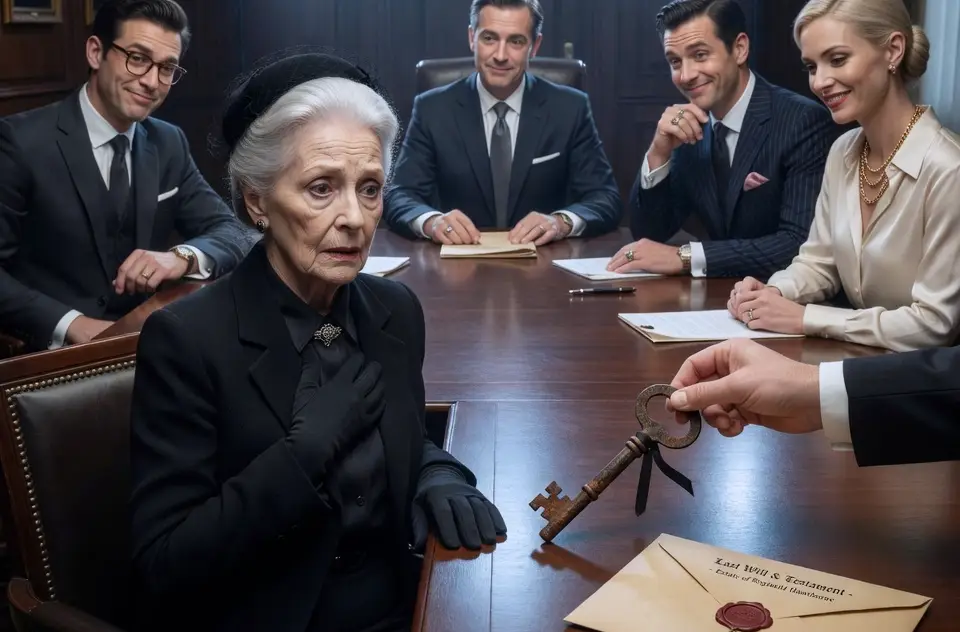
Marcus reached into his leather portfolio and withdrew a heavy brown envelope. He slid it across the polished wood. It stopped inches from Peggy’s folded hands.
“This contains the deed to the Millbrook property, already filed and transferred to your name,” Marcus said quietly. “There is also a key, and a handwritten note Richard asked me to include.”
Peggy looked down at the envelope. Her fingers felt completely numb as she opened the flap. Inside was a heavy iron key, rusted along the teeth, and a single sheet of Richard’s personalized cream stationery. The handwriting was his precise, unmistakable cursive.
47 Oakwood Lane, Millbrook, Massachusetts.
Peggy, this is yours now. Go there as soon as you can. You will understand everything once you arrive. I am sorry I couldn’t tell you before, but they were always watching, always waiting for an excuse. Trust me one last time, my darling.
All my love, always, Richard.
Trust me one last time. After publicly humiliating her. After stripping her of her home and leaving her entirely unprotected at sixty-eight years old, facing the terrifying reality of poverty, he wanted her to trust a rusty key to a ruined shack in a town she had never heard of.
Peggy pushed her chair back. The legs scraped loudly against the thick carpet. She did not look at Stephen, or Catherine, or Michael. She picked up the brown envelope, placed it in her purse, and walked toward the heavy glass door.
“Peggy,” Marcus called out, standing up quickly. “If you need anything. If you need help understanding the logistics of the move… please call my office.”
She gave him a single, curt nod without turning around, and walked out into the carpeted hallway. She maintained her posture all the way down the elevator, through the marble lobby, and out into the subterranean parking garage.
It wasn’t until she was sitting behind the steering wheel of her ten-year-old Honda Civic, the doors locked and the engine off, that the carefully maintained dam finally broke. She gripped the worn steering wheel, bowed her head, and wept until her chest ached with the physical effort of breathing…
To read the rest of the story – CLICK the NEXT button 👇👇👇