


At twenty-two years old, standing on the manicured central quad of Westfield University, I found that the heavy polyester of my graduation gown held the heat of the May afternoon. I stood shoulder-to-shoulder with my sister, Lily. Our matching black caps caught the breeze. Around us, thousands of families clustered on the lawn, taking photographs and holding foil balloons, completely consumed by the predictable joy of the milestone.
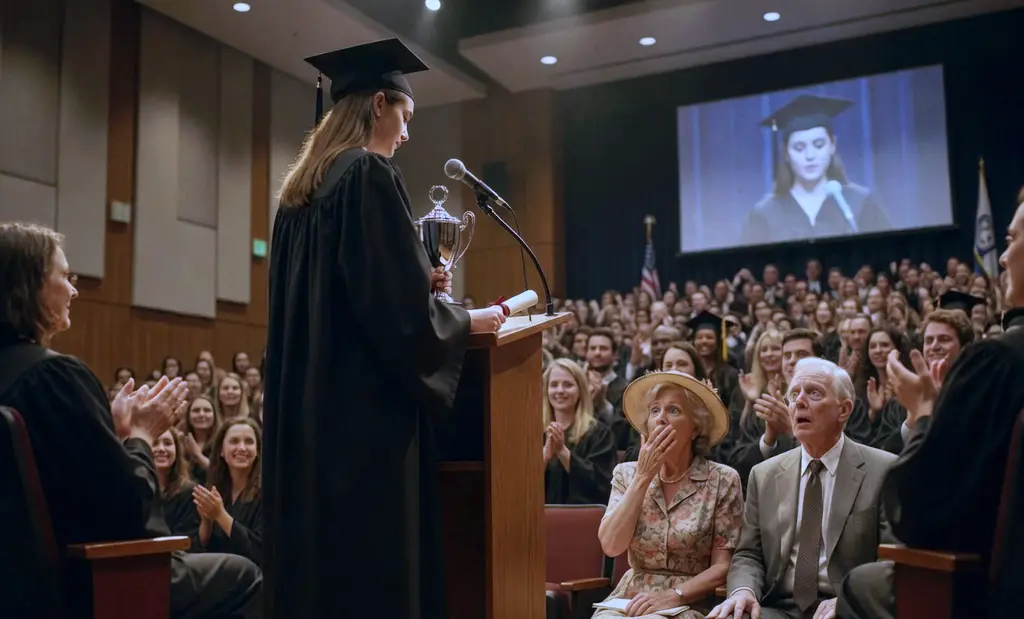
I smiled for the camera when prompted, but the path that had led me to this expanse of green grass wasn’t built on the typical foundation of parental support. It was built on a ledger.
I grew up in a postcard-ready suburb outside Grand Rapids, Michigan. Our two-story colonial sat behind a white fence that my father power-washed every spring, presenting a facade of wholesome, uncomplicated family life. Inside, the walls were lined with framed studio portraits. In every photograph, we were posed by height, smiling brightly, projecting a unity that dissolved the moment the camera flashed.
My parents were the kind of people who treated community standing as a vital currency. My dad, Robert, was a senior accountant at a mid-sized regional firm—a man who measured the world in columns, margins, and return on investment. My mom, Diana, taught high school English and possessed a remarkable talent for curating reality to fit her preferences.
Then there was Lily. Two years younger than me, she seemed to glide through the world without encountering friction. With her natural blonde curls, an easy laugh, and a knack for absorbing academic material with minimal effort, she was the physical embodiment of the success our parents wanted to project.
From the time we were in elementary school, the dynamic was quietly, firmly established. Lily was the protagonist of the Wilson household. I was the supporting cast.
It wasn’t usually explosive; it was a slow, steady accumulation of micro-measurements. I remember a string of Christmas mornings, the air thick with the smell of the artificial pine candle Mom always burned. I would sit on the rug, forcing a neutral expression, watching Lily tear into the heavy, rectangular boxes that held the year’s most expensive electronics. When it was my turn, I would unwrap practical bundles of winter socks, or generic clearance-aisle art kits.
“Your sister needs a bit more external encouragement to nurture her talents, Emma,” Mom would say smoothly, gathering the torn wrapping paper into a neat pile. Even at eight years old, the logic tasted wrong, but I learned to swallow it without speaking.
The disparity sharpened as we got older. When Lily entered the regional science fair, Dad took two personal days off work. He hovered over her at the dining room table, using a hot glue gun and a T-square to ensure her display board was mathematically perfect. When I had a charcoal drawing accepted into a county art exhibition, Mom rushed into the community center for fifteen minutes during her lunch break. She checked her phone twice, gave the drawing a tight nod, and headed back to her car.
“Art is fine for a weekend hobby,” Dad told me that evening over dinner, cutting his chicken with precise, even strokes. “But it won’t yield a livable salary in the real world. You need to focus on metrics.”
The only place I felt entirely seen was fifty miles north, at my grandmother Eleanor’s lake house. Our summer visits there were my sanctuary. The house smelled permanently of old paper, damp wood, and lemon polish. Grandma Eleanor would sit with me on her screened-in porch for hours, her arthritic hands resting on her lap, watching as I sketched the waterline.
“You have a sharp eye, Emma,” she told me once, her voice raspy from decades of strong tea. “You see how things are actually put together. Don’t let anyone convince you to stop looking.”
It was in her small, dust-mote-filled guest room that I began reading biographies of business leaders from the community library. I read about people who had built empires out of nothing but grit and a refusal to be ignored. I started to map out a way to build a fortress of achievement so massive my parents would be forced to look up at it.
By high school, I had forged that desire into a grueling routine. I devoured economics and statistics, discovering a natural, cold aptitude for numbers. When I won a regional business plan competition during my sophomore year, my economics teacher called our house to congratulate my parents.
“That’s nice,” Mom said into the phone, her eyes already drifting toward the hallway. She hung up and turned to my sister. “Lily, did you finish printing the timeline for your history project? You don’t want to lose points on formatting.”
I didn’t wait for their validation anymore. During my junior year, I took a job at a local independent coffee shop. I worked twenty hours a week, coming home smelling of roasted beans and sanitized rags, depositing my paychecks into a private account. I maintained a 4.0 GPA through sheer force of will, doing calculus homework in the breakroom. Meanwhile, Lily joined the debate team. My parents attended every single tournament, celebrating her minor regional victories with dinners at steakhouses I wasn’t invited to because I was “busy working.”
Because Lily accelerated through her coursework, we ended up in the same graduating class. We both applied to Westfield University, a prestigious state institution known for its rigorous business and political science programs.
In April, two thick, heavy envelopes arrived in the mail on the same afternoon.
I took mine to the kitchen island. My hands actually shook as I slid my thumb under the paper flap. I pulled out the heavy cardstock.
“I got in,” I said, the breath leaving my lungs in a rush of profound relief. “Full acceptance to the business school.”
Dad glanced up from his laptop. “Good for you, Emma.”
The front door opened before I could say anything else. Lily came down the hallway, waving the matching envelope over her head.
“I got into Westfield!” she shrieked, dropping her backpack onto the floor. “Political science program!”
Dad pushed his laptop away and stood up so fast his chair scraped loudly against the linoleum. Mom rushed out of the living room, throwing her arms around Lily. The kitchen transformed instantly into a celebration. Dad went to the basement fridge to get a bottle of sparkling cider, entirely forgetting that I was standing three feet away holding the exact same letter.
Two weeks later, the verdict was formalized.
We were sitting at the dining room table for a Sunday roast. Dad cleared his throat and folded his hands on the tablecloth, signaling a serious discussion. His eyes, however, were fixed firmly on my sister.
“We need to finalize the college logistics,” he announced. “We’ve been putting money into the 529 savings account since you were born. Westfield’s tuition is steep, but we can cover the four years entirely. We want you to focus purely on your coursework, without the distraction of financial stress.”
Lily beamed, sitting up straighter in her chair.
I waited. I assumed the savings account he mentioned was a collective pool. I watched Dad pick up his water glass. I watched Mom take a polite bite of carrots. The silence stretched until the air in the room felt thin.
“What about my tuition?” I asked. My voice sounded much smaller than I intended.
The rhythmic clinking of silverware stopped. My parents exchanged a look—a swift, calculated assessment.
Dad set his glass down. He employed his professional, measured tone, the one he used to explain tax liabilities to clients. “Emma, we have to look at the practical allocation of our funds. We only have enough capital to fully support one tuition. Lily has consistently demonstrated a more traditional academic trajectory. We believe investing the college fund in her education is the soundest decision.”
Mom reached across the table and patted my wrist. Her fingers felt cold. “You’ve always been so fiercely independent anyway,” she said, offering a tight, sympathetic smile. “You already have your coffee shop money. You can take out federal loans. Or, honestly, you might consider starting at the community college for your general education credits.”
I stared at them. I had spent seventeen years trying to balance an impossible scale, bringing home perfect grades and competition trophies, assuming that eventually, the ledger would balance. Instead, they had simply written me off as a bad investment.
“But my grades are higher than hers,” I said, the words catching in my throat. “I’ve been working part-time for two years and my GPA is higher.”
Mom sighed, withdrawing her hand. She looked exhausted by the mere fact of my pushback.
“It isn’t just about grades, Emma,” she said softly. “It’s about potential. She deserved it, but you didn’t.”
I stared at her. The air in the dining room seemed to grow thick, smelling of roasted meat and the lemon polish my mother used on the mahogany table. I looked across the centerpieces at Lily. My sister was suddenly very interested in her plate, using her fork to carefully separate a piece of potato from her green beans, refusing to make eye contact…
To read the rest of the story – CLICK the NEXT button 👇👇👇