


The brass key felt cold and jagged against my palm. I was sixty-eight years old, and I was spending the night of my birthday standing in a deserted industrial park, trying to force a rusted padlock open. A chill crept through the thin fabric of the black dress I had worn to my husband’s funeral just three weeks earlier. The air here was heavy, carrying the metallic scent of old oil and the distinct, dusty quiet of forgotten places. My hands were shaking so badly the key kept slipping against the metal faceplate.
What would you even do with a real inheritance, Mom?
Jonathan’s words played on a loop in my head, sharp and dismissive. I squeezed my eyes shut, swallowed hard against the tightness in my throat, and shoved the key into the slot. The ancient mechanism resisted for a second before yielding with a heavy, grinding clank.
The door groaned as I hauled it upward. I clicked on my heavy plastic flashlight, pointing the weak beam into the gaping darkness.
I expected rusted tools. I expected boxes of mildewed tax returns, stacks of old lumber, the mundane detritus of a forty-two-year marriage swept into a concrete box. That was what Jonathan believed it was. It was why he had so easily cast me aside.
To understand the absurdity of what I was looking at, you have to understand how my day had started. Twelve hours earlier, I hadn’t been a homeless widow clutching a battered overnight bag. I had been sitting in a high-rise law firm in Century City, listening to the reading of my husband’s will.
Mr. Hoffman, the attorney who had managed our family’s affairs for over two decades, had seemed uncharacteristically nervous. He sat behind his massive desk, adjusting his wire-rimmed glasses and pointedly avoiding my gaze.
Beside me, Jonathan checked his watch. My son looked immaculate in a tailored charcoal suit, his posture radiating the restless, aggressive energy that made him such a formidable presence in commercial real estate.
“Before I begin,” Hoffman had said, clearing his throat, “I want to assure you both that the documents I am about to read are legally binding. They were drafted precisely to Mr. Campbell’s explicit instructions during his final months.”
I should have recognized the disclaimer for the warning it was. But I was still caught in the fog of recent grief, staring blindly at the legal documents without absorbing the words. Then, Hoffman cleared his throat again and read the distribution of assets.
“To my son, Jonathan Campbell, I leave our penthouse residence in Los Angeles, along with my primary investment portfolio…”
I blinked, waiting for the rest. I assumed there was a trust for me, a life estate, an arrangement for my care. Robert had handled all our finances since the day we married. I had never needed to worry about the mechanics of our wealth.
Hoffman flipped a page, his voice dropping slightly. “…and to my beloved wife, Susan Campbell, I leave the property located at 1420 Industrial Parkway. The garage and its complete contents.”
Silence fell over the plush office. A garage. After forty-two years of marriage, of nursing him through progressive heart failure, of raising our son together, Robert had left me a storage unit.
I turned to Jonathan, expecting to see my own shock mirrored in his face. Instead, I saw a subtle, undeniable relaxation of his shoulders. The solemn mask of the grieving son slipped, replaced by the quiet satisfaction of a man who had just closed a difficult acquisition.
He reached over and patted my arm, his fingers squeezing slightly too hard. “Don’t worry, Mom,” he said quietly. “I’ll make sure you’re taken care of.”
I didn’t ask questions. I was too stunned, too humiliated by the sudden shift in gravity. Why would Robert do this?
The answer to what Jonathan meant by “taken care of” arrived that evening. He drove me back to the penthouse overlooking the city—the place I still thought of as home.
We had barely stepped out of the private elevator and into the marble foyer when Jonathan set my suitcase down by the door. He didn’t carry it into the bedroom.
“I have the contractors coming tomorrow morning,” he announced, loosening his tie as he walked toward the kitchen. “I’m having some colleagues over later this week to look at the layout. We’re going to tear out the study and open up the floor plan.”
I stood by my suitcase, my coat still in my arms. “Tomorrow? Jonathan, I haven’t even sorted through your father’s things.”
He opened the refrigerator, took out a bottle of sparkling water, and leaned against the granite counter. “I’ll have a service box up the clothes. But honestly, Mom, it would be easier if you found somewhere else to stay while the work is happening.”
I stared at him. “Where am I supposed to go?”
“Aunt Helen’s,” he suggested, taking a sip of water. “Or one of your friends. The place is going to be a construction zone. And really, it’s too much space for you now anyway.”
“It’s my home,” I said, my voice barely a whisper.
Jonathan set the bottle down. His face hardened, the corporate negotiator stepping forward. “Actually, Mom, it’s not. The deed transfers to me. Dad made that perfectly clear today.”
I grabbed the back of a dining chair to steady myself. The floor felt as if it were tilting. “You want me to leave. Tonight.”
“I’m just being practical,” he sighed, irritated by my lack of compliance. “Look, why Dad left you that dump of a garage is beyond me. But let’s be honest. What would you even do with a real inheritance? You’ve never managed an investment in your life. Dad knew you couldn’t handle it. He left the real assets to the person who knows how to maintain them.”
He checked his phone, already dismissing me. “I’ll have the doorman call you a car.”
I didn’t argue. The casual cruelty from the boy I had raised paralyzed my defense. I simply picked up my overnight bag, took my purse, and walked out. I drove my ten-year-old sedan aimlessly for hours, watching the glittering lights of the Los Angeles skyline shrink in my rearview mirror until the navigation system deposited me here, in the industrial district, staring into the dark.
Now, standing inside the threshold of 1420 Industrial Parkway, I swept my flashlight beam across the interior.
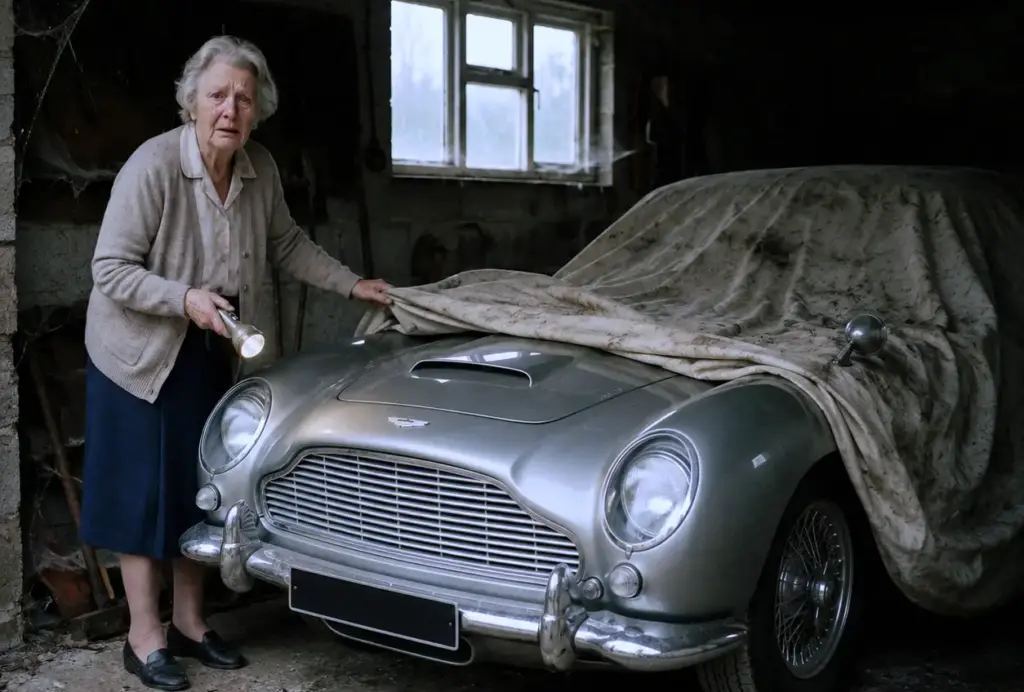
The light didn’t catch on rusted tools or cardboard boxes. It swept over a smooth, spotless expanse of floor and settled on three large, low shapes arranged in a precise row. Each was draped in a custom-fitted cloth cover.
My breath hitched. I stepped forward, my shoes squeaking softly on what looked like high-end epoxy flooring.
I reached out and gripped the fabric covering the first shape. I pulled it back. The soft material slid away, pooling on the floor.
The beam of my flashlight bounced blindingly off a polished chrome grille. It was a vintage Aston Martin—a 1964 DB5 in Silver Birch. It was identical to the one Sean Connery drove in the old James Bond films Robert used to watch on Sunday afternoons. The paint was flawless. It looked as though it had rolled off the factory floor in Newport Pagnell that morning.
“Robert,” I whispered into the stillness. “What were you doing?”
My husband had never mentioned collecting cars. In forty-two years, there hadn’t been a whisper of a secret hobby, let alone an investment of this scale.
I moved to the second vehicle, my pulse hammering a frantic rhythm against my ribs. I peeled back the cover. A 1956 Mercedes-Benz 300SL Gullwing emerged from the dark. The deep blue paintwork looked wet in the weak light, its sweeping lines and distinctive doors unmistakable even to someone who knew nothing about classic cars.
The third cover concealed a deep red Ferrari. A small brass plaque mounted on a display stand beside the front tire read: 1967 275 GTB/4.
Next to each car stood a slender metal podium holding a leather-bound portfolio. I opened the one beside the Ferrari. It was filled with heavy, archival-quality documentation—provenance papers, maintenance logs, original bills of sale.
I was no expert, but I wasn’t naive. These were not just “old cars.” These were museum-quality assets. Millions of dollars sitting silently in an anonymous concrete box.
“There has to be an explanation,” I murmured.
I swept the flashlight along the walls. Near the heavy rolling door, tucked beside a sleek, modern electrical panel, a creamy white envelope was taped to the wall.
It had my name, Susan, written across the front in Robert’s distinct, sloping handwriting.
My fingers felt numb as I pulled the envelope free. Right next to it was a bank of switches. I flipped the top one.
The space was instantly flooded with brilliant, clean light. High-end LED fixtures recessed into the ceiling buzzed to life. The sudden illumination revealed the true nature of the room. The walls were lined with custom cabinetry. Climate control vents hummed softly overhead, pushing dry, temperature-regulated air into the space. A high-tech security keypad glowed red near the entrance…
To read the rest of the story – CLICK the NEXT button 👇👇👇