


Autumn in the Cascade Mountains arrived with a bone-deep dampness. Thick morning fog clung to the tops of the Douglas firs, settling in heavy drops against the chain-link fencing of the enclosures. At Pine Haven Wildlife Rescue, the day began loud. Somewhere in the eastern sector, a mature male black bear huffed and paced for his breakfast, while a pair of yearlings in the adjacent yard clattered wooden logs against the wire. It was the ordinary, chaotic noise of life. But at the far end of the property, inside an isolated quarantine pen built from green corrugated steel, the silence was absolute.
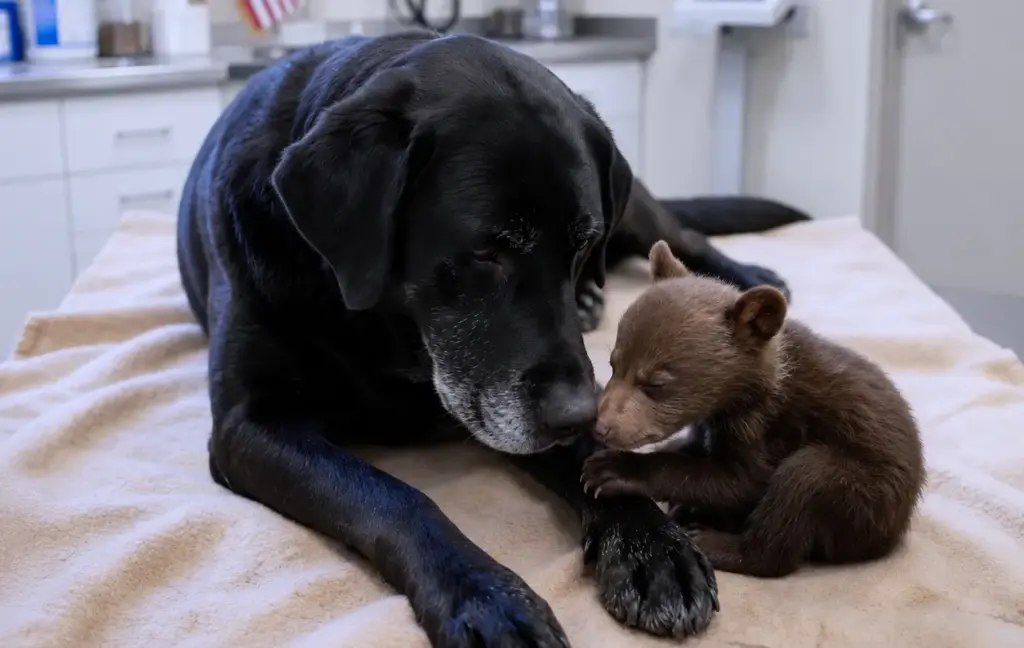
A dark lump lay on the concrete floor, half-buried in fresh straw. Coal was barely three weeks old. No larger than a house cat, his body was curled into the tightest possible sphere, his thin legs locked over his stomach and face. Instead of the dense, glossy coat of a healthy nursing cub, his fur hung in dull, matted patches. His breathing was shallow and erratic. Every inhalation required a visible, shuddering effort, as if the air inside the pen were too thick to draw into his lungs.
A thick, milky film had grown over the cub’s eyes. The infection had moved with brutal speed, sealing them completely. He was permanently blind. Two wet tracks running down his narrow snout were the only remaining signs of the active discharge.
Dr. Andrew Macaren stood on the other side of the heavy wire mesh. At fifty-two, the rescue’s chief veterinarian was a man built of tired angles. He methodically turned a paper cup of cold drip coffee between his hands, his knuckles turning white against the cardboard. In twenty years of wildlife medicine, Andrew had seen the worst of what humans left behind in the woods—animals dragging steel traps, starved exotics pulled from roadside cages, gunshot victims. He had built a thick professional armor against the grief of it. But this case was slipping through the cracks in that armor.
State forestry workers had brought Coal in five days ago. They had found him purely by chance in a logging tract, crying weakly and nudging the cold flank of his mother. Poachers had taken the sow for parts and left the rest of the carcass in a steep ravine. By the time the rangers located the orphaned cub, the ocular infection had already pushed past the point of surgical intervention.
Physically, Andrew’s team had pulled him back from the edge. They had pumped him full of broad-spectrum antibiotics and broken the raging fever. Everyone on staff understood the grim reality that a blind bear could never be released. But right now, Andrew was looking at a much more immediate problem. Coal hadn’t just lost his sight. He had stopped trying to live.
The cub ignored everything. He did not crawl toward the warmth of the infrared heat lamp suspended in the corner. He did not react to the scent markers of the other bears on the property. And he flatly refused to eat.
Elena, the senior veterinary technician, stepped up beside Andrew. She wore a damp fleece jacket zipped to her chin. In her fifteen years at Pine Haven, she had bottle-fed dozens of orphaned predators.
“His core temperature is dropping again,” she said quietly, her eyes fixed on the motionless black shape. “You can see every rib.”
Inserting a gastric tube for forced feeding was not a viable option. Coal was so weak and terrified that the physical restraint required to place the tube would almost certainly trigger capture myopathy. The sheer stress of being held down would stop his heart long before the nutrients reached his stomach.
They had exhausted the standard protocols. They had played audio recordings of a nursing sow through a Bluetooth speaker; the cub hadn’t even twitched an ear. They had tried placing a blanket carrying the scent of a calm, older female bear in the pen, but Coal had only pressed himself harder against the cold concrete wall.
The heavy door of the quarantine box creaked open. Ivan, the rescue’s oldest keeper, stepped inside. He carried a plastic nursing bottle filled with warmed formula. Ignoring the damp floor, the keeper lowered himself heavily to his knees. He moved with agonizing slowness, avoiding any sudden shifts in air currents, and began to speak in a low, continuous murmur.
Ivan reached out. He let his fingers rest lightly against the cub’s protruding shoulder blades.
Coal flinched violently. His entire body went rigid, his muscles locking tight as if bracing for a blow. Ivan didn’t pull back. He slowly brought the rubber nipple down to the cub’s nose. The heavy, sweet smell of warm milk filled the tight space of the enclosure.
A healthy cub would have latched onto the bottle with desperate, aggressive force. Coal’s wet nose twitched. He registered the scent of food. For three seconds, he lay perfectly still, listening to the breathing of the human beside him. Then, his chest dropped in a long, rattling exhale, and he buried his snout even deeper beneath his paws.
Ivan stayed on his knees. He sat perfectly still for twenty minutes, holding the bottle steady until the formula went completely cold. Finally, he set it aside, pushed himself up from the concrete, and wiped his hands on his denim jeans. He walked out of the pen, pulling the door shut behind him. When he met Andrew’s eyes through the mesh, he just shook his head…
To read the rest of the story – CLICK the NEXT button 👇👇👇