


The air conditioning in the UAV control room at Naval Base Coronado fought a losing battle against the Southern California heat, but the chill inside the concrete walls was absolute. Commander Claire Bennett sat at the secondary console, her fingers moving across the keyboard in a steady, unbroken rhythm. Outside the reinforced glass, the morning sun glared off the Pacific, and the distant, chest-rattling roar of an F/A-18 Hornet taking off off vibrated through the floorboards.
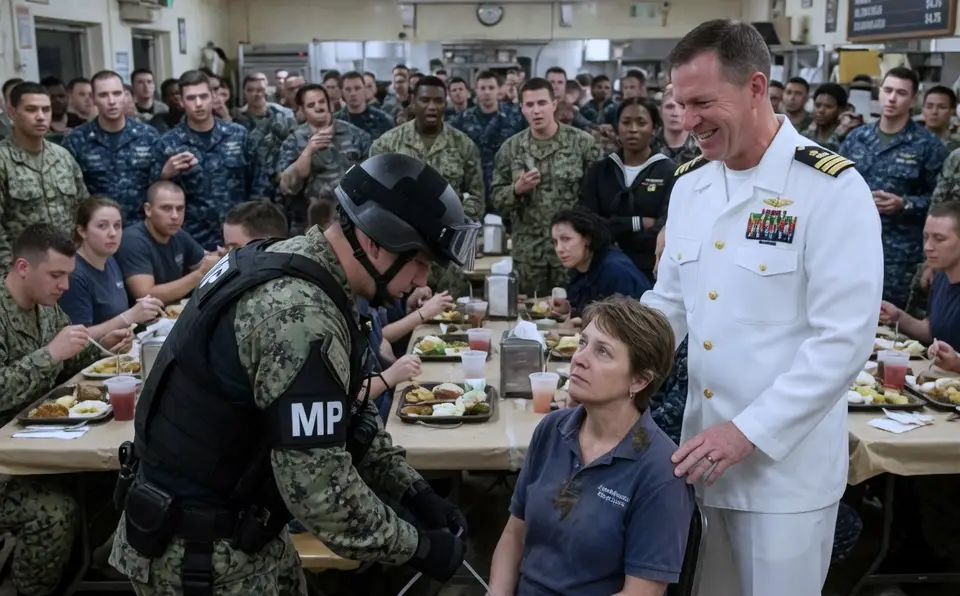
Bennett didn’t look up. She kept her eyes locked on the diagnostic feed of a reconnaissance drone currently holding a holding pattern somewhere over the Philippine Sea. Her uniform was standard-issue civilian contractor: khaki trousers, a navy-blue polo, and her hair pulled back into a severe, anonymous bun.
The heavy steel door opened, letting in a wave of hallway heat and the sound of overlapping male voices. The noise belonged to people who owned the building. Eight Navy SEALs filed into the narrow space, filling it instantly with broad shoulders, tactical nylon, and the specific, insulated confidence of Tier 1 operators.
At their center was Admiral Marcus Thorne. He wore his khaki service uniform with the precision of a man who believed appearance was a weapon. The silver eagles on his collar caught the fluorescent light. He stopped behind Bennett’s chair. He smelled of expensive, understated aftershave and starched cotton.
“And who exactly might you be?” Thorne asked. His voice didn’t boom. It was smooth, leveled at a conversational volume that forced everyone else in the room to lean in and listen. “Did they lose a barista at the commissary?”
A few of the younger operators chuckled. Lieutenant Brody Evans, standing just over Thorne’s right shoulder, grinned widely, eager to mirror his commanding officer’s amusement.
Bennett’s hands remained on the keyboard. She didn’t freeze. She didn’t flinch. She simply finished the command line she was typing, her left hand gripping the base of the digital tablet mounted next to her monitor. Three fingers anchored the back, thumb and index securing the edge—a locked, stabilized hold designed so that a sudden concussive blast wouldn’t knock the device from her hands.
“I asked you a question,” Thorne said, stepping closer. The amusement in his tone thinned out. “Rank. What’s your rank?”
Bennett turned her chair slowly. She met his eyes. Hers were a flat, pale gray, completely devoid of the deference a flag officer expected from a civilian.
“Higher than yours, sir,” she said. Her voice was quiet and perfectly flat.
The ambient chatter in the room died instantly. Evans shifted his weight, his boots squeaking against the linoleum. Thorne stopped moving. For a fraction of a second, a flicker of genuine confusion crossed his patrician features before his mouth hardened into a tight, dismissive smirk.
“Cute,” Thorne said, leaning his weight against the edge of her workstation. “Maybe I’ll let you keep wearing that polo after you finish scrubbing the bays. You have twenty seconds to explain why a tech-support contractor is touching a classified terminal before I have base security walk you out to the perimeter fence.”
“Eighteen seconds,” Evans added, checking his watch with a manufactured smirk.
Bennett reached into her chest pocket. The movement was so smooth, so entirely devoid of sudden acceleration, that Thorne didn’t instinctively flinch, though his eyes tracked her hand. She pulled out a laminated Department of Defense identification card and held it out.
“Technical consultant,” she said. “Cleared for system-wide diagnostic review.”
Thorne took the card. He didn’t look at it immediately, choosing instead to stare her down, waiting for her to look away. She didn’t. He finally glanced at the ID, tilting it to catch the holographic seal.
“I don’t care what procurement stamped on this piece of plastic,” Thorne said, tossing the card back onto her desk. It slid off the edge and hit the floor. “You stay off the tactical feeds. You fix the cooling fans when we tell you they’re broken. You don’t touch operational data.”
“Understood, Admiral.”
Bennett bent down to retrieve her card. As she extended her arm, the cuff of her sleeve rode up two inches. The skin on her inner left forearm was ruined. It wasn’t a clean surgical line, but a jagged, raised map of pale scar tissue—the undeniable, permanent signature of high-velocity shrapnel tearing through flesh.
Chief Warrant Officer James Russo, standing near the back of the group, saw it. His eyes narrowed, recognizing the blast pattern immediately, but he kept his mouth shut. Thorne hadn’t noticed. He was already turning away, his mind moving on to the morning briefing and the joint training exercise scheduled for the afternoon.
“Lieutenant Evans,” Thorne said, not looking back. “Make sure our consultant understands the boundaries of this room.”
“Yes, sir,” Evans said. He looked down at Bennett, his smile entirely devoid of humor. “Stay out of the way, miss.”
They filed out, the heavy door swinging shut behind them, cutting off the sound of their voices. The control room returned to the steady hum of cooling fans and server racks.
In the far corner of the room, sitting at a small metal desk piled with maintenance logs, Master Chief Silas Boone hadn’t moved. He was sixty-two years old, built like a cinderblock, and had been in the Navy long enough to watch three generations of hotshot officers come and go. He tapped his pen against a ledger, his heavy gray eyebrows lowered.
Bennett returned her attention to the screen. She entered a new sequence of encryption protocols. The codes changed weekly and usually took a trained systems operator two full minutes of careful keystrokes to authenticate. She bypassed the firewall and authenticated in eight seconds.
Boone stood up. He walked over to her station, his knees clicking faintly in the quiet room.
“Been at it long?” Boone asked, his voice rough, cured by decades of breathing in diesel exhaust and salt air.
Bennett didn’t stop typing. “Long enough, Master Chief.”
Boone rested a heavy, calloused hand on the edge of the partition. “Those encryption gates take most folks the better part of a coffee break to clear. And that grip.” He nodded toward her left hand on the tablet. “That’s not how a contractor holds gear. That’s how Coronado teaches you to hold it when someone’s shooting at you.”
She finally looked up at him. She measured the old man, calculating exactly how much of a threat his institutional memory posed to her cover.
“Is there a maintenance issue I can help you with, Master Chief?”
Boone held her gaze for a long moment. He looked at the rigid set of her shoulders, the absolute lack of wasted movement in her posture.
“Just observing,” Boone said quietly. He turned and walked to the door. With his hand on the heavy steel handle, he looked back over his shoulder. “Four seconds in. Hold for four. Four seconds out. That breathing pattern you’re doing right now. They teach that combat stress management in places most people don’t get to go. Have a good morning, miss.”
The door clicked shut, leaving Bennett alone.
She let out a slow, measured breath. Her left arm ached, the deep tissue throbbing in the humid San Diego air, a phantom reminder of a Syrian highway she hadn’t seen in two years. She pushed her sleeve down, covering the scars. Beneath the cuff, secured to her wrist, a heavy, matte-black watch displayed the time. On its side sat a recessed, pressure-sensitive button. She ran her thumb over the cold metal, feeling the precise weight of it, and turned back to the access logs…
To read the rest of the story – CLICK the NEXT button 👇👇👇