


Rachel woke at four in the morning. It was not a startled awakening, but a quiet, heavy surfacing from sleep. This had been her routine for the last eight months. She would lie in the dark, watching the shadows of the bare oak branches stretch across the bedroom ceiling, until the stillness of the empty house became heavier than the exhaustion in her bones. Lying in bed left too much room for thinking, and thinking always circled back to the same unchangeable center.
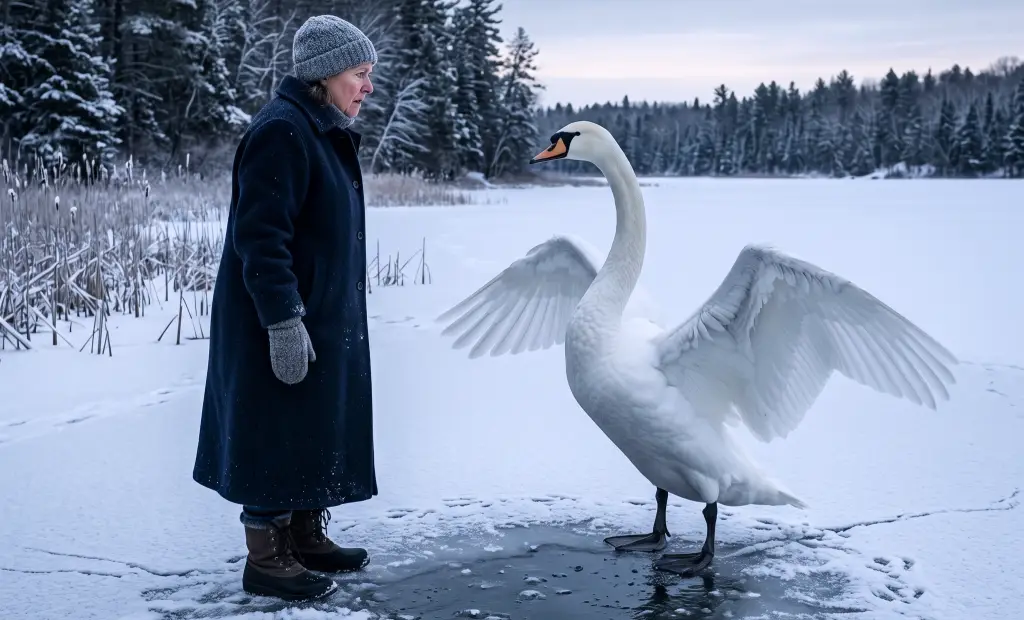
So she got up. She dressed in the dark, pulling on thick wool socks, insulated boots, and Paul’s heavy flannel-lined barn coat. Where she was going didn’t matter as much as the simple, mechanical act of moving forward.
It was a mile and a half to Stillwater Lake, out past the edge of the subdivision and through a dense stand of white pines. The air outside was bitter, hovering around zero degrees. Every breath pinched her nostrils, the cold settling sharp and deep in her lungs. Under the beam of her flashlight, the packed snow squeaked beneath her boots.
She and Paul used to ride their bicycles out this way in the summers. They kept it up right until his left knee gave out, forcing the bikes into the back of the garage where they still sat, gathering dust under a blue plastic tarp. She had thought the knee was the start of a long, gradual slowing down. She hadn’t known his heart would fail before the joint ever got the chance to. Thirty years of teaching high school geography had taught her how landmasses eroded over millions of years, how rivers slowly carved canyons out of solid rock. Paul’s death had not been erosion. It had been a fault line giving way without warning.
Rachel saw the lake from the crest of the ridge before she began her descent. It was a vast, flat expanse of white, locked tight by three weeks of hard January freezes. A thin, pale mist hung low over the surface, the kind of vapor that forms when the ice is solid but the air above it drops faster than the trapped water below. To the east, the black sky was just beginning to bruise a dull, grayish purple.
She walked down the embankment, pushing through the stiff, frozen reeds, and stepped onto the ice. It held firm. Somewhere far out in the center, a deep, hollow boom echoed through the dark—the sound of the thick ice shifting and settling under its own immense weight. She walked cautiously anyway, testing the surface with the toe of her boot.
“You’re a careful woman, Rachel,” Paul used to tell her. He had never said it as an insult.
A hundred yards from the shoreline, she noticed a white shape shifting against the gray light. At first, she thought it was a plastic grocery bag caught in the wind. Then she realized the air was dead calm.
She moved closer, the beam of her flashlight cutting across the ice.
It was a swan. It was massive, its thick body drawn tight, its long neck tucked deeply into its shoulders to conserve heat against the sub-zero draft. It was pacing in a slow, methodical circle. Step by step, its black webbed feet slipped over the frosted ice with a dry, scratching sound.
Inside the center of its circle lay a dark patch. It was a breathing hole, partially glazed over with a thin film of fresh ice, the black water visible just underneath.
Rachel stopped twenty yards away. The swan turned its body. It uncoiled its neck, the dark red bill pointing straight at her. It didn’t hiss. It just watched, holding its ground.
“Hello,” Rachel said.
The word hung in the freezing air, foolish and small. But she had spent three decades commanding classrooms of distracted teenagers; speaking into the silence was an old habit.
The swan shifted its weight, turning its head slightly to give her the full focus of one dark, unblinking eye.
“Your flock left,” she said, her voice carrying across the flat expanse. “They went south months ago. Why are you still here?”
The bird offered no answer. It just took a slow, deliberate step, placing itself directly between Rachel and the dark water.
Rachel took one step forward. Immediately, the swan raised its wings. They unfurled with a heavy, leathery rustle, spanning nearly seven feet across. The sheer size of the animal in the dim light was startling. It was an unmistakable, instinctual warning.
“Alright,” Rachel said, taking a step back. “I’ll stay right here.”
The swan kept its wings half-raised, its neck straight and tense. Rachel stood in the cold, observing. Even here, entirely alone on a frozen lake in the dead of winter, the bird was striking. Its feathers were pristine, thick and unruffled by the wind.
“I should go,” she said, pulling Paul’s collar up around her chin. “I’m going to freeze out here.”
She stepped to her left, intending to cut across the center of the lake toward the far trail. The swan mirrored her movement, stepping sideways to block her path.
She stopped. She moved to the right. The bird stepped to the right, lowering its neck, holding the line. It wasn’t going to let her near the thin ice.
Rachel yielded. She gave the bird a wide berth, walking a large arc twenty yards away from the hole. The swan didn’t follow, but it turned on its axis, tracking her every step until she was safely past. When she reached the far ridge, she stopped and looked back. Down on the vast, pale surface of the lake, the tiny white dot had folded its wings and resumed its slow, endless circle.
Back in her kitchen, Rachel pried off her heavy boots and set the kettle on the stove. She kept the lights off, letting the weak morning light filter through the frost-rimmed window above the sink.
On the wall next to the refrigerator hung a framed photograph. It was her and Paul at Glacier National Park, taken the summer they turned forty-six. They were both squinting into the sun, smiling, the water behind them so impossibly blue it looked like crushed glass. She stood in the quiet kitchen and looked at the picture until the kettle began to scream.
She poured her tea, took a piece of dry toast, and stood by the window to eat. Outside, the yard was buried in drifts. Beyond the fence sat the garage with the rusted bikes. And beyond that, past the tree line, was the lake.
Rachel stared out over the snow. Forty years with one man. It had been a good life. She was not afraid to use that word. People liked to say a good life was a simple one, but there was nothing simple about spending four decades beside the same person. It was an intricate map of compromises, unspoken apologies, days where they barely spoke, and days where she loved him so fiercely it frightened her.
It had been a good life. But as she stood in the empty kitchen, letting the tea cool in her hands, her mind drifted back to a dark November evening in nineteen ninety-eight, and the one heavy thing she still carried from it…
To read the rest of the story – CLICK the NEXT button 👇👇👇