


The morning wind off the Allegheny River carried a damp, bitter chill that seemed to settle directly into the bones. Outside UPMC Children’s Hospital in Pittsburgh, the cold wasn’t quite enough to produce snow, but it made every breath visible and turned the cheeks of passing nurses a raw, stinging pink. People hurried through the sliding glass doors, bundled in heavy wool coats and clutching paper coffee cups, moving with the frantic energy of those trying to outrun whatever emergency had brought them to a pediatric ward.
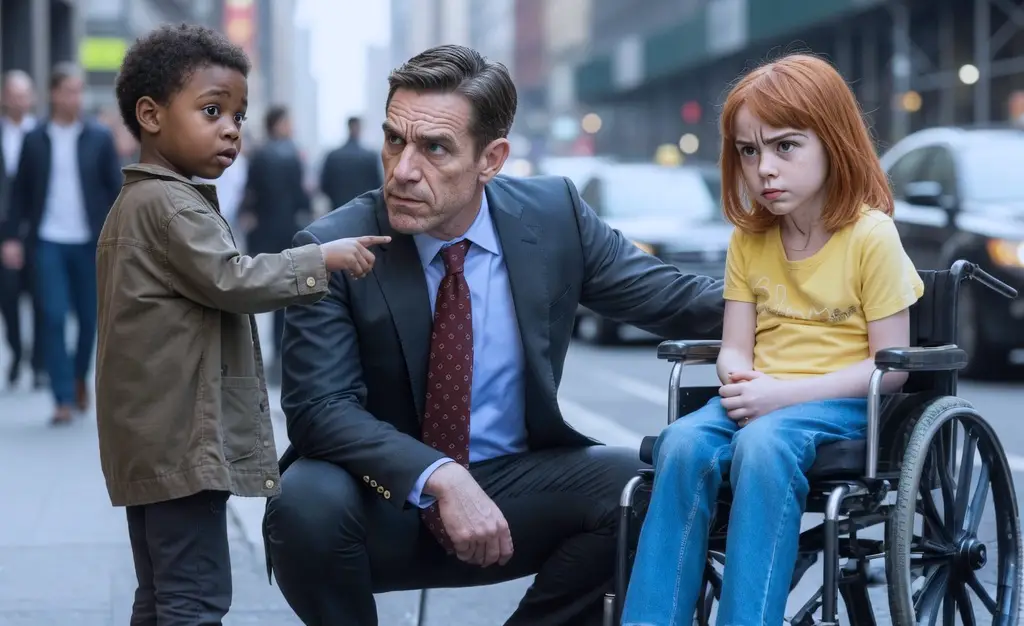
Only one person wasn’t moving.
He sat on a flattened cardboard box near the hospital’s concrete planters, quietly dragging a pencil across a weather-beaten notebook. His name was Micah Brooks, and he was nine years old. His winter coat was a size too big, the cuffs rolled back twice to free his hands, and a strip of silver duct tape wrapped around the toe of his left boot. A faded red beanie was pulled down low, barely covering his ears.
Micah didn’t hold up a sign. He didn’t ask for change. He just sat there, blending into the peripheral vision of the rushing adults, watching them with a steady, clinical focus. Security had tried to chase him off a few times when he first started showing up on Saturday mornings, but they eventually stopped bothering. He caused no trouble. When a passing janitor or orderly spoke to him, he offered a quiet, polite nod. Most assumed he belonged to someone inside—a kid waiting out a sibling’s chemo session, or killing time while a parent worked a shift. In a place built around pediatric trauma, people learned not to ask too many questions.
Across the street, parked illegally near a fire hydrant, a dark silver Range Rover idled. The engine hummed, pumping heat into the plush leather interior, but the driver made no move to put the car in gear.
Harrison Vance sat behind the wheel. He was forty-six, a corporate attorney whose sharp jawline was currently shadowed by two days of stubble. His tie hung loose against a wrinkled collar. The SUV gleamed under the flat winter light, a heavy, expensive fortress of a vehicle, but the man inside looked entirely hollowed out.
In the back seat, strapped into a booster, sat his six-year-old daughter, Clara. She wore a heavy pink coat, a wool blanket tucked around her legs. Her brown curls were neat, brushed carefully by her father that morning, but her eyes were vacant, fixed on the upholstered ceiling of the car. She hadn’t spoken a word since they left the house.
The accident was still a clear, sharp dividing line in their lives. Before it, Clara had been a blur of motion, racing her cousins across the lawn, climbing the oak tree in the backyard. After it, there was only the wheelchair. The doctors had explained that her spinal cord wasn’t entirely severed, that the nerve pathways were dormant, damaged but potentially viable. But the trauma of the crash—the metal, the noise, the pain—had locked her in. Her legs wouldn’t move, and the sterile hospital rooms, with their humming machines and pitying technicians, only seemed to make her retreat further into herself.
Harrison shifted into park. He got out into the biting cold, opened the rear door, and carefully unbuckled her. He scooped Clara into his arms, holding her tightly against his chest, terrified of jostling her. Her legs dangled limply against his hip. She stared over his shoulder, her face blank, actively avoiding the sight of the hospital doors.
Harrison didn’t notice the boy in the oversized coat. He was too focused on the ice on the pavement and the familiar weight of dread settling in his stomach.
But Micah noticed him. He saw the rigid, protective way Harrison carried the girl, treating her like she was made of spun glass. He saw the lifeless hang of her legs, and the exhausted slump of the father’s shoulders.
Micah stopped drawing. He closed the notebook, set it on the cardboard, and stood up. He waited until Harrison was three steps away.
“Sir,” Micah said.
Harrison didn’t stop, assuming it was a request for a dollar.
“I can help her walk again.”
Harrison froze. He stopped mid-step, the automatic doors sliding open a few yards away, letting out a blast of warm, sanitized air. He turned slowly. He expected a joke, a scam, or the disjointed rambling of a street kid.
But Micah wasn’t smiling. He stood perfectly still, his hands stuffed deep into the pockets of his oversized coat. His voice hadn’t held the rehearsed cadence of a pitch. It was quiet, steady, and entirely factual. A grown-up kind of stillness in a nine-year-old’s body.
Harrison pulled Clara a fraction of an inch closer to his chest. His jaw tightened. “What did you just say?”
Micah didn’t flinch under the man’s glare. He stepped forward. “I said I can help her walk again.”
Harrison stared down at the taped-up boot, the cracked plastic frame of the glasses hanging from the collar of the boy’s shirt. The sheer absurdity of it spiked a sudden, defensive anger in his chest. “That’s not funny, kid.”
“I wasn’t joking.”
Harrison held the boy’s gaze for a long second, searching for the punchline, the hustle. He found neither. Shaking his head at his own willingness to engage, Harrison turned his back and walked through the sliding doors, letting the hospital swallow them both.
Inside, the morning dragged into an exhausting loop of fluorescent lights and hushed medical jargon. Harrison sat in a small examination room, nodding as Dr. Aris went over the same functional plateaus.
“We need to manage expectations, Mr. Vance,” the neurologist said, gesturing to a chart on the tablet. “The muscles are experiencing secondary atrophy. The pathways are there, but the psychological block is severe. She views clinical therapy as a threat. Miracles take time.”
Harrison had heard it all before. He looked at Clara, who was staring blankly at the paper unrolling across the exam table. But as the doctor droned on, Harrison couldn’t focus on the medical terms. A voice kept echoing in his head, scratching at his exhaustion like a stubborn itch.
I can help her walk again.
By early afternoon, the sky over Pittsburgh had turned the color of bruised iron. Harrison carried Clara back out into the cold, the wind immediately cutting through his suit jacket. He walked toward the Range Rover, calculating the afternoon medication schedule, when he looked toward the concrete planters.
The boy was still there.
Same flattened box. Same faded beanie. Only this time, he wasn’t drawing. He was looking directly at Harrison, tracking his approach as if he had known exactly when they would walk out.
Harrison unlocked the SUV, gently lowering Clara into her seat and tucking the blanket around her dormant legs. He closed the door. He told himself to get in the driver’s seat and turn the heater on. Instead, he turned and walked across the pavement, his shoes crunching on the rock salt.
“You again,” Harrison muttered, his voice sharp with fatigue. “Why would you say something like that? You think this is a game?”
Micah shook his head slowly. “No, sir.”
“You don’t even know her.” Harrison’s voice rose, the months of helpless frustration bleeding through his expensive veneer. “You have no idea what her medical chart looks like. You have no idea what she’s been through, or what I’ve been through.”
Micah didn’t back down. He didn’t raise his voice either. “I don’t have to know her to help.”
Harrison let out a harsh, humorless breath. He looked the kid up and down. “You’re what, nine?”
“Almost ten.”
“Right. Almost ten. You’re a little boy sitting on a piece of cardboard outside a hospital. What could you possibly know about pediatric neurology?”
Micah looked down for a brief second, his thumb tracing the frayed edge of his notebook. “My mom used to help people walk again,” he said quietly. “She was a physical therapist. She taught me stuff.”
Harrison stopped, the anger losing a fraction of its heat.
“She said the body remembers things,” Micah continued, looking back up, his brown eyes locking onto Harrison’s. “Even when it forgets for a while. It just needs to be reminded the right way.”
Harrison stared at him, the heavy skepticism warring with an irrational, desperate spark in his chest. “So what? You watched her do some stretches, and now you think you can fix my daughter?”
“I watched her help a veteran walk after being in a chair for five years,” Micah said. “She didn’t use machines. She didn’t put them in scary rooms. She just used her hands, and patience.”
Harrison opened his mouth to shut the conversation down, to tell the kid to go home. But he hesitated. He glanced around. A nurse in scrubs walked past, giving Micah a warm, familiar smile. A security guard by the doors nodded in the boy’s direction. They all seemed to know him. He wasn’t a threat.
“I’m not giving you money,” Harrison said, his voice dropping.
“I didn’t ask for money.”
“Then what do you want?”
Micah adjusted the collar of his coat and stood a little taller. “One hour. Let me show you.”
Harrison looked back at the Range Rover. Through the tinted glass, he could see the silhouette of Clara’s head resting against the side of the car seat. He rubbed the bridge of his nose, feeling a headache building behind his eyes. He was a partner at a law firm. He dealt in facts, liability, and calculated risks. Standing on a freezing sidewalk negotiating physical therapy with a homeless nine-year-old was the definition of insanity.
“I should walk away right now,” Harrison said.
Micah didn’t move.
“I should call child services,” Harrison added.
The boy just watched him, perfectly willing to let the silence do the work.
Harrison finally let out a long, defeated exhale. His breath plumed in the freezing air. “Fine.” He pointed a finger at the boy’s chest. “You want to waste your time, kid? Meet us at Highland Park tomorrow. Noon. By the old oak tree near the basketball courts. Don’t be late.”
Micah gave a single, firm nod. “I’ll be there.”
Harrison turned, walked back to his SUV, and started the engine. He pulled away from the curb without waving, merging into the afternoon traffic. But a block later, when he checked the rearview mirror, he could still see the boy standing by the concrete planters, watching them leave, his face completely unreadable…
To read the rest of the story – CLICK the NEXT button 👇👇👇