


The late afternoon heat settled over the Tennessee foothills like a damp woolen blanket. Out in the main paddocks of the Cumberland Wildlife Sanctuary, the distant rumbles of the resident herd vibrated through the humid air. But here, inside the concrete walls of the isolation wing built for critical intakes, the only sound was the rhythmic click of an oscillating fan and a shallow, ragged wheeze.
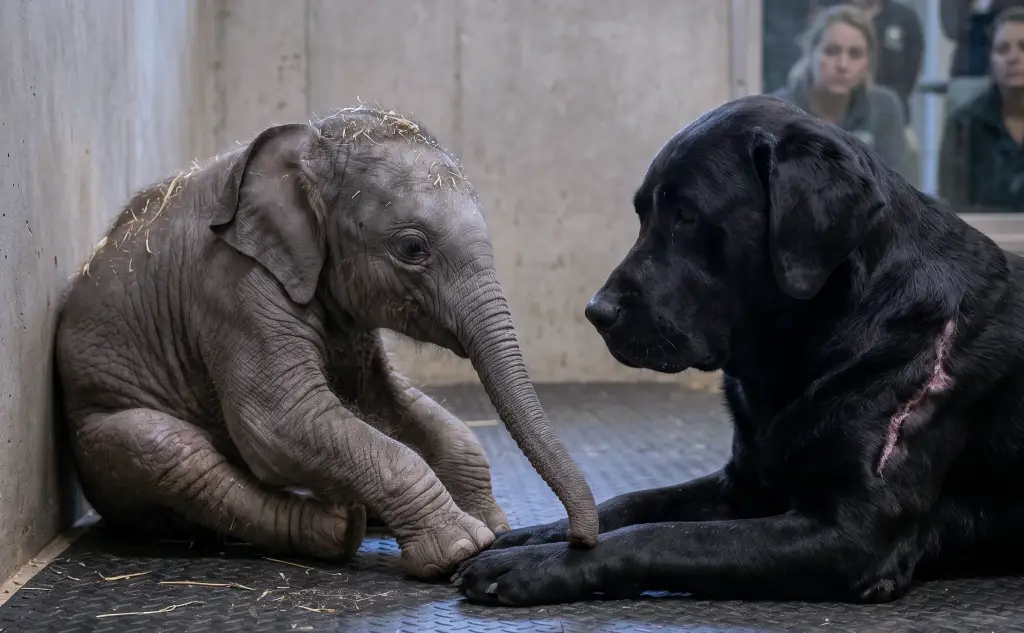
Dr. Elias Thorne stood at the edge of the quarantine enclosure, resting his forearms on the top rail of the steel fence. At fifty-two, Elias had spent two decades pulling large animals out of the worst situations human negligence could engineer. He was accustomed to the sting of iodine, the sweat pooling at the base of his neck, and the quiet calculus of veterinary triage. But the scene unfolding on the rubberized matting below was steadily dismantling his professional distance.
Amos, a three-week-old calf, lay curled into the tightest ball his skeletal frame would allow. His gray skin, which should have been thick with healthy baby fat, hung in loose, dehydrated folds over his ribs. An untreated bacterial infection had sealed his eyes shut days ago, leaving tracks of dried fluid trailing down his face. The sanctuary’s medical team had flooded his system with broad-spectrum antibiotics, stabilizing his vitals. But they had lost the battle for his sight. The damage to his corneas was permanent.
The calf had arrived five days earlier in a climate-controlled transport trailer escorted by agents from the U.S. Fish and Wildlife Service. They had confiscated him during a raid on a bankrupt roadside zoo down in the Florida panhandle. Amos’s mother, severely malnourished and suffering from advanced joint disease, had collapsed in her concrete pen during the seizure. She hadn’t survived the night.
Since the truck pulled through the gates at Cumberland, Amos had completely shut down.
He refused the specially formulated milk replacer. He ignored the fresh coastal bermuda grass. He flinched at the vibration of human boots and showed zero interest when the staff brought Stella, a gentle fifty-year-old matriarch, to the fence line to offer comforting rumbles. He hadn’t even reacted to Daisy, a playful two-year-old rescue who usually drew every new intake out of its shell.
Boots scuffed the concrete walkway behind Elias. Maya, the sanctuary’s senior elephant keeper, stepped up to the rails. Her khaki uniform was streaked with dried mud and chalky white milk replacer, and she looked like she hadn’t slept since the USFWS truck arrived.
“His respiration is climbing,” Maya said, her voice pitched low. She didn’t look at Elias. Her eyes stayed locked on the calf. “And his heart rate is getting reedy.”
“I see it,” Elias said, rubbing the tight muscles at the back of his neck.
“We can’t tube him again, Elias. We just can’t do it.”
She was right. They had forced a gastric feeding tube down the calf’s throat twice over the weekend. The physical restraint and the sheer, blinding panic it induced had spiked his cortisol levels dangerously high. Elias knew the stress of a third attempt would likely trigger a fatal cardiac event. Starvation was killing the calf slowly; the tube would kill him in minutes.
Down in the enclosure, the heavy steel door unlatched with a dull clack. Wyatt, one of Cumberland’s most experienced handlers, stepped inside. He moved with the agonizing slowness required when working with a blind, terrified prey animal. In his right hand, he carried a heavy plastic nursing bottle filled with two quarts of warmed formula. Elias and Maya watched in tight silence as Wyatt knelt on the matting, three feet from the calf’s head…
To read the rest of the story – CLICK the NEXT button 👇👇👇