


Alex Miller stared at the mortality report on his desk, rubbing a layer of fine, red dust from the rim of his coffee mug. Seven years as a senior wildlife veterinarian with the Mara Conservation Project had taught him that the dry season always brought out the worst in the region. He was halfway through documenting the loss of a young elephant to a wire snare when Samuel Kiprop opened the office door.
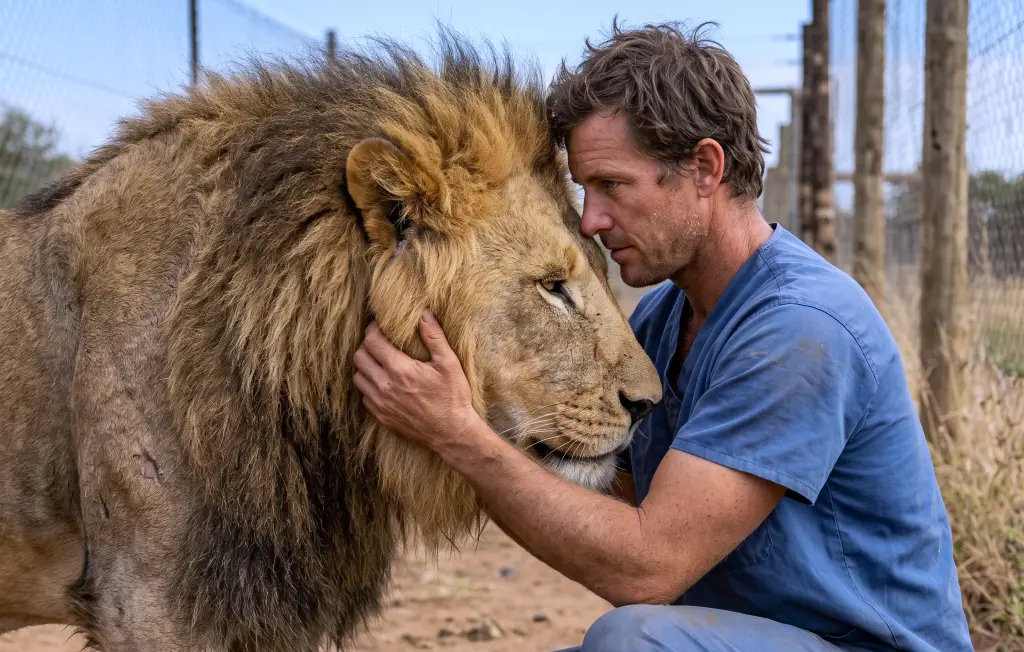
The anti-poaching unit coordinator didn’t knock. His normally composed features were tight, his uniform stained with fresh sweat.
“We need your medical kit,” Samuel said. “The local Maasai herdsmen found something off the northern boundary.”
Thirty minutes later, Alex was bracing himself against the dashboard of a Land Rover as it chewed through the scrubland. The heavy suspension bottomed out in a rut, jarring Alex’s teeth, but he kept his grip firmly on the handle of his trauma bag. In the back seat, Kibo, a junior ranger, sat in tense silence with his rifle resting across his knees.
Samuel kept his eyes on the uneven terrain, raising his voice over the roar of the diesel engine. “They’ve changed tactics. We’re not finding carcasses anymore.”
Alex frowned, watching the acacia trees blur past the window. “Live transport?”
“Looks like it,” Samuel said. “The black market is shifting. Private collectors in the Middle East and Asia are paying a premium for live specimens. A healthy male lion can pull in fifty thousand dollars. But they can’t move them immediately, so they’re building holding cells. Underground.”
The implications settled heavily in the cab of the truck. Standard poaching—horns, tusks, pelts—was brutal, but it was usually fast. Live trapping meant prolonged starvation. The traffickers accounted for a high mortality rate; as long as one or two animals survived the journey to a private menagerie, the operation remained immensely profitable.
When Samuel finally cut the engine, the sudden silence of the savanna felt heavy. They had parked near a cluster of dense, dry brush that looked entirely unremarkable. The heat radiating from the baked earth was intense, pressing down on them as they stepped out of the vehicle.
The rangers fanned out. Alex waited by the truck, knowing better than to trample potential tracks. It took Kibo twenty minutes of methodical pacing before he stopped and raised a hand.
“Here,” the young ranger called out.
Alex moved through the high grass. Kibo was standing beside a thicket of thorn bushes that appeared natural, but as Alex got closer, he noticed the subtle geometry of the deadwood. It had been woven together.
Together, Samuel and Kibo took hold of the brush and hauled it backward.
The stench hit them before they even saw the bottom. It was a physical wall of ammonia, dried blood, and the unmistakable, suffocating odor of rot.
Alex stepped to the edge and looked down. The poachers had dug a pit ten feet deep, reinforcing the crumbling dirt walls with scavenged sheets of corrugated metal and rotting timber.
At the bottom lay a fully grown male lion.
He wasn’t moving. His ribs protruded sharply through a dull, matted coat that was caked with dirt and his own waste. Where there should have been four hundred pounds of heavy muscle, there was only a ruined, skeletal frame. His golden mane was black with dried blood from the deep lacerations around his neck and shoulders, injuries earned from throwing himself against the metal walls.
“My God,” Alex said softly.
“Is he alive?” Samuel asked, stepping back from the edge.
As if in answer, the shallow rise and fall of the animal’s ribcage hitched.
“Barely,” Alex said. He dropped to one knee, unzipping his trauma bag. “Severe dehydration. His kidneys are probably already shutting down. We need a transport cage and the heavy rigging gear. Contact Dr. Kimathi. Tell her to prep the medical bay.”
Kibo scanned the tree line, his grip tightening on his rifle. “The poachers could come back to check the trap.”
“Then we work fast,” Alex said. He pulled a specialized dart gun from its hard case, his hands moving with practiced, mechanical efficiency. He loaded a vial of sedative, drastically cutting the standard dose. Sedating an animal in this condition was a massive gamble; the drugs could easily stop the lion’s weakened heart. But trying to extract a conscious apex predator was impossible.
He aimed down into the pit and fired. The dart struck the lion’s heavy shoulder muscle. The animal didn’t roar. He didn’t even flinch. He simply let out a low, rattling exhale.
Alex didn’t wait for the timer on his watch to reach the ten-minute mark. He grabbed a coil of heavy climbing rope from the back of the Land Rover, secured one end around the thick trunk of a nearby acacia, and tossed the rest into the hole.
“What are you doing?” Samuel asked, stepping forward. “Protocol says we wait for the rigging team.”
“Protocol assumes we have an animal with blood pressure,” Alex said, slinging his medical backpack over his shoulders. “He needs intravenous fluids right now. If we wait for the transport truck to get here, we’re going to be hauling out a corpse.”
“Alex, you can’t go down there with him.”
“Watch me.”
Alex grabbed the rope and repelled over the edge. The heat inside the pit was stifling, the air thick and airless. His boots hit the dirt floor with a soft thud. The ground was littered with the small bones of scrub hares and dik-diks—inadequate scraps thrown down to keep the animal just alive enough to sell.
The lion’s massive head rested in the dirt. His eyes, a pale, glassy amber, tracked Alex’s movement. Even sedated and starved, the sheer size of the predator’s skull was terrifying. Alex was kneeling less than two feet away. A single swipe of the paw, a sudden surge of adrenaline, and it would be over.
But the lion didn’t move. He lacked the strength for violence.
Alex took a steadying breath, the lingering traces of his Australian accent entirely gone when he murmured, “Easy, mate. Just going to give you a pinch.”
He pulled an IV catheter from his kit and ran a hand along the lion’s front leg. The skin felt like dry leather. He had to shave a small patch of fur and search for a vein that hadn’t completely collapsed. When he finally found a pulse, it was dangerously faint. Alex slid the needle in, taped it down securely, and attached a liter bag of saline, hanging it from a jagged piece of wood protruding from the pit wall.
He watched the clear fluid begin to drip down the line, disappearing into the ruined body of the animal.
Alex keyed the radio clipped to his chest harness. “Samuel. Fluids are in. Tell Nadia I’m bringing him in.” He looked down at the slow, heavy rise of the lion’s chest. “I’m calling him Lazarus. Because he’s going to need a miracle.”…
To read the rest of the story – CLICK the NEXT button 👇👇👇