


I clicked the silver button on the stopwatch. Four minutes and eighteen seconds. From the shadowed observation gallery of the Primate Conservation Habitat, the glass was thick enough to mute the wind blowing off the Ohio plains, but it did nothing to dull the sheer physical anomaly unfolding on the other side.
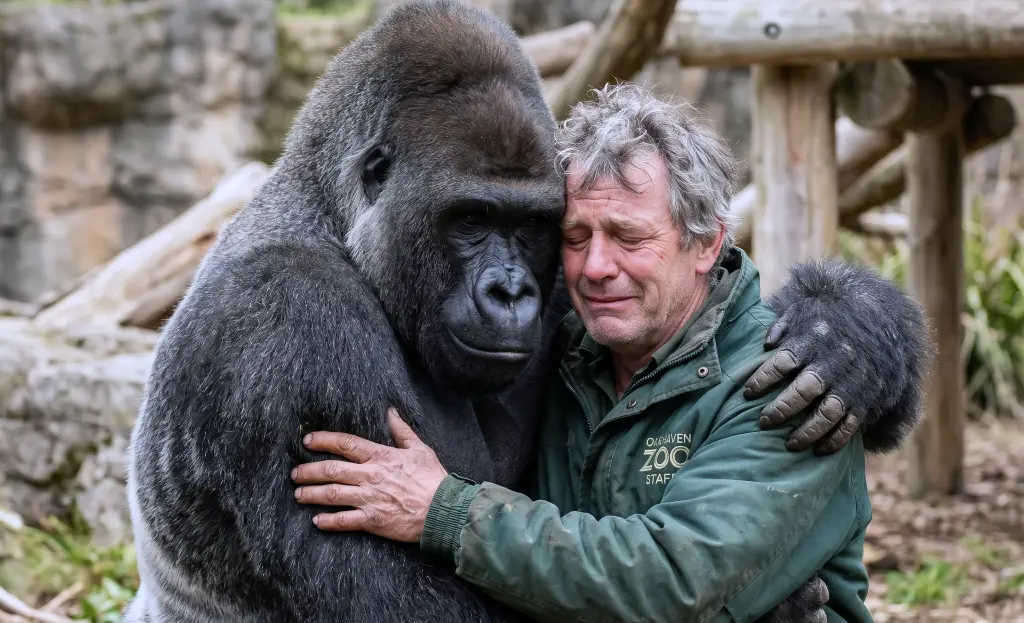
Down in the enclosure, surrounded by the graying late-October foliage of Oakhaven Zoological Park, four hundred pounds of western lowland silverback sat motionless on the damp earth. His massive, leather-padded arms were locked entirely around a man. Neither the animal nor the human moved.
The man caught in the primate’s grip was Arthur Hayes, our senior keeper. At fifty-five, Arthur was a fixture at Oakhaven—a quiet, heavy-shouldered man who lived in faded canvas work jackets and carried an air of absolute, unshakeable routine. He had worked with this specific silverback, Samson, for nearly three decades.
I had been studying great apes for fifteen years. I knew their capacities for violence, their intricate social hierarchies, and their profound emotional depth. But a silverback gripping a human being in a sustained, full-body embrace for over four minutes was not a display of affection. It was a staggering breach of natural behavior.
“He’s shifting his weight,” Julian muttered beside me.
Julian Vance was the junior keeper assigned to the primate wing. He stood a few feet to my left, his jaw tight, his thumb compulsively clicking a ballpoint pen against a heavy plastic clipboard.
Through the glass, Samson slowly loosened his hold. But the ape did not retreat. Instead, he dropped his weight forward onto his knuckles, keeping his colossal frame positioned between Arthur and the rest of the open habitat. Samson’s right hand lifted, the broad, calloused fingers settling heavily onto Arthur’s shoulder. It looked less like a gesture of companionship and more like a physical anchor.
“Tell me exactly how long this has been happening, Julian,” I said, keeping my voice low.
Julian stopped clicking the pen. He looked at the clipboard, then out at the gray sky, anywhere but at me. “Three months. At least, that’s when it got bad enough to start logging.”
“Logging?”
Julian handed me the clipboard. There was a spreadsheet attached, filled with tallies.
“August,” Julian said quietly. “It was maybe twice a week. Arthur would go in for the morning perimeter check, and Samson would block his path and initiate contact. By September, it was daily. Last week…” He swallowed hard. “Last week, we hit ten times a day. Today we’re already at twelve.”
I scanned the numbers. The escalation was geometric. “And the other staff?”
“Samson ignores the rest of us,” Julian said. “If I walk in there with the feed buckets, he stays up on the ridge. He doesn’t even track me with his eyes. But the second Arthur cycles the perimeter gate, Samson is on him. He won’t let Arthur out of arm’s reach.”
Down in the dirt, Arthur finally took a step toward the utility door. Samson mirrored the movement instantly, moving with that deceptive, silent speed unique to heavy primates, his shoulder brushing Arthur’s hip.
I handed the clipboard back. “Something is triggering this. Animals don’t alter decades of behavioral baseline without an environmental shift. What changed in Arthur’s routine?”
“Nothing,” Julian said too quickly.
I turned to look at him. The young keeper was sweating, despite the chill radiating through the observation glass.
“Julian,” I said. “A male gorilla is shadowing a senior keeper like a bodyguard. If Arthur makes a wrong move, or if Samson misinterprets a stumble, Arthur’s ribs will be crushed before you can even reach for the radio. What are you not telling me?”
He looked down at his heavy boots. For a long time, the only sound in the gallery was the hum of the climate control vents.
“It started with the lock sequences,” Julian finally whispered. “The heavy transfer doors between the holding pens. Arthur’s been doing it for twenty years. You slide the primary, drop the pin, check the visual, open the secondary. It’s muscle memory.”
“And?”
“Two months ago, I found him standing in the corridor. He was just staring at the pin. He had the keys in his hand, but he was looking at the mechanism like he had never seen it before in his life. I had to walk up and do it for him.”
A cold, heavy sensation began to settle in my chest. “Has he seen a doctor?”
Julian nodded, his voice dropping so low I had to lean in to hear him. “His wife made him go right after Labor Day. He’s been forgetting names. Not just us. The animals. He called Nia by the wrong name last week. Nia’s been here since ninety-eight.”
“What did the doctors say?”
“Early-onset Alzheimer’s,” Julian said, his voice cracking slightly. “Stage one. But the neurologist told him it’s moving aggressively. Way faster than the typical curve.”
I turned slowly back to the thick glass. Down below, Arthur was fumbling with the heavy latch of the utility door. He seemed to be struggling to align the key with the cylinder.
Samson was right beside him. The gorilla wasn’t looking at the door, nor was he scanning the tree line for threats. His dark, deeply set eyes were fixed entirely on Arthur’s face. The primate’s expression lacked the sharp, rigid tension of aggression, but it also held none of the loose posture of play. It was an intense, unbroken scrutiny…