


The Briar Creek stockyard had a smell that got into a man’s clothes and stayed there.
Hot diesel. Trampled hay. Wet iron. The sour bite of animals that had been hauled too far and handled too roughly.
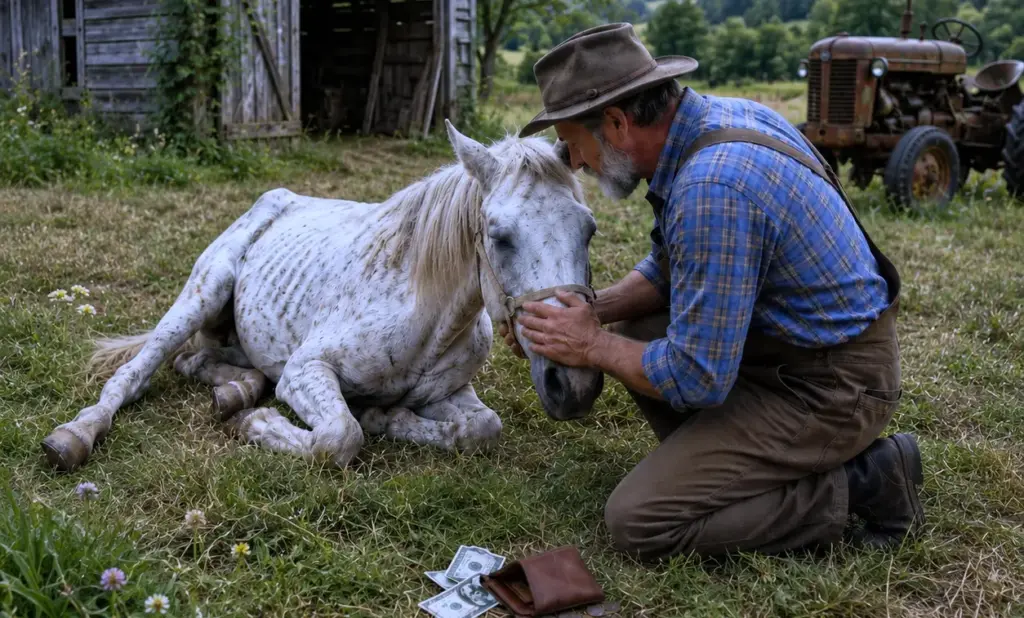
Samuel Calder stood just beyond the main auction barn, one hand resting in the pocket of his old canvas coat, the other curled around a slip of paper with a tractor-part number scribbled on it. He had written the number twice that morning because his hand had been shaking the first time.
A rebuilt alternator.
That was what he had come for.
Nothing else.
His old Ford tractor had quit in the lower pasture three days earlier, dead as a stump in waist-high Johnson grass. Without that tractor, he couldn’t cut the field before the county sent another notice about overgrowth. Without the field, he couldn’t keep the place looking like a farm instead of a property waiting to be taken.
And without the farm, Samuel wasn’t sure what would be left of him.
He had two hundred and forty dollars in his wallet. He had counted it at the kitchen table before sunrise, under the dim light above the sink, with Nora’s coffee mug still sitting in the cabinet where she had always kept it.
Fourteen months gone, and he still couldn’t move that mug.
He had brought every bill he could spare from the farm account. Property taxes were coming. The bank had already sent letters with polite words that meant ugly things. He needed that alternator, needed the tractor running, needed one small piece of his life to start doing what it was supposed to do.
So he walked past the main pens without slowing.
Past the yearling steers with their slick coats and sharp black eyes.
Past the crates of chickens fluttering against wire.
Past the goats bleating like they were personally offended by the world.
Men called greetings to one another from under sweat-stained caps. The auctioneer’s chant spilled from the barn in a fast, rattling rhythm, all numbers and breath. Gates clanged. Trucks backed up. Buyers leaned against rails and pretended not to care too much.
Samuel kept his head down.
He had become good at that.
Before Nora died, people had stopped him everywhere. At the feed store. At church. At the diner out by Route 9. They had asked after her garden, her peach preserves, the quilt she’d been sewing for somebody’s new baby. After the funeral, they asked after him instead.
How are you holding up?
Need anything?
You ought to come by sometime.
He had learned to nod without answering. Learned to look busy. Learned to move like a man on his way somewhere, even when he had nowhere to go.
That morning, he drifted past the equipment tables and toward the far side of the stockyard before he realized he had taken a wrong turn.
The gravel thinned out there. The crowd noise dropped behind him. Beyond the last row of trailers stood a line of battered pipe pens, half sunk in weeds and dust.
Samuel knew what that corner was.
Every auction had one.
The cull pens.
Animals too old, too injured, too thin, too inconvenient. The ones nobody spoke of with affection. The ones measured not in temperament or bloodline but in pounds.
A black cow stood hip-shot in one pen, flies clustering along the wet corners of her eyes. A ewe with a twisted horn limped in slow circles in another. Farther down, three horses stood pressed together under a sheet-metal shade, their heads low.
Samuel should have turned around.
The tractor part was in the north lot.
His list was in his pocket.
His money had a purpose.
Then he saw the white mare.
At first, she hardly looked white. Mud clung to her sides in dark, stiff sheets. Her mane hung in ropes along her neck. Her tail was a matted drag of straw, burrs, and dried manure. She stood alone in the center of the last pen, as if even the other animals had given her room out of pity.
Every bone in her showed.
Not just ribs. Hips. Spine. The hard edges of her shoulders. Her skin looked stretched over a frame that had been built for grace and then left to starve.
But Samuel’s eyes went to her left front leg.
The knee was swollen into an ugly round mass, pulled tight and shiny under the dirt. The joint had thickened so badly that the whole limb hung at a wrong angle. She held the hoof barely off the ground, trembling from the effort of not using it.
A man laughed behind Samuel.
“Don’t get sentimental over that one.”
Samuel turned just enough to see him.
The man was leaning on the fender of a dented livestock truck, smoking a cigarette burned almost to his fingers. He had a narrow face, a patchy beard, and the flat eyes of someone who had learned not to look too long at suffering.
“Yours?” Samuel asked.
“For the next hour or so.” The man flicked ash into the dirt. “Bought her cheap out of a back lot. She’ll go cheaper when the hauler gets here.”
Samuel looked back at the mare.
“She’s hurt bad.”
“No kidding.” The broker gave a dry little snort. “That leg’s cooked. Infection up in the joint, most likely. She might not even make the ramp. Driver won’t love that, but that ain’t my problem once she’s loaded.”
The mare’s ears twitched at his voice, but she didn’t lift her head.
The broker stepped closer, lowering his tone like he was doing Samuel a favor.
“You want advice, old-timer? Keep walking. She’s not a rescue project. She’s a shovel job.”
Samuel said nothing.
He had seen sick animals all his life. Cows with milk fever. calves born wrong. dogs gone gray at the muzzle and too tired to climb the porch steps. Farm life didn’t make a man soft. It taught him exactly how much pain could be endured before mercy became the only honest thing left.
But the mare raised her head then.
Slowly.
As if even that small act cost her something.
Her eyes found Samuel’s through the fence.
He expected fear. A horse in that condition usually had plenty of it left. They threw their heads, rolled their eyes white, kicked at shadows, tried to survive with every last scrap of instinct.
This mare had gone past fear.
There was a stillness in her that made Samuel’s stomach tighten. Not peace. Not trust. Just the tired, inward quiet of a creature that had stopped asking for the world to be kind.
He knew that look.
Nora had worn it near the end.
Not every day. Not at first. She had fought the cancer with a stubbornness that made nurses smile and made Samuel believe things he had no business believing. She had kept a notebook of pills and appointments. She had fussed at him for overwatering the tomatoes. She had told the hospice chaplain he could pray, but not in that funeral voice.
Then, during the last week, something in her had pulled away.
She would look past him toward the window, her hand small and dry inside his, and he would understand that she was no longer trying to stay.
He had sat beside her and hated his own hands because they could fix fences, engines, roofs, busted gates, frost-bit pipes, and none of it mattered. They could not hold her here.
The mare blinked once.
Samuel stepped closer to the fence.
“Don’t,” the broker said. “She might bite.”
Samuel slipped his hand between the rails.
The mare flinched.
It was not a dramatic movement. No snort, no rear, no wild scramble. Just a tired ripple through her skin, the kind an animal gives when it expects pain and no longer has the strength to avoid it.
Samuel held his hand still.
The auction noise carried faintly from the barns behind him. Numbers. Laughter. Engines starting.
He waited.
The mare’s nostrils moved. She shifted her weight and gave a tiny, awkward hop forward on three legs. The injured one shook beneath her like a loose fence wire in the wind.
When her muzzle reached his palm, she didn’t nuzzle him.
She just breathed.
Warm air touched his skin. Slow. Damp. Alive.
Samuel closed his fingers carefully, not gripping, just letting the tips rest against the softness of her nose.
A foolish thought came to him then.
Maybe not her.
Maybe I can keep this one thing from leaving.
He pulled his hand back.
The broker straightened when Samuel reached into his coat.
“What’re you doing?”
Samuel opened the worn leather wallet Nora had given him fifteen Christmases ago. The stitching had come loose along one side. The bills inside were folded twice, tucked behind his driver’s license and a photo of Nora standing beside a row of sunflowers taller than she was.
He took out the cash.
All of it.
The broker stared.
Samuel held the money over the rail.
“I’ll buy her.”
The man looked from the bills to the horse and back again.
“You serious?”
“Yes.”
“You hear what I said about that leg?”
“I heard you.”
“She’s half-starved.”
“I can see that.”
“She drops in your trailer, that’s your problem.”
Samuel’s arm did not move.
The broker shook his head and laughed once, hard and humorless.
“Hell, I don’t care. Two hundred even.”
Samuel kept the remaining forty in his wallet without counting it. He let the broker snatch the rest from his fingers.
“You got a trailer?” the man asked.
“Out by the equipment lot.”
“Then get it before I change my mind.”
Samuel looked at the mare again.
Her head had lowered. Her eyes were nearly closed.
He had lost the alternator money. He had bought himself an animal who might be dead before dark. He had just made the kind of decision a sensible man would mock from the safe side of a feed-store counter.
But when he walked away to get the trailer, he walked faster than he had in months. For the first time since Nora’s funeral, there was something waiting on him that needed him alive…
To read the rest of the story – CLICK the NEXT button 👇👇👇