


From thirty-nine stories above the city, Daniel Mercer’s apartment looked out over Lake Michigan as if the water had been placed there for him alone. The windows were tall enough to make people lower their voices. The floors were white stone, the counters pale and seamless, the furniture chosen with the kind of taste that left no room for accident, clutter, or fingerprints.
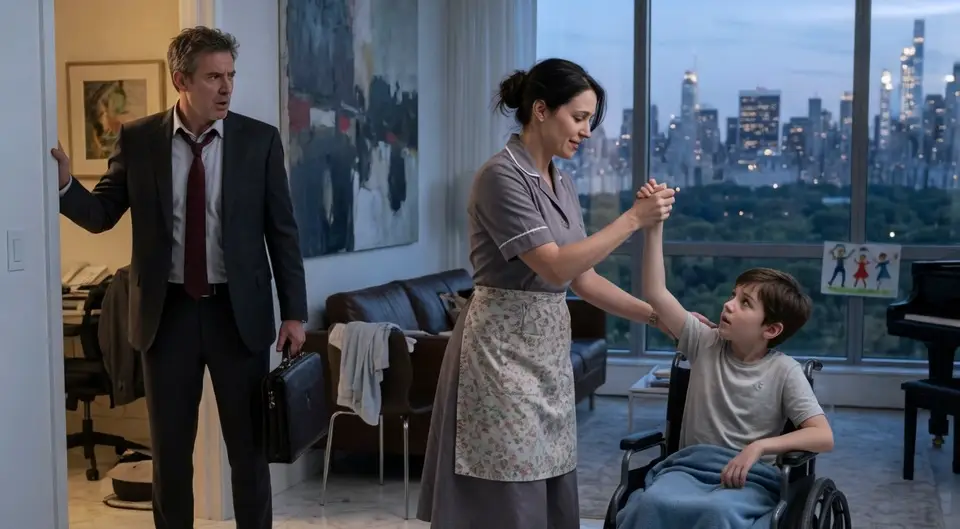
It was not an ugly home. Visitors always said it was stunning.
No one ever said it felt alive.
For three years, Daniel had kept it that way without meaning to. After the crash, after Amelia, after the hospital rooms and surgeons and stunned relatives whispering in corners, he had built a life around control. Nurses came at scheduled hours. Therapists documented progress that never came. Meals arrived on trays and left nearly untouched. The staff moved carefully through the apartment, not because Daniel was cruel, but because grief had become the household’s weather. Everyone learned to breathe around it.
Owen Mercer was nine years old and had not spoken since the night his mother died.
The doctors had different words for it, and Daniel had paid enough of them to fill an entire shelf with reports. Traumatic withdrawal. Dissociation. Neurological complications. Partial paralysis below the waist. Severe emotional shutdown. Each diagnosis came printed on thick paper, surrounded by cautious language and careful recommendations. Daniel read every line. He underlined. He made calls. He flew in specialists. He funded trials before the trials had names.
His son remained in the same wheelchair, beside the same wall of glass, staring out at the same stretch of water with eyes that seemed to look through everything.
On the morning it began, Daniel was supposed to be downtown presenting quarterly numbers to a room full of board members. The meeting fell apart before sunrise because a major investor’s plane had been grounded in Toronto. Daniel’s assistant offered to fill the empty hours with calls, but Daniel declined. He had no particular reason to go home. He only disliked blank space on his calendar.
The private elevator opened directly into his foyer at 9:17 a.m.
At first, he thought the sound was coming from another apartment.
It drifted through the long hall in a thin, wavering line, almost too soft to identify. Not the apartment’s built-in sound system. Not one of Owen’s prescribed audio exercises. This music had a flaw in it, a small human crackle, as if it were playing from a phone speaker tucked somewhere in the living room.
Daniel stopped with his briefcase still in his hand.
Then he heard movement.
Not footsteps exactly. Something lighter. A brushing turn, a slow slide across the floor, the faint whisper of fabric moving through air. He walked toward it carefully, with the irritation of a man entering a room where a rule had been broken and the unease of a man who already knew the rule would not matter.
Maya Duarte was in the middle of his living room.
She had worked in the apartment for just under two months, hired through the building’s private staffing agency after the previous housekeeper retired. Daniel knew very little about her beyond the basics. Early thirties. Quiet. Reliable. Brazilian mother, American paperwork, excellent references. She cleaned without needing to be seen, which Daniel appreciated because there were already too many people in his home doing things that had not helped his son.
Now she was barefoot on the marble floor, turning in a slow circle with one hand lifted.
Owen’s hand rested in hers.
Maya was not pulling him from the chair or forcing his body into some reckless imitation of movement. She was guiding only his arm, lifting it gently, following the rhythm as if his loose fingers carried some secret authority. Her own steps were small and unshowy. No performance, no grand gesture. Just a woman moving to a quiet waltz in the sun.
Daniel’s first instinct was anger.
Then he looked at Owen.
His son’s head was tilted. His eyes, which so often drifted away from faces, were fixed on Maya. They followed her hand as she turned. They followed the sweep of her shoulder, the soft swing of the hem of her work dress, the pattern of light shifting across the room. His gaze did not empty out. It did not slide past her toward the window.
Owen was watching.
Daniel’s hand tightened around the handle of his briefcase until his fingers hurt.
For more than a year, no one had been able to hold Owen’s attention for longer than a few seconds. Therapists had tried puppets, screens, touch boards, lights, textured objects, trained voices, recorded maternal tones. Daniel had watched his son endure all of it like a child trapped behind thick glass.
But here he was, looking at the housekeeper as if some small part of him had leaned toward the sound.
Maya completed one final turn. The song thinned, crackled, and ended. She lowered Owen’s arm as carefully as she had raised it, letting his hand come to rest in his lap. Only then did she look across the room and see Daniel.
She did not jump. She did not apologize.
For a moment, neither of them moved. The sunlight lay between them in pale bands, and Owen sat inside it, his face calm and tired in a way Daniel had almost forgotten children could look.
Maya gave Daniel a small nod, not guilty, not proud. Then she picked up her phone from the side table, slipped it into her apron pocket, and reached for the cleaning cloth she had left folded beside a vase.
Daniel tried to speak. Nothing came.
Maya returned to wiping the table, humming under her breath now, the same melody stripped of its speaker’s tinny echo. She worked as if the apartment had not just opened a door Daniel had spent three years beating his fists against.
It took him several minutes to cross the room.
Owen’s hands rested loosely in his lap. Daniel stood over him, searching his face for the retreat he knew so well. Usually, after a therapy session or any unexpected noise, Owen’s body seemed to fold inward without moving at all. His eyes would dull. His mouth would settle into that flat, unreachable line…
To read the rest of the story – CLICK the NEXT button 👇👇👇