


The wolf came in before the woman did. For half a second, the people inside the Cinder Creek Community Hall did not understand what they were seeing. They had been laughing over paper cups of punch and cheap wine, standing under blue-and-gold streamers someone had taped too low across the ceiling. Then the front door opened, the desert wind slipped in, and an animal the size of a shadow crossed the threshold.
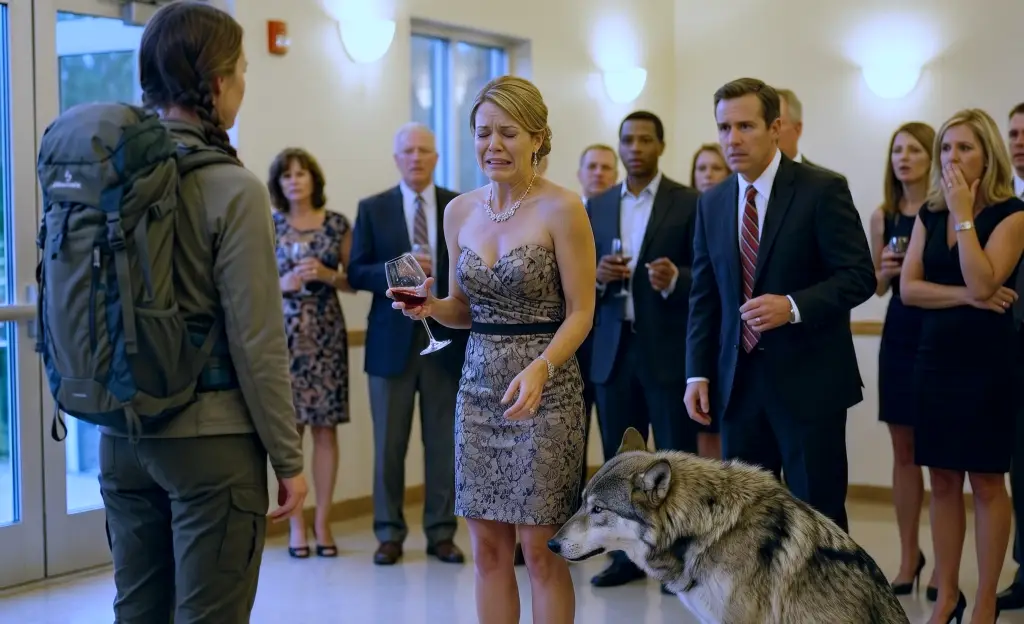
He was gray through the shoulders, pale along the chest, with amber eyes that moved across the room without hurry. Not wild in the way people imagined wildness, all teeth and lunging panic. He was controlled. Watchful. He entered like he had already measured every exit.
Behind him came Talia Yazzie.
At first, no one said her name. The hall reacted before memory did. A chair leg shrieked against the linoleum. Someone stumbled backward into the refreshment table. A glass hit the floor and burst, bleeding red wine into the grout lines.
Talia stood in the doorway in dusty field pants, boots scuffed white from dry clay, her black hair braided down her back. A weathered leather satchel hung across her chest, the strap darkened where her hand had worried it for years. She looked nothing like the girl most of them remembered, and still, in some cruel way, exactly like her.
Bree Parrish gripped her husband’s sleeve hard enough to wrinkle it. Eli Mercer, standing beside the little podium with a folded speech in his hand, went pale around the mouth. Mr. Paul Parrish, retired biology teacher and father to Bree, set down his cup without taking his eyes off Talia.
Outside the tall windows, the western sky burned copper over the high desert. Cinder Creek sat far enough from real towns that people measured emergencies in miles and prayers. The wolf seemed to know it. His gaze drifted from face to face, not threatening, simply taking inventory.
Talia laid two fingers against the thick fur at his neck.
“Easy, Rook,” she said.
Her voice was low. Not soft. Low.
The wolf stayed at her left leg.
No one laughed now.
Ten years earlier, they had laughed at everything she did.
They had laughed when she spent recess crouched beside anthills instead of playing kickball. They had laughed when she brought feathers, owl pellets, and half-rotten seed pods to science class, arranging them in careful rows like evidence from a world only she knew how to read. They had laughed when she corrected a teacher about the way a frightened dog held its tail.
Talia had never understood why animals made more sense to her than people. Animals did not say one thing and mean another. A crow’s anger sounded like anger. A dog’s fear showed in the whites of its eyes. A horse’s distrust lived in the feet, in the breath, in the tiny shift before a kick.
People smiled while sharpening themselves.
Her mother, Mara Yazzie, used to say Talia had been born listening sideways. “You hear what the rest of us miss,” she would murmur while brushing Talia’s hair at night. “That’s a gift. Don’t let anybody make it ugly.”
Mara cleaned the floors at Cinder Creek High after everyone went home. She pushed a mop past trophy cases full of white boys holding basketballs and white girls wearing crowns, past classroom doors where teachers smiled politely at her and forgot her name. Talia sometimes waited for her in the hallway, reading library books under the buzzing fluorescent lights while her mother scrubbed up other people’s footprints.
They lived in a single-wide trailer on the edge of town, where the last paved road turned to dirt and the desert came close enough to tap against the windows at night. In summer, heat pressed through the thin walls. In winter, wind found every seam. Mara made soup from almost nothing and sang while she cooked, not because she was happy every day, but because she refused to give the silence everything.
Cinder Creek had two histories. One was printed on plaques downtown, full of ranchers, founders, and brave families who “settled” the valley. The other lived in women like Mara and Grandmother Elsie, in stories told quietly at kitchen tables, in the old names for washes and ridgelines no map bothered to keep.
Talia learned early which history was allowed in school.
She also learned what children do with permission they do not know they have been given.
At eight, she found a sparrow stunned beneath a classroom window. She cupped it in both hands and sat under the mesquite tree, whispering nonsense until its breathing slowed. Bree Parrish knelt beside her then, still her best friend in those days, eyes wide with wonder.
“Can you fix it?” Bree asked.
“Maybe,” Talia said. “We have to keep it warm.”
For one afternoon, they were a team. Bree brought tissues from the bathroom. Talia found a shoebox. Together they watched the bird come back into itself, blink, and finally flutter into the low branches.
The next week, Mr. Parrish held up Talia’s migration chart in biology club and praised it for being “real field observation.” He meant kindness. Talia knew he meant kindness.
Bree heard something else.
After that, small things shifted. Bree stopped saving Talia a seat. She rolled her eyes when Talia answered questions. She told the other girls Talia thought she was better than everyone because she knew the names of birds.
By middle school, the cruelty had a rhythm. Somebody barked when Talia walked past. Somebody left a dead mouse in her backpack. Someone wrote WILD GIRL in permanent marker across her locker. When Talia washed it off, the stain ghosted there for months.
Eli Mercer had been one of the loud ones. Broad-shouldered even at fifteen, son of a rancher, quarterback by inheritance before he had thrown his first decent pass. His father’s opinions came out of his mouth in younger, meaner versions.
Bree knew where to hurt her because Bree had once been trusted.
Then came the storage closet.
Talia was a sophomore then, still trying to pretend she could endure until graduation. Someone told her Mr. Parrish needed help moving lab supplies. She stepped into the narrow closet behind the biology room, and the door slammed. The lock clicked.
At first, she did not scream. Pride held her still for almost a minute. Then the dark began to breathe around her. The shelves smelled like bleach, dust, old dissection trays, and mouse droppings. She pounded the door until her palms burned.
Outside, she heard laughter.
Not everyone laughed. That was one of the things memory kept returning to, even years later. Some voices went quiet. Someone whispered, “Let her out.” Someone else said, “Don’t be such a baby.”
Bree said nothing.
Two hours later, Mara found her because she had come early for her cleaning shift and heard a sound that was no longer quite a voice. Talia came out shaking so violently her teeth clicked together. Her mother wrapped her in both arms and did not scold, did not ask for names, did not tell her to be strong.
She only kept saying, “I’ve got you. I’ve got you.”
A month after that, Talia left Cinder Creek.
At first, everyone said she had gone to stay with relatives in Silver Junction. Then they stopped saying anything. Life in town healed itself around her absence. The locker was assigned to someone else. The closet kept holding supplies. Mara kept cleaning the floors.
Talia tried to build a life where nobody knew her. She stayed with a cousin who was kind but busy, then an aunt who made it clear that charity had an expiration date. She finished school online in pieces, moving from couch to couch, doing odd jobs, keeping to herself.
The letter came when she was eighteen.
Grandmother Elsie had written it by hand. Three sentences on cream paper.
Your mother is gone.
She waited as long as she could.
Come home when you are able.
Talia read the words in the laundry room of her aunt’s apartment building. A dryer thumped unevenly behind her, metal buttons striking the drum. She read the letter once, twice, then folded it so carefully the crease cut across her thumb.
She did not go home.
That night, she took the little cash she had, packed a bag, and bought a bus ticket north. She got off before the end of the line and walked until buildings gave way to ponderosa pine, red dirt, and cold sky. Black Pine National Forest became the place where she stopped answering to anyone.
She did not think of it as survival at first. She thought of it as refusal.
Refusal to return. Refusal to forgive. Refusal to be seen by people who had looked at her and decided she was something lesser, stranger, easier to break.
Grandmother Elsie found her eventually because grandmothers know roads that maps do not. She came once a month with flour, batteries, canned peaches, socks, and silence. She never demanded Talia come back. She only sat beside the fire until Talia was ready to speak.
One dawn, almost a year after Mara died, Talia stood on the lip of a canyon with the cold moving through her jacket. She had not slept. She had not eaten since the day before. She was tired in a way that had nothing to do with her body.
Then she heard the crying.
It was thin, rough, and furious. Not human. She followed it through juniper and scrub oak until she found the young wolf caught in a steel trap, his hind leg mangled, the dirt around him torn up from hours of fighting.
He bared his teeth when he saw her. His body was failing, but his eyes were all fire.
Talia crouched beyond the reach of his jaws and spoke to him until her throat went dry. She told him every harmless thing she could think of. Her mother’s soup. The broken heater in the trailer. The sparrow under the mesquite tree. Bree’s laugh before it became a weapon.
The wolf listened because he had no choice.
It took three hours to free him. He bit through the sleeve of her jacket and nearly took skin with it. She cried once, from pain and fear, then kept working. By the time the trap opened, both of them were trembling.
She could have left him there.
Instead, she dragged him back to camp on a tarp, set the leg as best she could with branches and strips of cloth, and spent the next four months feeding him before she fed herself.
She named him Rook because he was black along the muzzle then, clever-eyed and suspicious, a creature that watched before he moved.
When he healed enough to leave, he didn’t.
That was the first thing in years that Talia could not explain with bitterness.
Now, standing in the Cinder Creek Community Hall with Rook pressed against her leg and every old ghost staring back at her, Talia wondered whether coming here had been courage or stupidity.
Three days earlier, she had asked Grandmother Elsie the same thing.
Her truck had rattled up the long dirt drive to Elsie’s adobe house just before sundown. Rook rode in the bed, head low, ears alert, unhappy with the smell of people and old roads. Talia had not driven that way in a decade, but her hands knew the turns before her mind admitted recognition.
Elsie came out before Talia knocked. She was smaller than Talia remembered and somehow stronger, her white hair twisted into a knot, her face lined by sun, grief, and patience.
For a moment, neither of them moved. Then Elsie opened her arms.
Talia stepped into them with the awkwardness of someone who had forgotten how to be held.
“You came,” Elsie said against her shoulder.
“I almost didn’t.”
“I know.”
They sat on the porch after dark with coffee strong enough to bite. The invitation lay between them on the little wooden table.
Cinder Creek High Class of 2016 — Ten Years Later
Below that, in Eli Mercer’s careful handwriting:
Please come. I owe you something I should’ve given you a long time ago.
Talia stared at the words until they blurred.
“He wants a performance,” she said. “A clean little apology. Everybody cries, everybody feels better, and I’m supposed to bless them so they can go home lighter.”
“Maybe.”
Talia looked at her grandmother.
Elsie lifted one shoulder. “Or maybe he means it. People do change sometimes. Not as often as they claim, but sometimes.”
“They locked me in a closet.”
“I remember.”
“They called Mom names when she cleaned their school.”
“I remember that too.”
Talia’s hand went to the satchel hanging from the back of her chair. Inside it was the clay urn she had carried from one camp, cabin, truck, and rented room to another for eight years. Mara’s ashes rested in deerskin, wrapped and rewrapped so often Talia could tie the knots in darkness.
Elsie saw the movement. Her face softened in a way Talia could barely stand.
“She wanted the forest,” Elsie said.
“I know.”
“Near the place you found him.”
Talia looked toward Rook, who lay under the porch steps, eyes glowing faintly in the dark.
“I tried,” she said. “Twice. I couldn’t open it.”
Elsie did not reach for her. She knew better than to touch grief too quickly.
“Your mother’s last thought of you was love,” she said. “Not blame.”
Talia’s mouth tightened.
“She left me.”
“She ran out of strength.”
“That’s a prettier way to say it.”
“It’s the true way.”
The desert cooled around them. Somewhere beyond the wash, a night bird called once and stopped. Talia wanted to argue, but she had been arguing with the dead for years and winning nothing.
Elsie tapped the invitation with one bent finger.
“Don’t go for them,” she said. “Go because a door is still open inside you, and it’s letting in weather. Close it, or walk through it, but stop standing in the draft.”
The next morning, Talia drove to the cemetery.
Mara Yazzie’s marker was plain rose-colored stone, because that was what Elsie could afford. Dust had gathered in the carved letters. Talia brushed it away with her sleeve and felt foolish for doing so, as if cleanliness mattered to the dead.
Rook sat beside her in the brittle grass.
“I’m angry,” Talia told the grave.
The words surprised her. She had said them in her head thousands of times. Speaking them aloud made them smaller and crueler.
“I’m angry you left me here. I’m angry you thought I could survive without you. I’m angry that I did survive, because now everyone thinks that means it was fine.”
Rook leaned his shoulder against hers. His fur was warm from the morning sun.
Talia wiped her nose with the back of her hand and gave a humorless breath. “I’m also angry I wasn’t with you. I should’ve come back. I should’ve answered Grandmother’s calls. I should’ve known.”
The cemetery gave nothing back. Only wind. Only the dry rattle of weeds against stone.
“I’m going tonight,” she said. “Not to forgive them. Don’t worry. I’m not that generous.”
Rook’s ears twitched.
“I just need them to see me. I need to see me, maybe. I don’t know.”
She stayed until the sun rose high enough to heat the back of her neck. Before leaving, she laid her palm flat on the stone.
“I brought you with me,” she whispered. “I still don’t know how to let you go.”
That evening, she did not dress for reunion photographs. She wore the clothes she trusted: field pants, a rust-colored shirt, boots that knew rock and mud and blood. She braided her hair tightly and buckled the satchel across her chest.
Grandmother Elsie watched from the doorway.
“You look like yourself,” she said.
“That’s all I have.”
“That’s plenty.”
Rook jumped into the passenger seat before Talia could call him. He sat tall, filling the cab with fur and heat and the faint smell of pine smoke.
“You don’t have to come in,” Talia told him.
He looked at her, unimpressed.
“Fine,” she said, starting the truck. “But no biting unless I ask.”
His tail thumped once against the seat.
The community hall looked smaller than memory had made it. Someone had strung lights around the doorway. The parking lot was full of trucks, SUVs, and the kinds of sedans people bought when they wanted the world to know they were doing better than their parents.
Talia sat with both hands on the steering wheel after she parked.
Through the window, she could see silhouettes moving inside. Adults with the same faces they had worn as children, softened or hardened by time. She wondered how many of them remembered. She wondered how many had turned what they did to her into “kids being kids,” that soft grave where accountability went to die.
Rook nudged her elbow.
“I know,” she said.
She took the satchel from the floor, stepped out of the truck, and walked toward the door with the wolf at her side.
Inside, the party had been going on for nearly an hour. People had already settled into their old patterns. Eli Mercer stood near the podium with his speech folded in one hand. Bree Parrish held court by the punch bowl, her blond hair cut sleek at her jaw, her cream dress too elegant for the room. Her husband, Caleb, stood beside her with the bewildered patience of a man used to smoothing over edges he had not made.
Mr. Parrish lingered near the wall, not quite part of any conversation. Marisol Vega, who had once shared library books with Talia before fear taught her silence, stood near a display of old photographs and kept touching her necklace.
Then the door opened.
Now Talia stood in the place that had helped make her and watched the past recognize her one face at a time.
A woman near the refreshment table gave a brittle laugh. Jenna Pike. Talia remembered the lice rumor, the fake gagging noises, the way Jenna had once sprayed perfume into the air after Talia passed.
“What is that supposed to be?” Jenna asked, pointing at Rook. “Please tell me it’s a dog.”
Talia did not look away from her.
“Gray wolf,” she said. “His name is Rook.”
Jenna’s smile slipped.
A murmur moved through the hall. Not loud. Worse than loud. The old little swarm of whispers.
Eli stepped down from the podium, throat working.
“Talia,” he said. “You came.”
“You asked.”
“I did.” His hands tightened around the paper. “I’m grateful.”
“I didn’t come for gratitude.”
Bree made a sound under her breath. Talia turned toward it, and for one brief second they were girls again: one holding a wounded bird, the other holding tissues, both believing kindness was simple.
Bree looked away first.
Eli drew in a breath. “Then I won’t waste your time.”
He walked to the center of the hall. The paper in his hand shook, and for the first time Talia noticed he was not the boy from her nightmares anymore. He was taller, broader, but diminished somehow, as if grief had scraped away the shine.
“My father died in January,” he said.
No one moved. Even the music seemed suddenly inappropriate, still playing low from a speaker near the wall.
“He left me a letter. Most of it was about things he should’ve said while he was alive.” Eli glanced toward Talia and then down again. “Some of it was about her.”
Rook shifted his weight. Talia’s fingers brushed his ear, and he settled.
Eli unfolded the letter.
“I’m not going to read all of it,” he said. “Some of it belongs to my family. Some of it doesn’t deserve privacy.”
He swallowed.
“He wrote that he taught me to despise what I didn’t understand. That he made racism sound like common sense. That every time I repeated one of his jokes, every time I called somebody lazy or dirty or less than us, I was speaking in his voice.”
Bree stared at the floor. Jenna’s mouth hardened. A man near the door folded his arms as if preparing to be offended.
Eli kept going.
“He wrote that Mara Yazzie was a good woman. He wrote that she deserved respect from this town and didn’t get it. He wrote that Talia had something rare in her, and that instead of protecting it, people like him taught kids like me to crush it.”
Talia felt the name of her mother move through the room like a hand across a bruise.
Eli looked up then. His eyes were wet, but he did not hide behind them.
“I hurt you,” he said to Talia. “Not by accident. Not because I was young and confused. I knew you were scared. I knew you were alone. I liked having power over someone. That’s the truth.”
No one whispered now.
“I helped lock you in that closet,” he said. “I ruined your science project. I called you names I’m ashamed to remember. I laughed when other people hurt you because laughing kept me safe and made me feel strong.”
His voice thinned, but he forced the rest out.
“I am sorry. I don’t expect that to fix anything. I don’t expect forgiveness. I just needed to say it in front of the people who watched it happen.”
For a moment, the hall held only breath and the hum of old fluorescent lights.
Then Bree Parrish laughed.
It was not amusement. It was panic wearing a mean little mask.
“Oh, come on,” she said. “Are we really doing this? We were teenagers. Everybody was awful in high school.”
Talia turned slowly.
Bree’s husband touched her arm. “Bree.”
“No.” Bree pulled free. Her cheeks had gone pink, and her eyes were bright in a way that made Talia think of fever. “I’m not going to stand here and pretend we committed some crime because Talia didn’t fit in. She was always strange. Everyone knew it.”
Rook’s lips lifted just enough to show white.
“Down,” Talia murmured.
He obeyed, though his eyes stayed on Bree.
Talia walked three steps into the room. People moved aside for her. Not out of respect, she knew. Not yet. Out of fear.
“That’s what you’re calling it?” Talia asked. “Not fitting in?”
Bree crossed her arms, but her fingers trembled against her elbows.
“You want us all to crawl?” she snapped. “Is that why you brought the wolf?”
“No,” Talia said. “I brought him because he knows what humans are capable of.”
The words landed harder than she meant them to. Or maybe exactly as hard.
Eli lowered the letter. “Bree, stop.”
But Bree had waited ten years to defend the version of herself she could live with. She was not ready to let it die.
“She left,” Bree said, looking around as if searching for allies. “She disappeared. We didn’t make her do that.”
Talia’s hand closed around the satchel strap.
“My mother died eight years ago,” she said.
The sentence did not sound dramatic. It sounded almost ordinary. That made it worse.
Mr. Parrish flinched.
Talia kept her eyes on Bree. “She took her own life after years of watching this town teach me I was something to be ashamed of. I wasn’t here when it happened because I had already run as far as I could get from all of you.”
Bree’s face lost its color so quickly Caleb reached for her again.
“I didn’t know,” Bree whispered.
“No,” Talia said. “You didn’t.”
There was no anger in her voice now. Anger would have been easier.
“You didn’t know because knowing would’ve required you to wonder what happened after the joke was over. You didn’t wonder.”
Mr. Parrish stepped forward, his face gray with old guilt.
“Talia,” he said, and stopped.
He looked suddenly like a man standing in front of a locked door he had walked past too many times.
“I should have protected you,” he said.
Talia looked at her former teacher. Of everyone in the room, he was the hardest to hate cleanly. He had seen her. He had praised her work. He had once given her a field guide with his own notes in the margins.
And he had not done enough.
“You tried,” she said.
His mouth twisted.
“I tried quietly,” he replied. “Quietly wasn’t enough.”
No one knew what to do with that.
The reunion did not recover. Music still played for another minute before someone had the sense to turn it off. Without it, the hall became too honest. The ice machine knocked once in the kitchen. A plastic cup rolled beneath a folding table. Outside, the desert wind worried at the door…
To read the rest of the story – CLICK the NEXT button 👇👇👇