


By eight-thirty that morning, every bench in Courtroom 4B had been filled. Reporters lined the back wall with notebooks balanced against their palms. A sketch artist sat near the aisle, sharpening pencils with careful, nervous movements. Even the bailiff, who had worked long enough in Ridgeway County Criminal Court to look bored through almost anything, kept glancing at the side door.
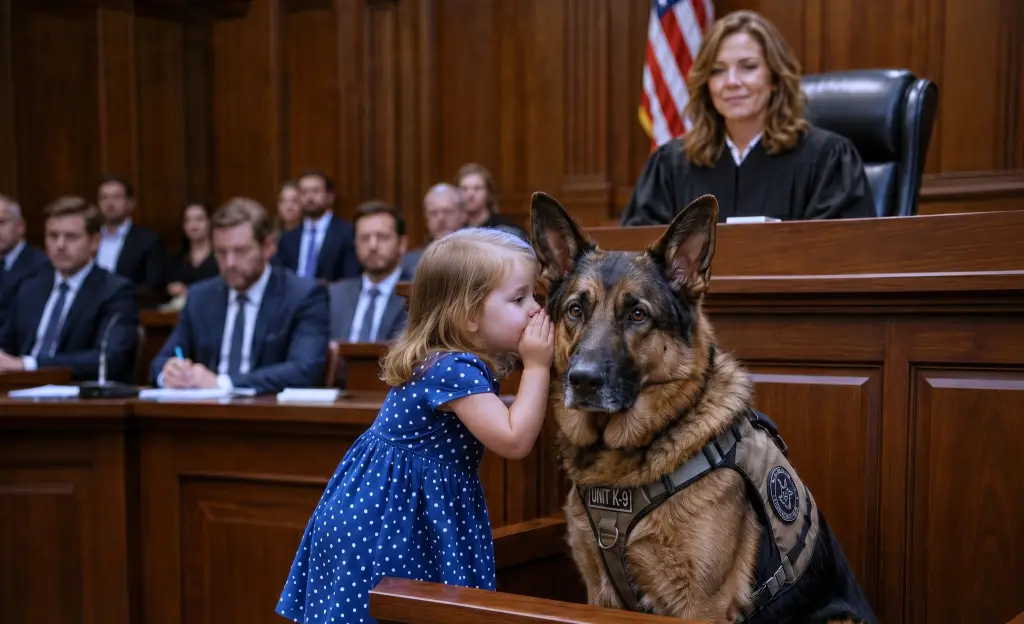
The case had already been whispered about for weeks.
A young mother, Marissa Lane, had been found barely alive on her kitchen floor. Her boyfriend at the time, Ryan Decker, sat at the defense table in a dark suit that looked too new for him, his hands folded so tightly his knuckles had gone pale. His attorney, Julian Vale, sat beside him with the stillness of a man used to owning whatever room he entered.
But the real weight of the morning rested on someone who was not yet in the courtroom.
Nora Lane was three years old.
She had been in the apartment the night her mother was attacked. She had been found curled beneath a blanket near the hallway closet, awake, dry-eyed, and silent. Since that night, she had not spoken to police, doctors, social workers, or even the foster mother who tucked her into bed.
Judge Evelyn Warren had reviewed the request for Nora’s testimony more than once. She had held hearings. She had spoken privately with specialists. She had read every objection from the defense. And still, when she looked down at the empty witness chair, she felt the unease of a decision that could not be made clean.
Children that young did not understand courts.
But sometimes they remembered rooms.
The side door opened with a soft click.
Nora appeared first, small enough that the door seemed to swallow her shadow. Her foster mother, Rina Patel, walked beside her, bent slightly to keep hold of Nora’s hand. The child wore a yellow dress with a crooked hem and white shoes that had already scuffed at the toes. A stuffed rabbit hung from her elbow, its cotton ear rubbed nearly flat.
Behind her came Atlas.
The German Shepherd moved at an easy, practiced pace, his navy vest snug across his shoulders. He was large enough to make several people straighten in their seats, but he carried himself with a quiet steadiness that changed the shape of the room. His handler stayed near the wall, but Atlas did not need direction. He crossed to the rug placed beside the witness chair and sat there, watching Nora as if the courthouse had been built for that one purpose.
Nora stopped.
Her eyes moved over the strangers, the railings, the flags, the judge’s bench. Her hand tightened around Rina’s fingers. For a few seconds she seemed to shrink into herself, chin lowering, shoulders lifting toward her ears.
Then she saw the dog.
Rina whispered something, but Nora had already let go.
She walked toward Atlas in short, careful steps. No one told her to. No one dared interrupt. When she reached him, she did not touch his head right away. She stood in front of him, studying his face, as if deciding whether he belonged to the kind of world that hurt people or the kind that kept them safe.
Atlas lowered his chin.
Nora dropped to her knees and pressed her forehead into the thick fur at his neck.
The court clerk’s fingers hovered above the keys. A reporter lowered his pen. Judge Warren leaned back slightly, not to distance herself, but to keep from frightening the child with too much attention.
Claire Morgan, the assistant district attorney, watched from the prosecution table with a folder open in front of her and nothing useful in her hands. She had prepared questions for weeks. Gentle ones. Simple ones. Questions reviewed by experts and rewritten so many times they no longer sounded like language.
Now none of them mattered.
Nora’s lips moved against Atlas’s ear.
At first, Claire thought it was only breath. A child hiding words in fur. But then Nora pulled back and looked across the courtroom, not at the judge or the jury, but toward the defense table.
Her face changed.
It was not panic. Panic would have been easier to understand. This was recognition, small and terrible, working its way through a child who had not yet learned how to protect adults from what she knew.
Nora lifted one hand, then let it fall.
“He hurt Mommy,” she said.
The words were not loud. They did not need to be.
Julian Vale stood so fast his chair scraped backward.
“Objection.”
Judge Warren’s gavel came down once. “The jury will disregard any statement not given in response to a question.”
But the instruction sat awkwardly in the air. Jurors had already heard the child’s voice. They had seen where she looked. They had seen Atlas remain beside her, motionless except for the slow rise and fall of his breathing.
Nora climbed into the witness chair only after Atlas moved close enough for her fingers to reach his fur. She sat sideways, legs tucked beneath her, one hand tangled in his coat.
Claire approached carefully and stopped several feet away before lowering herself to one knee.
“Hi, Nora,” she said. “My name is Claire. We met once in the little room with the crayons. Do you remember?”
Nora did not answer. She looked down at Atlas’s collar tag and rubbed it between her thumb and finger.
“That’s okay,” Claire said. “You don’t have to look at me.”
Nora leaned toward Atlas and whispered into his ear again.
Claire waited.
Waiting was the hardest part. Adults hated empty spaces. They rushed to fill them with questions, explanations, promises. But Dr. Samuel Kim, Nora’s trauma specialist, had told Claire the same thing three separate times: Do not chase her. Let her find the door herself.
So Claire stayed where she was.
After a while, Nora said, “He knows.”
Claire kept her voice low. “Atlas knows?”
Nora nodded, still not looking at anyone else. “I told him.”
“What did you tell him?”
Nora’s fingers tightened in the dog’s fur. Her mouth opened, closed, then opened again.
“There was loud,” she said.
Someone in the gallery shifted. Judge Warren raised one hand, and the movement stopped.
“Was the loud sound in your house?” Claire asked.
Nora nodded.
“Can you tell Atlas about it?”
The child turned her face into Atlas’s neck. “Mama cried. The table made a crack.”
Claire felt the muscles in her throat tighten. The broken kitchen table had been in the crime scene photographs. Nora had not been shown those photographs. No one in the foster home had discussed them within earshot. Claire knew that because she had asked everyone twice.
“What happened after the table cracked?” Claire asked.
Nora did not answer in words. She reached into the tiny pocket of her dress and pulled out a folded paper square.
Rina made a faint sound from the gallery, surprised. She had not known the child had brought it.
Nora held the paper out toward Atlas first, as though asking permission. Then she passed it to Claire.
It was a crayon drawing.
The lines were uneven, the colors pressed too hard into the paper. A little blue figure crouched beneath a table. A bigger figure stood near it with black hair and red marks around the hands. Beside the table was a shape that might have been a lamp or a chair, broken into pieces.
Claire did not hold it up immediately. She looked at Nora first.
“Is this your kitchen?”
Nora touched Atlas’s ear. “It was.”
“And is this you?”
A nod.
Claire pointed gently to the larger figure. “Who is that?”
Nora glanced toward the defense table again. Ryan Decker stared at the floor. Julian Vale watched the child with a tight expression that almost passed for pity.
“The angry man,” Nora whispered.
Julian rose. “Your Honor, this is exactly the problem. The child is drawing monsters and assigning meaning under the pressure of a courtroom.”
Claire stood, still holding the drawing. “No one prompted this drawing. No adult asked her to bring it. The physical details match the scene.”
“Counselors,” Judge Warren said. “Approach.”
The bench conference was brief and tense. When the attorneys returned to their tables, Judge Warren allowed Claire to mark the drawing for identification, with instructions to the jury that it was to be weighed carefully and not treated as a photograph or adult testimony.
That instruction was legally necessary.
It was also impossible to place back over what had already been exposed.
Claire asked only a few more questions that morning. Nora gave answers in fragments. The lamp broke. Mommy fell. Nora hid. She was quiet because loud made angry people louder. Each answer came only after she touched Atlas or spoke first into his ear.
When Julian Vale’s turn came, he buttoned his jacket before approaching. His face had softened into the expression lawyers used when they wanted a jury to see patience.
“Nora,” he said, bending just enough to appear kind, “do you know what it means to tell the truth?”
Nora looked at Atlas.
“You can answer,” Julian said. “It’s only a question.”
Claire rose. “She’s allowed time.”
Judge Warren nodded. “Give her room, Mr. Vale.”
Julian smiled, but the smile did not reach his eyes. “Of course.”
Nora finally said, “Truth is what happened.”
A few jurors looked down, hiding their reactions.
Julian clasped his hands. “And stories are things we make up, right? Like when you draw pictures or talk to your dog?”
Nora frowned.
“Sometimes children imagine things,” he continued. “That doesn’t mean they’re bad. It just means they’re little.”
Nora’s lower lip trembled. Atlas shifted closer to the chair, pressing his shoulder against her knee.
Julian tried again. “Atlas wasn’t in your apartment that night, was he?”
“No.”
“So he couldn’t see anything.”
Nora stroked the dog’s head from between his ears down to his neck, slowly, the way Rina had taught her when nightmares came.
“He didn’t see,” she said. “I did.”
Julian’s smile thinned.
“And I told him,” Nora added. “He listens right.”
Claire looked at the jury. None of them were writing now.
Julian asked three more questions. Each one tried to loosen the child’s memory from the facts. Each one made her retreat into Atlas, but not disappear. When Judge Warren finally called a recess, Nora slid down from the chair and wrapped both arms around the dog’s neck.
In the hallway outside the courtroom, Claire leaned against the wall and closed her eyes for only a second. Her hands were steady. She made sure of that before opening them.
Dr. Samuel Kim stood nearby with his arms folded, watching Rina kneel beside Nora.
“She gave more than I expected,” Claire said quietly.
“She gave what she could,” Dr. Kim replied. “There’s a difference.”
Claire looked through the small glass pane in the courtroom door. Atlas was lying on the carpet, Nora curled against his side as if he were a piece of ground that could not move beneath her.
“I’m afraid to push too hard,” Claire said.
“Then don’t push,” he answered. “Follow.”
When court resumed, Claire did exactly that.
She did not ask Nora to perform. She did not ask her to point. She placed a box of crayons on the witness stand, opened a blank page, and asked, “Would you like to show Atlas where you were?”
Nora chose blue first.
She drew a small body beneath a table. Then red. Then black. The bigger figure came last, wider than the others, hands marked in frantic circles.
“What is the red?” Claire asked.
Nora stared at the page. “Mad.”
“Where was your mom?”
Nora drew a long shape on the floor.
The jury watched the crayon move.
“She didn’t get up,” Nora said.
Claire swallowed before asking the next question. “Did you stay under the table?”
Nora shook her head. “I crawled. I went where coats are.”
“The hallway closet?”
Nora nodded. “Blanket was there.”
That detail had been in one police report, one photograph, and nowhere else.
Julian objected again, arguing foundation, competency, contamination. Judge Warren allowed the line of questioning to continue, but her voice had grown more careful. She was not blind to the danger. A courtroom could harm a child even while trying to hear her.
Still, the child was speaking.
And everyone understood the difference.
When the day ended, Nora did not wave at anyone. She did not smile for the cameras waiting outside. She walked between Rina and Atlas with her stuffed rabbit dragging by one ear.
As she passed Claire, she stopped.
Claire crouched.
Nora leaned close, whispering so quietly that Claire almost missed it.
“Atlas knows where I hide now.”
Claire nodded. “Yes,” she said. “He knows.”
Nora looked toward the courtroom doors, then back at the dog.
“He can come tomorrow?”
Claire glanced at Judge Warren, who had paused beside the bench with her robe folded over one arm.
The judge’s face softened by a degree.
“Yes,” Claire said. “He can come tomorrow.”
Nora put her hand on Atlas’s head and walked out of the courtroom without looking back.