


The bottle had gone cold in Mara Ellis’s hand. She stood in the nursery room at Cypress Creek Wildlife Recovery Center, one knee pressed into a rubber mat, her waterproof boots damp to the ankle. Steam no longer rose from the nipple. The formula inside had separated into pale streaks against the plastic, untouched after twenty-two minutes of coaxing, warming, waiting, and trying again.
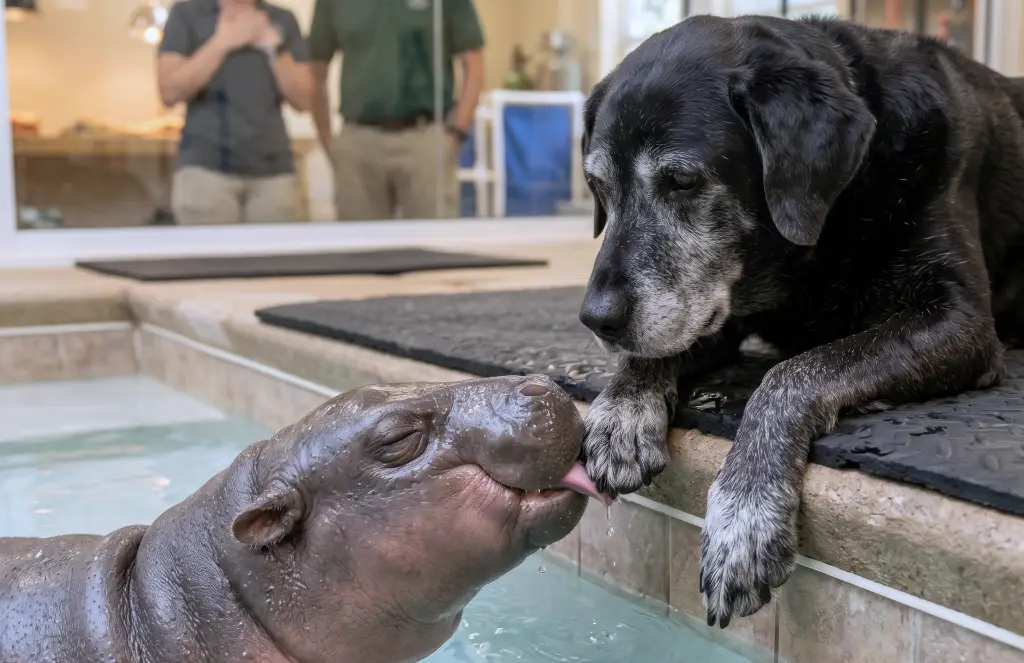
In the shallow pool beside her, a baby pygmy hippo floated with his chin tucked against his chest.
He was small enough that Mara could still lift him if she had to, though “small” meant something different with a hippo. His body was dense and slick, all soft folds and dark gray skin with a faint copper sheen under the heat lamps. His ears were rounded and delicate. His feet, too large for the rest of him, rested against the sloped tile as if even water had become too much to trust.
They had named him Ember because of that warm glint in his skin after they rinsed him clean.
Now he looked like something the world had already used up.
Dr. Nathan Keller stood just inside the doorway with his arms folded tightly across his chest. He had been a veterinarian for twenty-six years, long enough to know when hope had begun disguising itself as stubbornness. The nursery smelled of warm water, diluted disinfectant, wet towels, and the sour trace of infection that had clung to the calf since the night he arrived.
Mara lowered the bottle again and rested her wrist against her thigh. “He knows it’s there,” she said.
Nathan nodded once. Ember’s nostrils had widened when the nipple touched his mouth. His ears had twitched at the soft scrape of Mara shifting on the mat. There was nothing wrong with his ability to sense the room.
He simply would not take what might keep him alive.
Three days earlier, state animal welfare officers had brought Ember in from a shuttered roadside wildlife park two counties south. The place had been closed after neighbors reported a smell from the old concrete pools behind the ticket stand. By the time officers got there, Ember’s mother was dead in a narrow enclosure filmed with algae, and the calf was pressed against her side, blind, dehydrated, and too weak to call for her.
His eyes had been the worst of it. Infection had moved fast through tissue already damaged by neglect. The surgical team relieved the pressure and stopped the spread, but there was no saving his sight. Nathan had delivered that news without softening it, because people who worked with animals deserved the truth cleanly stated.
Blindness did not make survival impossible in human care.
Refusal did.
Mara touched two fingers to the calf’s shoulder. Ember flinched under her hand, but he did not move away. In some ways, that frightened Nathan more. A healthy calf would have shoved, squealed, tried to escape, tried to find its mother, tried to live out loud. Ember had retreated into a stillness so complete it felt less like calm than absence.
“How’s his temperature?” Nathan asked.
Mara glanced toward the digital monitor clipped above the tile. “Down again.”
Nathan stepped closer. The water was warm, the heat lamps were steady, and a thick towel had been folded under the calf’s chin so he did not slip beneath the surface if he weakened further. They had done everything correctly. Fluids, antibiotics, pain control, electrolyte support, careful handling, a dim room, no unnecessary voices.
Ember’s body had accepted treatment.
The rest of him had not.
Cal Reeves, the senior animal care tech, came in from the prep area carrying a fresh towel. He was a broad, quiet man who had a habit of humming under his breath when he was scared. He was not humming now.
“He didn’t swallow?” Cal asked.
Mara held up the bottle. “Not once.”
Cal looked at Nathan. “We can tube him.”
“We might have to,” Nathan said.
No one said what they all knew. Tube-feeding a fragile exotic calf could keep calories moving into him, but it would not make him want to live. Restraint would scare him. Scaring him would burn energy he did not have. Every intervention that forced his body forward risked pushing his mind farther away.
Mara stood carefully, her knees stiff from the floor. “Tessa wants everyone in the office.”
Nathan did not answer right away. He watched Ember’s nostrils open and close above the surface of the water. The calf’s ears trembled at some sound outside the room, perhaps a cart rolling down the hall or rain tapping the metal roof.
There was still somebody in there, listening.
The office in the main building was too small for grief. Five people gathered around a table crowded with medical charts, paper cups, and a half-eaten sleeve of crackers someone had opened at dawn. Rain streaked the window. Beyond it, the grounds of Cypress Creek blurred into gray-green marsh grass and low pine woods.
Tessa Vaughn, the operations director, had the morning labs spread in front of her. She had spent twelve years making impossible budgets work and impossible animals comfortable. She did not scare easily. That morning, she looked like she had aged overnight.
“Nathan,” she said, “we need to talk about where this is going.”
Mara stood near the filing cabinet, still holding the cold bottle because no one had taken it from her. Cal leaned against the wall with his hands in his pockets. No one sat down.
Tessa tapped the lab report once with the end of her pen. “His glucose is dropping. Kidney values are moving the wrong way. He’s losing ground every time we handle him. If he keeps refusing oral feeds, we’re not rehabilitating him. We’re postponing the decision.”
The word decision landed hard because everyone knew what lived behind it.
Nathan looked at the bottle in Mara’s hand. A pale line of formula clung to the inside where it had cooled. He thought of Ember tucked against his dead mother in that filthy pool, too young to understand absence but old enough to feel it. He thought of the calf’s ears turning toward every footstep, searching a world that never answered with the right sound.
“I’m not asking for weeks,” Nathan said. “Give me forty-eight hours.”
Tessa’s eyes narrowed. “For what?”
“I don’t know yet.”
“That’s not an answer I can put in a report.”
“No,” he said. “It isn’t.”
Mara looked up from the bottle. “You have something in mind.”
Nathan took a slow breath. He did have something in mind, but it was unformed and professionally inconvenient, the kind of idea that usually belonged in the space between exhaustion and bad judgment.
That morning, one of the county shelter volunteers had called about vaccines for a dog they had taken in after a flood response outside Branton. A black Labrador. Older. Medically stable, emotionally gone. The volunteer had described him almost apologetically, as if she were reporting a failure of kindness.
“He just lies there,” she had said. “He waits for a man who isn’t coming.”
The sentence had stayed with Nathan.
“I need to make a stop,” he said.
Mara stared at him. “Now?”
“Now.”
The county shelter sat behind the public works garage on a road that collected rainwater in long brown ditches. Nathan parked beside a row of animal control trucks and sat for a moment with the engine running. He knew the difference between instinct and sentiment. He had built a career on not confusing the two.
Still, he went inside.
Jodie Mercer met him at the front desk, her hair twisted into a loose knot and a leash looped twice around her wrist. She had the tired kindness of someone who had seen too many animals arrive after people had run out of excuses.
“You came about Scout,” she said.
“I came to look at him.”
Jodie did not ask why. She led him past the main kennels, where younger dogs barked and jumped and threw themselves against chain-link with all the faith in the world. At the end of the hall, through a second door, the noise faded. The recovery kennels were warmer and quieter. A washing machine thumped somewhere behind the wall.
Scout lay on a folded quilt in the last run.
He was a big black Lab with a white muzzle and a thick body that had once been powerful. A shaved patch ran along his ribs where stitches pulled a healing wound tight. His front paws were crossed neatly in front of him. When Nathan and Jodie stopped outside the gate, Scout lifted his eyes but not his head.
“That’s more than he does for most people,” Jodie murmured.
Nathan crouched.
“Hey, boy.”
Scout’s tail moved once. Not a wag, exactly. More like an old habit remembering itself.
Jodie hooked her fingers through the fencing. “He belonged to Henry Blake. Retired game warden. Lived alone out past Mill Road, near the low marsh. During that storm last month, Henry went out to secure a damaged gate. They think his heart gave out. Water was already coming up over the yard.”
Nathan kept his eyes on Scout.
“Neighbors heard barking around dawn,” Jodie continued. “Found Scout half in the water, half on the porch steps, still beside him. Hypothermic, cut open on some sheet metal, wouldn’t let anybody touch Henry. Not until he collapsed.”
Scout blinked slowly. His gaze had moved past Nathan to the hallway, as if he were listening for tires on gravel.
“He eats if I sit with him,” Jodie said. “Sometimes. He won’t play. Won’t join the yard groups. Every afternoon around four, he gets up and stands at the kennel door. That must’ve been when Henry’s truck used to come back.”
Nathan rested one hand against the gate. Scout’s nose shifted toward him, taking in the scent of disinfectant, rain, other animals, nursery formula. The dog did not growl. He did not brighten. He simply breathed and waited.
“How is he with other animals?” Nathan asked.
“Gentle. Before this, he helped Henry with injured birds, fawns, whatever people dropped at their place. Not trained like a service dog, but steady. That’s the word everybody uses for him.”
Steady.
Nathan thought of Ember in the warm pool, lost inside a body that had stopped asking for comfort because the only comfort he knew was gone. He looked at Scout, who had survived the water and the storm and the loss, then come out the other side unwilling to step any farther into his own life.
Two creatures, both alive on paper.
Jodie crouched beside him. “What are you thinking?”
Nathan did not answer immediately. A bad idea was still bad even when it came from compassion. A domestic dog and a pygmy hippo calf did not belong together. Disease risk, stress response, injury risk, unpredictable scent associations, institutional liability—every word in his training stood up and objected…
To read the rest of the story – CLICK the NEXT button 👇👇👇