


By noon, the covered arena at the Pine Wash County fairgrounds had turned into a tin oven. Heat collected under the metal roof and pressed down on the crowd until shirts stuck to backs and paper cups sweated through in people’s hands. The air carried the sour mix of diesel fumes, spilled beer, livestock, and the fine yellow dust that rose every time a boot shifted or a horse struck the ground.
No one paid much attention to the heat.
Every face in the bleachers was turned toward the far end of the arena, where a black mustang had turned a holding chute into a war zone.
They had named him Cinder, though nothing about him looked soft enough for a name. He was all angles and muscle, a thousand pounds of fear packed under a coat so dark it drank the light. Dust from the north Nevada basin had settled across his neck and shoulders in pale streaks, turning sweat into muddy tracks along his ribs. His nostrils stretched wide with each breath. His ears were buried flat against his skull.
When one of the handlers moved too close to the panels, Cinder fired both hind feet into the pipe fence.
The crash cracked across the arena and made half the crowd flinch.
Up in the announcer’s stand, the microphone popped before the man behind it found his voice again. “Well, folks, the range crew didn’t bring us a sleepy one this year. This black horse came in late from the Granite Range, and from what I hear, he’s already made a few strong opinions known.”
A little laughter moved through the stands, but it thinned out almost immediately. People liked watching a wild horse test a fence until the horse looked too afraid to be entertainment. Cinder wasn’t performing. He was trapped, and every muscle in him knew it.
Near the secondary barrier, Jonah Reed sat in a wheelchair with his hands closed hard around the push rims.
He was seventeen, but nothing about him looked young in that moment. His face had sharpened over the last two years, not from age but from pain that had nowhere to go. His shoulders were narrow but strong, built from pushing himself through a world that had not been made for him. His boots, once scuffed and packed with arena dirt, sat clean and still on the footplates.
Before the accident, nobody at an event like this would have expected Jonah to stay behind a fence. He had grown up in arenas, on ranches, at dusty county shows where kids slept in truck cabs and ate breakfast burritos before sunrise. He had won youth cutting classes before he was old enough to drive alone. He had hands people noticed. Quiet hands. Patient hands.
Then a four-wheeler rolled in a dry wash behind a neighbor’s property, and everything that had once seemed automatic—standing, walking, climbing into a saddle—became a memory other people handled too carefully around him.
“Jonah,” his mother said behind him. “Back up a little, okay?”
Caroline Reed tried to keep her voice calm. She had learned that fear made him shut down faster. But he heard the strain in it anyway, the same tight thread that had been there in hospital rooms, physical therapy appointments, and the long months when she left dinner outside his bedroom door because he wouldn’t open it.
Her hands moved toward the grips on the back of his chair.
Jonah jerked forward before she could touch them. His front wheels dug into the loose dirt, and his arms shook from the effort of forcing the chair ahead. “Don’t,” he said.
“I’m not trying to—”
“I said don’t.”
Caroline stopped. Her fingers curled against her palms. Around them, a few spectators glanced over and then looked away too quickly, pretending they had not noticed the boy in the chair snapping at his mother.
Jonah felt the looks without turning. He had gotten good at that. Pity had weight. Curiosity did, too. For two years, people had watched him the way they watched a storm-damaged house they remembered when it was new. They all knew the story. Jonah Reed, the local horse kid. Jonah Reed, the one who wrecked. Jonah Reed, who used to ride like he had been born in the saddle and now barely left his room.
His mother had brought him to Pine Wash because she was running out of ways to reach him. She had said it would be good to smell horses again, to hear the announcers, to see old friends. Jonah had sat through most of the morning with his face blank and his mind somewhere else.
Then Cinder came into the chute.
Jonah moved closer to the gate. The dirt fought him with every push, grabbing the small front casters and twisting them sideways. Pain burned through his shoulders, but he welcomed it. Pain in his arms made more sense than the empty silence below his waist.
Cinder paced along the panels, frantic and furious, swinging his head whenever a man shifted outside the fence. Every handler’s movement pressed him tighter into himself. Every rope, every raised arm, every direct stare told him the same thing.
Predator.
Jonah knew that word in his bones now. Not because he had ever been chased by one, but because he knew what it was to wake up surrounded by people with plans for your body. Doctors. Nurses. Therapists. Family. Everyone meaning well, everyone asking, testing, touching, measuring. Everyone standing over him while he lay there with no way out.
Cinder spun toward the gate when Jonah reached it.
The horse blew hard, the sound sharp and wet. His head dropped low, not in surrender but warning. Jonah’s fingers closed around the latch.
Behind him, Caroline sucked in a breath. “Jonah, no.”
He did not look back. If he looked back, he would see her fear. If he saw it, he might stop. And if he stopped now, he was not sure he would ever move toward anything again.
The latch lifted with a dull scrape.
The opening was narrow, barely wide enough for his chair. Jonah pushed through, the metal gate brushing his knuckles as he entered the main ring.
The announcer noticed first. “Hold up. Hold up, we’ve got someone inside the fence.”
Handlers turned. One of them swore under his breath and started toward Jonah at a jog. Another raised both hands as if he could stop danger from a distance. The crowd shifted above them, boots banging against aluminum risers.
Jonah rolled only a few yards into the open dirt, then stopped.
Cinder faced him from the chute mouth, shaking with so much contained energy that the muscles in his neck trembled. The horse’s eyes flashed white. The chair was strange to him—metal, rubber, spinning wheels, a human body that sat low and wrong. He snorted again, louder this time, and pawed once at the ground.
“Everybody stay back,” one of the older handlers barked.
Jonah heard the command but did not turn his head. He let his hands fall away from the push rims and rest loose against his thighs. He did not reach toward Cinder. He did not square his shoulders. He did not try to prove courage by staring into the horse’s eyes.
Predators stared.
He lowered his chin a little and looked at a spot in the dirt a few feet off Cinder’s shoulder. His breath came too fast at first, so he made it slow. In through his nose. Out through his mouth. He let his shoulders drop, then his elbows, then the hard line of his jaw. Piece by piece, he removed himself from the fight.
The arena changed around him.
The announcer went quiet. The handlers froze where they stood, knowing one sudden rush could send the horse straight through the boy. Caroline clung to the chain-link behind the barrier, her face pale and rigid.
Cinder’s hooves shifted in the dirt.
Jonah saw it without looking straight at him. The horse’s head came up half an inch. His ears moved—not forward, not yet, but no longer flattened all the way back. He took one stiff step, then stopped as if surprised by his own body.
Jonah did nothing.
That was the hardest part. Every old instinct in him wanted to help, to soften his voice, to offer his hand, to show the horse he meant no harm. But Jonah had learned long before his accident that horses did not need humans to explain themselves so much as they needed them to stop shouting with their bodies.
Cinder came another step closer.
The crowd held its breath in pieces. A child whispered and was hushed. Somewhere outside the arena, a truck engine turned over, and Cinder’s head snapped toward the sound. Jonah kept his body loose. He did not chase the moment. He did not ask for it back.
The mustang looked at him again.
Then he walked forward.
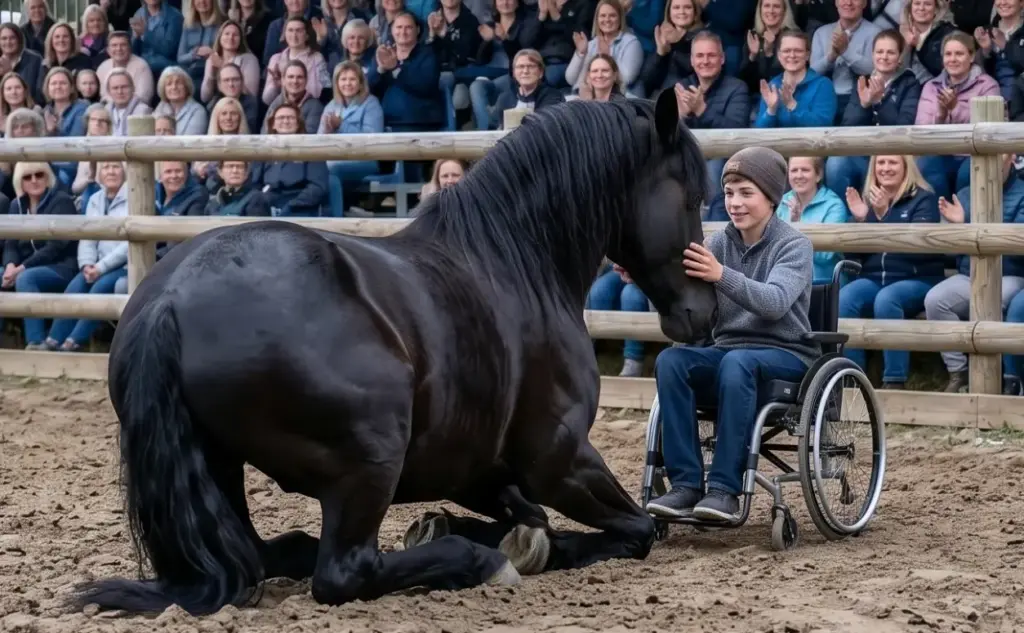
Not fast. Not gently. He moved like a creature crossing ice, placing each hoof with suspicion, ready to launch away from the first wrong thing. Dust puffed around his feet. The dark line of his neck stretched long, and his nostrils worked over the chair, the rubber tires, the clean leather boots Jonah had not dirtied in two years.
Cinder lowered his head until his muzzle hovered above Jonah’s toes.
Warm breath spilled over the boots, stirring the dust on them.
Jonah’s throat tightened so hard he had to swallow against it. He did not move. He barely let himself breathe.
The horse exhaled again, longer this time, a deep shudder that ran through his ribs. His head stayed low. His eyelids softened. In front of hundreds of people who had come to watch men handle wild horses with ropes and flags, Cinder stood over the boy in the chair and let the fight drain out of him.
For several seconds, no one made a sound.
Then applause rose from the lower bleachers. It started uncertainly, as if people were afraid noise might break whatever they had just witnessed. But it spread, climbing row by row until the metal roof caught it and threw it back down over the arena.
Jonah barely heard it. He was too close to the horse’s breathing, too aware of the warm life standing in front of him, too shaken by the small opening that had appeared inside his own chest.
One of the handlers moved in from the side with careful, rounded steps. Another followed, speaking low. Cinder lifted his head, but he did not explode. He allowed himself to be guided toward the holding pens, not haltered, not conquered, but no longer trying to tear the fence apart.
The moment the horse was clear, Caroline came through the gate.
She reached Jonah with both hands trembling. This time he did not pull away when she grabbed the handles of his chair and dragged him backward through the heavy dirt, back behind the barrier, back into the world of rules and consequences and mothers who had almost watched their sons get trampled.
She came around in front of him and crouched low, one hand pressed to his knee as if she could still feel whether he was there. “What were you thinking?” she whispered.
Jonah looked past her, toward the empty place where Cinder had stood.
“Jonah.” Her voice broke on his name. She touched his cheek, then pulled her hand back when he flinched. “Please look at me.”
He tried. He really did. But words had gathered somewhere behind his ribs and locked themselves in place. The clarity he had felt in the dirt was already slipping, replaced by the familiar heaviness of the chair, the uselessness of his legs, the faces turning toward him…To read the rest of the story – CLICK the NEXT button 👇👇👇