


The roses were wet enough to darken my gloves. I had been outside since sunrise, kneeling in the bed my father had planted along the east side of the house, cutting away dead stems from the white rosebushes he used to fuss over like they were children. He had planted them the spring before my wedding, saying every bride deserved something that would still be beautiful after the guests went home.
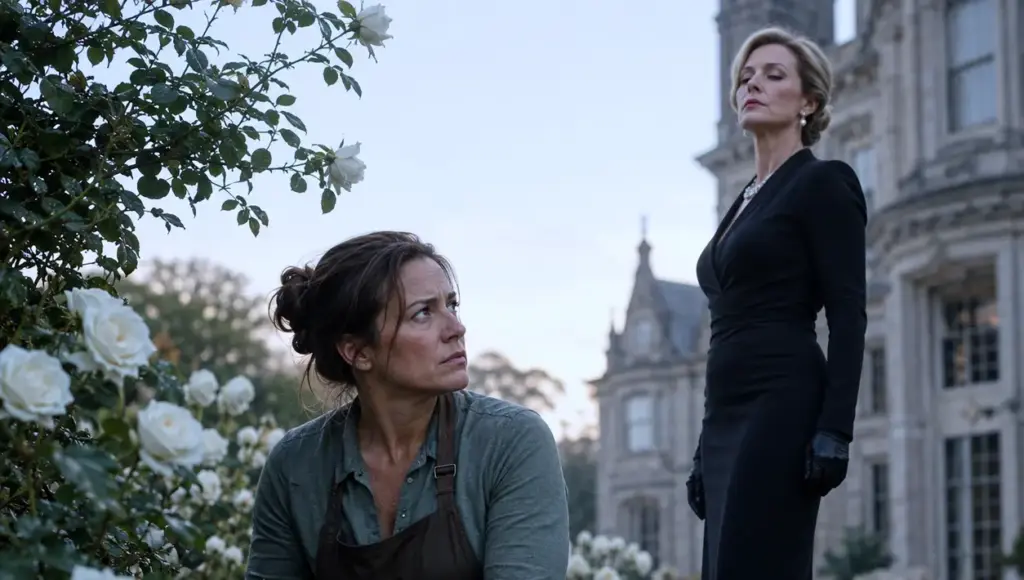
That had been fifteen years ago. The marriage had ended three years ago. My father had been buried two weeks before that morning.
I was easing a thorn from my sleeve when I heard the first hard click on the stone path.
The sound didn’t belong in that garden. It was too sharp, too expensive, too pleased with itself. I didn’t have to turn around.
Only Vivian Cross would wear red-bottom heels to step over damp soil and funeral flowers.
“Well,” she said, drawing the word out as if she’d found me doing something embarrassing. “Still hiding out here with the plants.”
I clipped a dead bloom and let it fall into the basket beside my knee. “Good morning, Vivian.”
“Is it?” She came closer. I could smell her perfume before her shadow reached me, something heavy and sweet that sat wrong in the clean June air. “I suppose that depends on how tomorrow goes.”
Tomorrow was the reading of my father’s will. Everyone knew it. No one decent would have shown up at my house before then to circle the property like a buyer at an open house.
I kept my eyes on the roses. “You didn’t drive all the way over here to talk about the weather.”
“No.” She gave a small laugh. “Reed and I think it would be better if we all behaved like adults before the lawyers get involved.”
I stood slowly, my knees stiff from the damp ground. The pruning shears rested in my right hand, their blades stained green. “The lawyers are already involved.”
“Please.” Vivian’s smile settled into place. It was the same smile she’d worn in the doorway of my bedroom three years earlier, one sheet clutched to her chest, my husband standing behind her with his face turned toward the floor. “You know what I mean.”
I wiped my gloves on my apron. “Say it.”
Her eyes moved over the house behind me, three stories of stone and glass, the porch wrapped in ivy, the tall windows catching the pale morning light. My father had built that house piece by piece over thirty years, arguing with contractors, changing plans by hand, choosing every hinge and railing as if permanence could be measured in brass and cedar.
“Your father loved Reed,” Vivian said. “He practically treated him like a son.”
“My father tolerated Reed because I married him.”
“That’s not true, Claire.”
Hearing my name in her mouth made my stomach tighten.
She tilted her head, pretending sympathy. “Bennett was a generous man. He understood loyalty. Reed worked beside him for years. They golfed together. They had Sunday dinners. You don’t get to erase that just because your marriage failed.”
“My marriage didn’t fail,” I said. “It was betrayed.”
A flicker crossed her face. Then the smile returned, thinner this time. “Ancient history.”
I looked at the woman who had made a sport of stepping into other people’s rooms and calling them empty. Her lipstick was perfect. Her black dress was fitted and tasteful, just mourning enough for a woman who had not lost anything she loved.
“You should leave,” I said.
“I’m here because there may be a misunderstanding about the estate.” Vivian folded her arms, careful not to brush against the roses. “Reed and I expect your father recognized the place Reed held in his life. We’re not greedy. We simply want what’s fair.”
The shears felt heavier in my hand.
“You mean the house,” I said.
“The house. Shares in Mercer Industries. Certain liquid assets.” She waved a hand as if naming my father’s life work bored her. “We’re reasonable people.”
“You are standing in my father’s garden two weeks after his funeral asking how much of him you can carry away.”
For the first time, she stopped pretending.
Her mouth hardened at the corners, and the sweetness dropped out of her voice. “This place is worth more than you know what to do with. You think you can sit here alone in Bennett Mercer’s mansion, pruning flowers and playing grieving daughter, while everyone else gets nothing?”
“My father knew exactly what Reed was.”
“And your brother?” she asked.
That stopped me.
Vivian watched the effect land, satisfaction moving through her eyes before she hid it. “Nate seems to have a more balanced view.”
I hadn’t spoken to my brother since the reception after Dad’s funeral, if anyone could call that cold, catered gathering a reception. Nate had spent half of it in the corner with Reed, his hand on my ex-husband’s shoulder, both of them murmuring like men who had lost the same father. I had gone home with my grief and let the distance between us harden.
“You’ve talked to Nate,” I said.
“We’ve done more than talk.” Vivian stepped closer, lowering her voice. “He understands how fragile your father became near the end. He understands that a will signed by a dying man can be questioned.”
My fingers tightened around the shears before I made myself loosen them.
Dad had taught me how to prune when I was eight. A rosebush needed nerve, he said. Cut too little and it choked itself. Cut too much and you punished it for trying to grow.
“Get off the property,” I said.
Vivian laughed softly. “Still pretending it’s yours.”
“It is until someone with the authority to say otherwise tells me it isn’t.”
“That happens tomorrow.” She turned toward the gate, then paused as if remembering one last cruelty she had meant to deliver. “You may want to start sorting through things. Reed hates the library wallpaper, and I’ll need the garden beds removed before we put in the pool.”
I didn’t answer. If I had opened my mouth, I might have said something my father would have been ashamed to hear from me.
Her heels clicked back down the path, leaving little crescent marks in the wet soil where she’d strayed too close to the beds. I stayed where I was until her car door shut. A moment later the engine started, smooth and expensive, and rolled down the long drive.
Only then did I look at the roses.
One of the white blooms had been crushed under her heel.
I knelt and lifted it from the mud. The petals were bruised, the stem snapped, but the fragrance remained, faint and stubborn. That was when I saw the envelope.
It was tucked beneath the lowest branches of the old rosebush, sealed in a plastic sleeve, half-hidden by leaves. Dew clung to the corner. My name was written across the front in my father’s hand.
Claire.
For a while, I couldn’t pick it up. I could only stare at those five letters, slanted a little to the right, the way his writing had leaned more in the months after his diagnosis.
When I finally reached for it, my hands were unsteady enough that the sleeve crackled.
I carried it into the house without opening it.
Dad’s study still smelled like him. Pipe tobacco, lemon oil, old paper, and the faint mineral scent of the stones around the fireplace. His reading glasses lay beside the lamp where he had left them, one earpiece folded, one open, as if he had only stepped out to answer the phone.
I sat in his leather chair and called Tessa Navarro.
She answered on the second ring. “Claire?”
“Vivian came by.”
The line went still in the way only Tessa could make silence feel deliberate. She had been my best friend since college and my father’s attorney for the last six years. She could read a contract like a battlefield map and a person’s pause like a confession.
“What did she say?” Tessa asked.
“That Reed deserves part of the estate. That Nate is helping them. That I should start packing.” I looked at the envelope in my lap. “And I found something in the roses. From Dad.”
Tessa’s voice changed. “Don’t open it yet.”
“I wasn’t going to.”
“I’m coming over.”
She arrived twenty-two minutes later with her legal briefcase in one hand and a bottle of red wine in the other, because Tessa believed grief required paperwork and alcohol in equal measure. She set both on the desk, took in my face, and didn’t waste time with comfort neither of us would believe.
“Show me.”
I handed her the envelope. Her thumb brushed the handwriting, and for the first time since she entered, her professional expression slipped.
“He told me there would be something in the garden,” she said.
My breath caught. “You knew?”
“I knew he had contingencies. I didn’t know exactly where he hid this.”
“Tessa.”
She looked at me, and her eyes were tired. “Open it, Claire.”
Inside was a single folded page and a small brass key taped to the bottom. The paper smelled faintly of cedar, like the drawer where Dad kept his personal stationery.
I unfolded it carefully.
My Claire,
If you found this, then someone has come for the house before I am cold in the ground. I have my guesses. Vivian never had the patience to wait for a proper invitation.
Do not panic. Do not agree to anything. Do not let anger make you careless.
The key opens the locked drawer at the bottom right side of my desk. What’s inside will not take away the pain of betrayal, but it will keep betrayal from winning.
Remember what I told you when you wanted to quit chess because Nate kept taking your queen: the person who moves too fast usually misses the board.
I love you more than this house, more than the company, more than every rose in that garden.
Dad
For several seconds, the study blurred around the edges. I pressed the letter to my chest before I could stop myself, not dramatically, not for anyone to see. It was simply the closest I could come to being held by him again.
Tessa waited.
When I could breathe evenly, I slid from the chair and knelt by the desk. The locked drawer had always been off-limits when we were children. Nate and I used to make up stories about it: treasure, secrets, adoption papers, a hidden map. Dad would laugh and say some drawers should be opened only when a person was old enough to understand what was inside.
The brass key turned with one soft click.
The drawer held a manila envelope thick enough to strain its clasp, a small black flash drive, and another note in Tessa’s handwriting instructing me not to remove anything from the property without legal counsel present.
I looked up at her. “What did he do?”
“He protected you,” she said. “And he made sure Vivian and Reed would have to reveal themselves in order to hurt you.”
I opened the envelope. Photographs slid across the carpet and over my knees. Vivian in a parking lot at night, her face turned toward a man I recognized as one of Mercer Industries’ outside consultants. Reed entering a law office my father had never used. Copies of emails. Bank records. A photograph of Vivian leaning over the front desk at Dad’s hospice agency with a white envelope in her hand.
I picked up the last photo and felt my stomach drop.
Nate.
He was standing outside a coffee shop with Vivian, his shoulders hunched, his expression hard to read. In the next photograph, he was walking away with a check in his hand.
“I knew it,” I whispered.
“No,” Tessa said quickly. She crouched beside me and tapped the second picture. “Look at him.”
I looked again. Nate’s face wasn’t smug. It wasn’t guilty in the way I expected. He looked sick.
“He brought that check to your father the same day,” Tessa said. “Vivian offered him half a million dollars to say Bennett wasn’t mentally competent when he finalized his estate documents.”
The room seemed to tilt slightly, and I put one hand on the desk to steady myself. “Nate told Dad?”
“He did.”
“Then why didn’t he tell me?”
“Because your father asked him not to.” Tessa stood and reached for the flash drive. “Claire, your dad changed his will more than once near the end. Tomorrow’s reading is going to start one way and end another.”
I could hear the grandfather clock in the hall, the slow weight of each second.
“Tell me,” I said.
Tessa inserted the drive into Dad’s computer but didn’t open it yet. “The version Vivian and Reed expect to hear gives them a significant conditional share. Enough to make them think they’ve won.”
My hand tightened around the edge of the desk. “Why would Dad do that?”
“So they’ll accept it on record.” Tessa’s expression sharpened into the look she wore in court, calm and exact. “The acceptance triggers a clause tied to a separate evidence disclosure. If they claim that inheritance, they also acknowledge the validity of the documents your father executed during the same period they plan to challenge. And once they make that claim, I’m instructed to release evidence of attempted bribery, financial misconduct, and conspiracy to the authorities and the corporate board.”
I stared at her. “He set a trap.”
“He built a locked gate and let them decide whether to walk through it.”
The flash drive opened. Folder after folder appeared on the screen: video files, scanned statements, audio recordings, investigator summaries. Dad had not spent his final months simply dying. He had watched. He had planned. He had arranged the pieces with the patience of a man pruning roses.
Tessa touched my shoulder. “There’s one more thing.”
I already knew I wasn’t going to like it. “What?”
“Nate wants to come tonight. He says there are things you need to hear from him before tomorrow.”
I looked toward the window. Outside, Vivian’s heel marks cut through the damp path, dark half-moons in the soil. Beyond them, the white roses lifted their faces to the late morning sun as if no one had ever tried to crush them.
“Call him,” I said.
Nate arrived after dark with no coat, no tie, and no trace of the brother who used to enter rooms as though they had been built for him. His shirt was wrinkled under a navy suit jacket, and he looked like he had slept badly for weeks. He stopped in the doorway of Dad’s study, holding a leather portfolio against his side. The porch light behind him made him look older than thirty-nine…
To read the rest of the story – CLICK the NEXT button 👇👇👇