


By the time the rain found him that Tuesday, Officer Luke Bennett had already learned how to live with an empty leash hanging by his front door. He had not learned how to stop looking at it. Nearly a year had passed since the explosion at the old Meridian Textiles warehouse, but his apartment still held the shape of the life he’d lost. Ranger’s steel water bowl remained under the kitchen window, dry and polished clean by dust. The dog’s favorite rubber ball had rolled beneath the couch months ago, and Luke had seen it there more than once, blue and chewed and half-hidden in shadow, but he had never been able to reach for it.
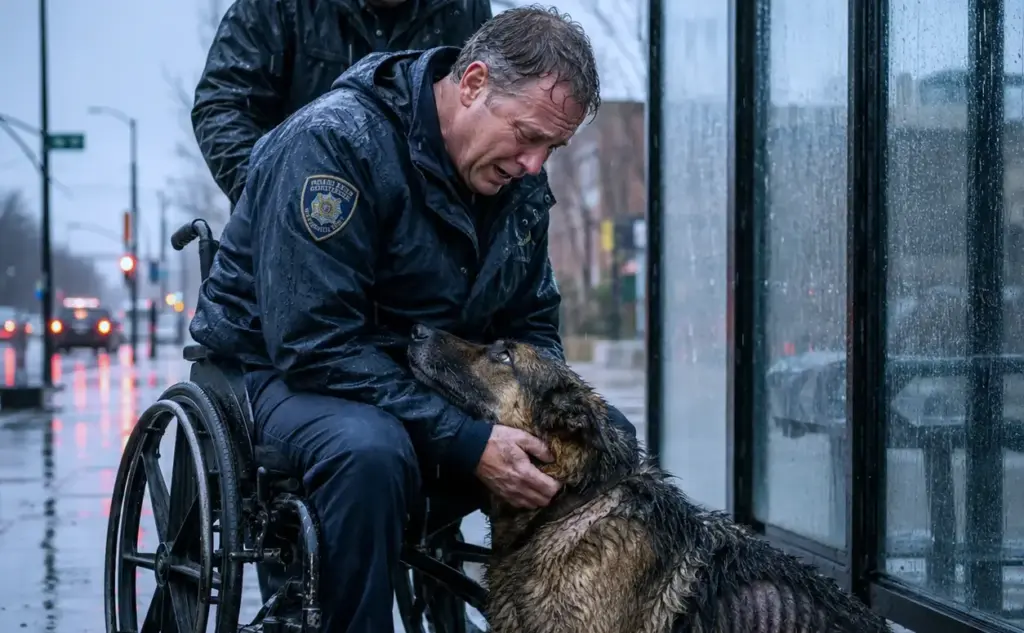
Not because of the wheelchair.
Because picking it up would mean admitting Ranger was never coming back.
Before the blast, Luke had been known around the Eastbrook Police Department for steadiness. He was the officer who spoke quietly when everyone else raised their voice. The one rookies watched during tense calls because he never moved unless he meant to. He had been a firearms instructor, a field training officer, and the kind of cop people trusted to make a hard room safer simply by stepping into it.
But the title that mattered most sat stitched above his badge in small white letters: K-9 Unit.
Ranger had entered his life as a young German Shepherd with oversized paws, sharp ears, and eyes the color of old brass. Most dogs in training watched handlers for food, commands, or approval. Ranger watched Luke as if he were trying to memorize the rhythm of his breathing.
The trainers noticed it the first day.
“He’s picked you,” one of them said, arms folded, trying not to smile.
Luke had laughed then. “I thought I was supposed to pick him.”
“Not with a dog like that.”
A dog like that became the story people told at roll call. Ranger learned scent work faster than the older K-9s. He crossed obstacle courses with a strange, liquid grace, landing without noise, turning before Luke gave the signal. On patrol, he seemed to understand what danger felt like before it showed itself. A change in the air, a twitch near a suspect’s hand, the wrong kind of stillness behind a closed door—Ranger caught all of it.
They found missing kids in creek beds and wooded parks. They tracked armed suspects through alleys after midnight. They cleared buildings where every doorway seemed to be holding its breath. Luke learned to trust the tension in Ranger’s body the way another officer might trust the click of a safety or the crackle of a radio.
Off duty, the dog was different. He stole socks from the laundry basket and carried them proudly through the apartment. He slept with his head on Luke’s boot. He pressed his nose against the passenger window whenever they passed the bakery on Grayson Street, because once, only once, Luke had bought him a plain biscuit there.
The job had taken plenty from Luke over the years. Sleep. Patience. A marriage that ended quietly and without a fight. The easy kind of laughter he’d had in his twenties. Ranger gave some of it back without asking for anything but work, food, and a hand behind the ears at the end of the day.
Then came the call to Meridian Textiles.
It was supposed to be routine enough: suspicious activity at an abandoned warehouse on the south industrial edge of Eastbrook. Lights seen through broken windows. Trucks coming and going after dark. Maybe stolen goods. Maybe squatters. Maybe nothing.
Luke remembered stepping out of the cruiser into a bitter wind that carried the smell of rain and rust. Ranger had stood beside him, ears forward, body too still. That was the first warning.
Inside, the warehouse was colder than the street. Water dripped from the roof into old puddles. Luke’s flashlight swept over collapsed shelving, rotted pallets, and sheets of plastic fluttering from exposed beams. Ranger moved ahead on a short lead, nose working, shoulders tight beneath his harness.
Halfway through the building, the dog stopped.
Luke stopped with him.
“What is it?” he whispered.
Ranger did not bark. He turned his head slightly toward the far end of the warehouse, where a wall of stacked crates hid a room that shouldn’t have had light behind it.
Luke radioed for backup. He never got the chance to hear the response clearly.
The next few seconds came back to him later in broken pieces: men shouting, Ranger launching forward, Luke ordering hands where he could see them, someone reaching for something he should not have reached for. The flash came before Luke understood the shape of the danger.
Fire swallowed the back of the warehouse.
The blast threw Luke hard enough to steal the air from his lungs. When he opened his eyes, he was on his back beneath torn metal, the world reduced to smoke, heat, and a high ringing in his ears. He tried to move and felt nothing from the waist down.
Then he heard Ranger.
Not a full bark. Not the powerful command voice the dog used on patrol. It was strained, urgent, somewhere beyond the curtain of smoke.
Luke clawed at the concrete with bare fingers. “Ranger!”
The dog appeared for half a second through the gray, limping badly, dragging one rear leg but still trying to reach him. Luke saw the harness. The ears. The eyes fixed on him with terrified determination.
“Come on,” Luke rasped. “Come on, buddy.”
The ceiling gave way before Ranger could reach him.
When the rescue crew pulled Luke out, hours seemed to have passed, though later they told him it had been less than thirty minutes. His uniform was torn open. His face was blackened with soot. He kept trying to speak, but the words came out as smoke and blood.
“My dog,” he kept saying. “Find my dog.”
They searched. Luke was told that much. They moved debris until the fire chief pulled crews back from the unstable structure. They brought in lights, thermal equipment, more officers. They found burned equipment, twisted metal, and places where the concrete had buckled from heat.
They did not find Ranger.
In the hospital, Luke woke to white walls and the steady mechanical sounds of a room designed to keep bodies alive whether their owners wanted to be in them or not. His legs were useless beneath the sheet. His spine, the doctors explained gently, had suffered damage that would change everything.
Luke heard them. He understood the words. But the first question he asked was not about walking.
“Where’s Ranger?”
No one answered quickly enough.
The chief came later, hat in both hands, looking older than Luke had ever seen him. Chief Walter Maddox was not a man who softened bad news. He delivered it clean and direct because he believed people deserved the dignity of truth.
That day, he could barely meet Luke’s eyes.
“I’m sorry,” Maddox said. “We did everything we could.”
Luke stared past him at the window. It was raining then, too. A hard, cold rain that blurred the hospital glass until the city outside looked like it was melting.
“You found him?” Luke asked.
The chief’s jaw worked once. “No.”
That was worse.
For weeks, Luke’s body healed in ways the doctors could measure while the rest of him stayed at the warehouse. The department brought flowers. Officers left cards. Someone placed Ranger’s framed service commendation on the table beside his bed, and Luke stared at it until he couldn’t breathe….
To read the rest of the story – CLICK the NEXT button 👇👇👇