


By the time the formula cooled, Claire Rowan had stopped pretending the bottle was the problem. She sat on the wet rubber floor of the nursery at Blue Heron Wildlife Recovery Center, one boot braced against the shallow therapy pool, the other tucked beneath her. Her sleeves were damp to the elbows. The soft plastic bottle in her hand had been warmed twice and coaxed forward a dozen different ways, but the milk inside had begun to separate in pale, cloudy ribbons.
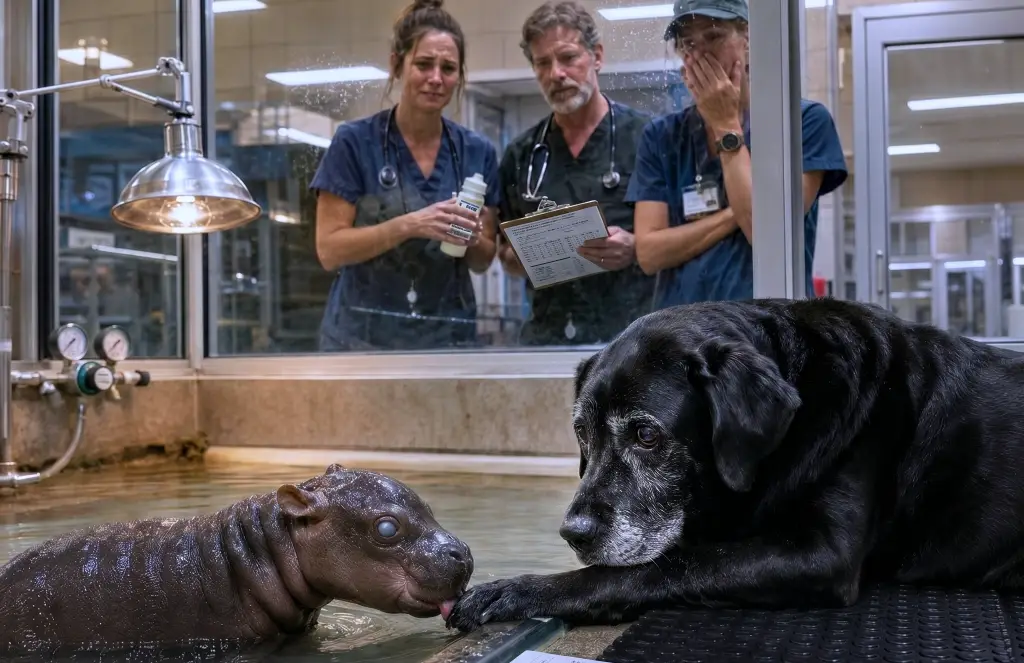
In the pool, the baby pygmy hippo floated with his chin low against the water.
They had named him Copper because of the dull reddish shine that showed through his dark skin after the first bath. Under the heat lamps, the color had made him look almost burnished, as if some small piece of warmth had survived the place he came from. Now his body seemed too heavy for him, all folded skin and oversized feet and small rounded ears that trembled at every sound.
Claire touched the nipple to the corner of his mouth again.
Copper turned his face away.
Dr. Owen Bell stood just inside the nursery door, watching the calf’s nostrils flare. He had practiced veterinary medicine long enough to know the difference between pain, confusion, fear, and surrender. What frightened him most that morning was not Copper’s blindness. It was the way the little animal no longer fought much of anything.
A healthy calf would have resisted. He would have shoved, squealed, searched, demanded the missing body of his mother with every ounce of him. Copper simply floated, listening to a room that never gave him the one sound he wanted.
“He knows it’s food,” Claire said. Her voice was quiet, but there was an edge under it from holding herself together too long.
“I know,” Owen said.
The nursery smelled of warm water, disinfectant, towels that had been used too many times in one night, and the faint sour odor of infection that still clung to Copper’s skin. Three days earlier, state animal welfare officers had pulled him from a closed roadside animal park two counties south. The place had been hidden behind peeling signs, sagging fencing, and enough excuses to keep people from asking questions until the smell reached the neighboring properties.
Copper’s mother had been found dead in a concrete pen filmed green with algae. The calf had been pressed against her side, blind from untreated infection, dehydrated, and too weak to cry.
Owen had handled the examination himself. The eye damage had been too advanced by then, the pressure and infection moving through tissue that neglect had already made fragile. They had cleaned what they could, treated what they could, stopped what they could. Sight was not among the things they could save.
That part, terrible as it was, did not have to be fatal.
A blind pygmy hippo could survive in human care with the right space, the right keepers, and careful routines. Copper could learn voices, textures, smell, sound. He could have a life built for the body he had left.
But he had to choose food first.
Claire lowered the bottle and rested her wrist on her thigh. Her fingers were wrinkled from the pool water. “His mouth works. His swallow reflex is there. He just won’t.”
Owen stepped closer and looked at the monitor clipped above the tile. The numbers had been worse at dawn and worse again at midmorning. His glucose was sliding. His temperature kept dipping despite warm water and lamps. His kidneys were beginning to complain about everything his small body had been asked to endure.
“How long since the last intake?” he asked, though he knew.
“Nothing meaningful since yesterday afternoon,” Claire said.
Ben Alvarez came in from the prep room carrying a stack of towels warm from the cabinet. He was the senior care tech, big-shouldered and soft-spoken, the kind of man who could move an injured pelican without raising his voice or his pulse. He looked at the bottle in Claire’s hand, then at Owen.
“No luck?”
Claire shook her head.
Ben set the towels down slowly. “We can tube-feed him.”
“We can,” Owen said.
Nobody reached for the equipment.
Tube-feeding would get calories into Copper. It would also mean restraint, stress, and fear. They had already done enough to him with hands and needles and lights and instruments, all of it necessary, none of it something his body could understand as help. Each procedure kept him alive while teaching him that touch meant danger.
Claire leaned over the pool and slid two fingers along Copper’s shoulder. The calf twitched beneath her hand, then settled without moving away.
That hurt to watch.
Ben looked toward the office wing. “Dana wants us in the conference room.”
Claire did not stand immediately. She lifted the bottle once more, not toward Copper’s mouth, just into the air between them, as if some stubborn part of her wanted him to smell that it was still there.
He did. His ears moved. His nostrils widened.
Then he tucked his chin lower into the warm water.
The conference room at Blue Heron had never been meant for decisions that large. It had a scarred laminate table, a coffeemaker that burned everything by noon, and one window looking out over marsh grass, wet pine, and the gravel drive. That morning, rain dragged silver lines down the glass while five people stood around the table and avoided the chairs.
Dana Whitcomb, the operations director, had Copper’s lab work spread in front of her. Dana was not hard, exactly. She was practical in the way exhausted women become practical after years of stretching grant money, apologizing to donors, and making sure animals got what they needed before anybody on staff got what they wanted. Her hair was pulled back too tightly, and there were deep crescents under her eyes.
She tapped one page with her pen. “We need to be honest about the direction this is going.”
Claire held the bottle against her chest. No one had taken it from her.
Dana looked at Owen. “His values are moving the wrong way. He’s not maintaining temperature. Every handling session costs him. If we keep forcing intervention without oral intake, we may not be rescuing him anymore.”
The room tightened around that last sentence.
Ben stared at the floor. Claire’s face changed, but she did not speak. Owen looked at the lab report, then toward the wall beyond which Copper floated in his pool, blind and silent and young enough that the whole world should still have been milk and warmth and the pressure of his mother’s body beside him.
“Give me two days,” Owen said.
Dana’s eyes lifted. “For what?”
“I’m not sure yet.”
“That’s not a plan.”
“No,” he said. “It’s not.”
Claire turned toward him. “But you have something.”
Owen rubbed one hand over his jaw. He did have something, though not the kind of thing a veterinarian liked saying in front of an operations director who had to think about liability, disease protocols, staff safety, and insurance carriers. It had begun that morning as a sentence on the phone, tossed out by a shelter volunteer who sounded as tired as everyone else in animal work sounded before breakfast.
We have this Lab, she had told him. Old boy. Sweet. He just lies there waiting for someone who’s dead.
The dog had been brought in after floodwaters tore through a rural neighborhood outside Harrow Bend. His owner had died during the storm. The dog had survived, injured and half-frozen, and had spent the weeks since then refusing most food, most people, and any invitation to rejoin the living.
At the time, Owen had written down vaccine information and promised to send records.
But the dog had stayed with him.
“I need to go to the county shelter,” Owen said.
Dana stared at him. “Right now?”
“Right now.”
Claire’s expression went from confusion to disbelief. “Copper is crashing, and you’re leaving?”
“I’ll be back.”
“That is not reassuring.”
“I know.”
No one stopped him, perhaps because there was nothing useful left to say. Owen took his rain jacket from the hook by the door, crossed the muddy lot, and got into his truck. For a minute he sat with the engine running and the wipers beating hard against the windshield.
He had spent his adult life mistrusting miracles. Most of the time, what people called a miracle was labor they had not seen, luck they did not understand, or grief that had not finished making its case. He believed in fluids, antibiotics, diagnostics, quiet rooms, clean hands. He believed in good records.
Still, he drove to the shelter.
Dunlin County Animal Services sat behind the public works depot, past rows of salt trucks and a ditch full of rainwater. Inside, the main kennel building rang with barking, metal doors, and the particular hope of dogs who believed every opening latch might belong to them. Owen followed a shelter worker through that noise and into a smaller recovery wing where the air was warmer and the floor smelled faintly of bleach and wet bedding.
Robin Sykes met him at the second door. She was in her late fifties, with cropped gray hair, mud on her jeans, and kindness worn down to something quieter than cheerfulness.
“You’re Dr. Bell,” she said. “You came about Otis.”
“I came to meet him.”
She nodded once, as if questions could wait.
Otis was in the last run.
He was a large black Labrador with a graying face and a body that must once have carried itself with easy strength. A shaved patch showed along his ribs, where a stitched wound had begun to heal. His front paws were crossed neatly on the quilt beneath him. When Robin and Owen stopped at the gate, he lifted his eyes but not his head.
“That’s more interest than he gives most people,” Robin said softly.
Owen crouched outside the kennel. “Hey, old man.”
Otis’s tail shifted once against the quilt. It was not quite a wag. More like the memory of one.
Robin hooked her fingers through the chain-link. “He belonged to Walter Greer. Retired wildlife officer. Lived out past Sawgrass Road, almost to the low marsh. Storm knocked a section of fence down, and Walter went out to secure it. Medical examiner thinks his heart gave out before the water rose too high.”
Otis blinked slowly.
“The neighbors heard barking before dawn,” she continued. “They found Otis on the porch steps beside him. Water up around them both. Dog was cut open, hypothermic, wouldn’t let anybody near Walter until he dropped.”
Owen kept his hand low near the gate and waited. Otis turned his nose slightly toward him, catching the smells that had followed Owen in from Blue Heron: antiseptic, formula, wet towels, calf, worry.
“He eats if I sit with him,” Robin said. “Some days. He doesn’t play. Doesn’t want the yard. Around four every afternoon, he gets up and stands at the kennel door. We figure that’s when Walter used to come home.”
The dog’s eyes moved toward the hallway, toward some sound Owen could not hear.
“How is he with other animals?” Owen asked.
“Gentle. Walter used to take in injured things when people called him—fawns, herons, turtles, whatever showed up. Otis was always around. Never pushed. Never fussed. Just stayed nearby.”
Owen looked at him for a long moment.
Two animals, he thought, both technically alive. Both waiting for a world that had already changed its locks.
Robin lowered herself beside him. “What are you thinking?”
Owen should have said nothing yet. He should have asked for records, checked titers, called Dana, built a case with all the proper words around it. Instead, Otis lowered his head onto his paws and released a long breath through his nose, the kind of breath that came from an animal too tired to hold itself apart from the floor.
Owen stood.
“I’m thinking,” he said carefully, “that I may need to borrow your loneliest dog.”
Claire said no before Owen finished explaining.
They were back in the Blue Heron conference room, rain still ticking against the windows, the day turning gray around the edges. Dana sat at the table with her hands folded over Copper’s lab report. Ben leaned against the wall near the supply cabinet, his face set in that careful blankness people use when they are trying not to take sides too soon…
To read the rest of the story – CLICK the NEXT button 👇👇👇