


Cold sweat gathered beneath Grace Bennett’s hair and slid down the side of her neck as the train lurched hard enough to make the overhead lights flicker. Her legs, locked inside stiff carbon-fiber braces, answered with a bright, burning pulse that traveled from her hips to the bottoms of her feet. She had just enough strength left to drop into the only empty seat in the car before her knees quit pretending they could hold her.
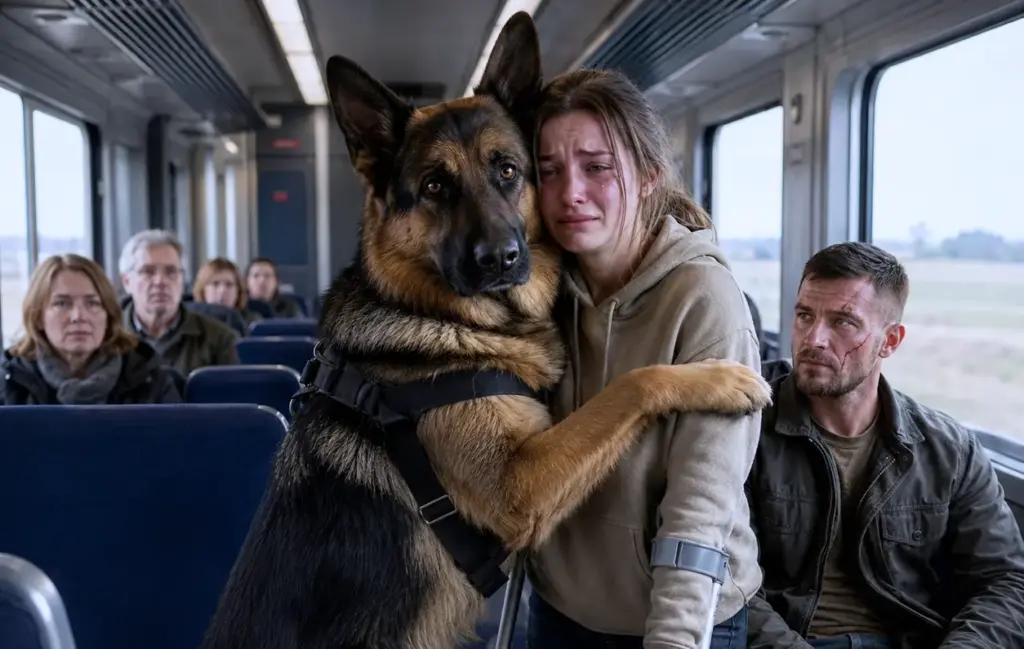
The man by the window did not move. He sat with his shoulders square, his black cap pulled low, and a pale scar cutting down from his cheekbone into the collar of a faded field jacket. At his feet lay the reason no one else had taken the seat: a massive German shepherd in a tactical harness, still as a carved thing, his amber eyes already fixed on Grace.
Most working dogs either ignored her braces or disliked them. Some flinched from the metallic click of her forearm crutches. Some looked past her as if the equipment made her part of the furniture.
This dog did neither.
His head lifted slowly. His ears came forward. The muscles along his back went tight, not with fear and not with the restless energy of an animal looking for trouble. He looked at Grace once, then turned his body toward the aisle, placing himself between her and everyone else in the crowded Amtrak car.
Washington Union Station on a Friday evening could make anyone feel small. For twenty-four-year-old Grace, it was a test of endurance she had failed in her head at least six times before she reached the platform. She had been born with a spinal cord defect, had grown up inside hospitals and physical therapy rooms, and now moved through the world with custom braces, forearm crutches, and the practiced stubbornness of someone who had learned that strangers were not usually cruel. They were simply in a hurry.
That evening, everybody was in a hurry.
The air inside the station smelled like burnt coffee, soft pretzels, wet wool, floor cleaner, and the warm electrical smell that hung around old terminals. People rolled suitcases over her crutch tips without seeing her. A man with earbuds and a laptop bag stepped across her path so abruptly that she had to plant both crutches and absorb the twist through her lower back. The pain came white and sharp, and she bit down on the inside of her cheek until she tasted blood.
Her train was the evening westbound line toward Pittsburgh. Home was only a few hours away, but after a full day at a specialist clinic in D.C., the distance felt ridiculous. Her thighs trembled under the braces. The muscles around her spine spasmed in small waves, each one reminding her that she had pushed too hard.
When boarding was called, the platform became a current. Grace did not enter it so much as survive it. Business travelers flowed past with garment bags and phones pressed to their ears. College students laughed too loudly. A couple with matching hard-shell suitcases blocked the narrow gap at the train door while arguing about seat numbers. No one meant to shove her, but by the time she crossed from concrete into the vestibule, sweat had soaked the collar of her sweater.
Inside the car, the empty seats were already claimed by coats, backpacks, purses, and silent hostility. People looked down at their screens the moment they saw her approach. Grace knew the choreography. She could ask, and someone would sigh, move a bag, perform kindness as if it had cost them something. She hated needing anything badly enough to invite that sigh.
Her hands shook on the grips of her crutches. The aisle looked impossibly narrow. She dragged one brace forward, then the other, the locking joints clicking softly with each step.
By the time she reached the rear of the car, she was almost out of options.
That was when she saw the open aisle seat.
For half a second, relief loosened her chest. Then she noticed the man by the window and the dog at his boots. The man looked like someone who had spent years sleeping lightly. He wore dark jeans, heavy boots, and a field jacket that had faded from olive to dust. His face was not old, exactly, but it carried old weather. The scar along his jaw had healed badly, raised and pale against his skin.
The German shepherd was bigger than any dog Grace had ever been that close to. His coat was a dark blend of charcoal, sable, and rust. His harness was thick black nylon with reinforced handles and a patch that read: WORKING K-9. DO NOT DISTRACT. He looked less like a pet than a soldier who happened to have four legs.
Grace hesitated. Behind her, someone muttered, “Can you move?”
The train horn blew. The sound punched through the car, loud and final.
Grace swallowed. “Excuse me.”
The man’s eyes opened at once. They were gray, flat, and alert, as if he had been awake long before she spoke. His gaze moved over her face, her white fingers around the crutch handles, the braces locked around her legs. He did not smile. He did not give her the soft, embarrassed pity she had learned to brace for.
“Is this seat taken?” she asked.
For a moment, he only studied her. Then he gave a small nod and lowered two fingers beside his knee.
The dog obeyed without a sound. He rose with controlled, unsettling grace and backed closer to the man’s boots, making a narrow space for Grace’s legs.
“Thank you,” Grace breathed.
She sat too quickly. Pain flared through her hips, but the seat caught her, and that was enough. She leaned both crutches against the wall under the window, pressed her palms to her thighs, and closed her eyes as the train began to move. The simple relief of taking weight off her legs was so strong it made her dizzy.
For the first ten minutes, no one in their row spoke.
Grace kept her eyes shut and counted breaths. Four in, six out. She had learned the rhythm from a pain therapist at nineteen, back when she still believed there was a correct way to be brave. The train gathered speed, rolling out of D.C. and into the fading light beyond the city. Around her, passengers settled into the private mess of travel: snack wrappers, phone chargers, low conversations, a baby fussing three rows ahead.
The man beside her sat without fidgeting. The dog lay at his feet again, but not fully relaxed. Every so often his ears shifted, following sounds Grace barely noticed.
His name was Mason Reed, though Grace did not know that yet. He was not simply a veteran with a service dog, though that was the explanation most people reached for and left alone. Mason had spent fifteen years in Army special operations and several more on classified security contracts that kept his name off most paperwork. He had worked in deserts, mountains, ruined cities, and rooms where the lights had gone out on purpose. He carried silence the way other people carried luggage.
The dog was Ranger.
Ranger was not trained to comfort children in hospitals or sit patiently at school assemblies. He had been trained to detect explosives, track hostile targets, hold under fire, and listen to Mason’s smallest signal over chaos. He had ridden in helicopters, searched dark buildings, crossed borders that did not appear in briefings, and once pulled Mason out from under collapsed concrete by the strap of his vest.
He was trained to ignore civilians. Loud ones, crying ones, drunk ones, bleeding ones. He did not beg for food. He did not react to friendly hands. He did not break a command because a stranger looked sad.
That was why Mason noticed when Ranger broke the rules.
Grace shifted in her seat, trying to ease the pressure on her right hip. A spasm seized her leg without warning. The brace snapped forward and struck the metal support beneath the seat in front of her with a hard, ugly clank. She sucked in a breath and caught her lower lip between her teeth, fighting the sound that wanted to come out of her.
Ranger’s ears snapped toward her.
Mason watched from the corner of his eye, expecting the dog to remain down. Ranger had been told to settle. To most dogs, that meant lie still for a while. To Ranger, it meant become furniture until released.
Instead, the shepherd stood.
Mason’s body tightened so subtly no one else would have noticed. His right hand lowered near the authorized sidearm under his jacket, not touching it, just close enough. Ranger did not disobey unless something in the environment had crossed from inconvenient into dangerous.
But the dog was not looking at the aisle.
He turned toward Grace.
She froze as the huge shepherd eased into the small space in front of her knees. His head was level with her lap. His mouth stayed closed. He did not bare his teeth. He leaned forward with astonishing care and rested his heavy chin across the brace on her right leg.
Grace stared at him, afraid to move.
The dog exhaled, a low rumbling sound that was not quite a growl. Then he shifted his body until his shoulders faced the aisle and his ribs pressed lightly against Grace’s knees. He sat upright, broad chest out, eyes forward.
He had made himself a wall.
“I’m sorry,” Grace whispered. Her hands hovered over his head, uncertain. “Is he—should I not touch him?”
Mason turned toward her fully now. He looked at the exhaustion around her eyes, the sweat at her hairline, the tremor running through her fingers. Then he looked at Ranger, who was watching the aisle with the cold focus Mason knew too well.
“He’s fine,” Mason said. His voice was low and rough, the kind of voice that had been shaped by dust, bad radios, and years of speaking only when necessary. “He just doesn’t usually do that.”
“Do what?”
“Choose somebody.”
Grace’s fingers sank carefully into the thick fur behind Ranger’s ear. To Mason’s surprise, the dog leaned into the touch without taking his eyes off the aisle.
“He’s not a therapy dog,” Mason said. “He’s a working K-9. Military background. He detects threats. He doesn’t usually make friends on trains.”
Grace looked down at the animal using her leg brace as a post. “Then why is he doing this?”
Mason did not answer right away.
His gaze moved through the car with practiced discipline. Row by row. Elderly couple sleeping under matching travel pillows. College kid with headphones and a laptop. Mother bouncing a toddler on her knee while the child jabbed at a cartoon on a tablet. A woman in scrubs reading a paperback. A man in a navy suit sitting three rows forward on the aisle.
Mason’s attention stopped there.
The man in the suit was handsome in a clean, forgettable way. Dark hair, expensive glasses, polished shoes, leather briefcase. He looked like a lawyer on his way to a conference or a consultant who spent his life inside airport lounges. But he held his magazine without reading it. Ten minutes had passed, and he had not turned a page.
More importantly, he was watching the reflection in the darkening window.
Not the passing landscape. Not himself.
The last row.
Ranger’s chest vibrated under Grace’s palm.
“What’s wrong?” she asked softly. She felt the dog change beneath her hand, muscle hardening under fur.
“Nothing for you to handle,” Mason said. “Keep your hands where they are. Don’t look up fast.”
Grace’s heart began to beat hard. “What does that mean?”
“It means Ranger noticed somebody before I did.”
The man in the navy suit rose. He adjusted his jacket, lifted his briefcase, and stepped into the aisle. He did not walk toward the café car or the restroom. He came toward the rear of the train with a measured pace that tried too hard to look casual.
Ranger’s lips moved just enough to show the white edge of one tooth.
Mason’s posture did not change, but everything about him sharpened. He had become still in a different way now, not tired stillness, not passenger stillness. The kind before action.
The man stopped beside their row and looked down at Grace.
His face was pleasant. His eyes were not. They were flat and bright behind the lenses, taking in her braces, her crutches, the narrow space she occupied.
“Those must be tough to travel with,” he said.
It was the kind of line strangers used when they wanted permission to stare. Grace had heard versions of it her whole life. Usually she answered politely and tried to make herself smaller.
This time, she did not get the chance.
Ranger moved like a released spring. He did not bark. He surged forward across Grace’s knees, jaws snapping shut in the air inches from the man’s thigh. The sound was sharp enough to make the passengers nearby gasp.
The man stumbled backward into the opposite armrest. For one bare second, his pleasant expression slipped. What showed underneath was not fear.
It was rage.
“What the hell?” he snapped, too loudly. “Control your dog. He almost bit me.”
Mason looked up at him. “No, he didn’t.”
The man’s mouth tightened. “Excuse me?”
“If he wanted to bite you, we’d all know.” Mason’s voice remained level. “He told you to step back.”
A few passengers turned in their seats. The man in the suit seemed to remember he had an audience. He lifted one hand, palm out, and forced a thin smile.
“I was only trying to be helpful.”
“Then go be helpful somewhere else.”
For three seconds, neither man moved. Grace sat pinned between them, one hand locked in Ranger’s fur, her breath caught in her throat. She did not understand the shape of the danger, only that it had found her before she knew it was there.
The man’s eyes flicked to Mason’s jacket, then to Ranger. He smiled again, smaller this time.
“Fine,” he said. “No need to get dramatic.”
He turned and walked toward the front of the train. His shoes made almost no sound on the carpet. When the sliding door closed behind him, Grace realized her hands had gone numb.
“What was that?” she whispered.
Mason leaned down and touched Ranger’s shoulder. “Easy.”
Ranger stopped showing his teeth, but he did not move away from Grace.
“I don’t know who he is,” Mason said, watching the door. “But he wasn’t making conversation.”
The train ran west into the dark.
For a while, nothing happened, which made the air feel worse. Ordinary noise returned in cautious layers: a cough, a whispered complaint, the toddler’s tablet playing too softly, the dull clatter of wheels under the floor. But Grace could not settle back into her body. Her leg still throbbed where the spasm had hit, and Ranger remained pressed against her like a living sandbag, warm and immovable…
To read the rest of the story – CLICK the NEXT button 👇👇👇