


The janitor’s cart had one bad wheel. Every Thursday night, when Noah Bennett pushed it past the west lecture hall at Merritt University, it announced him before he arrived: a soft clack, a pause, then a crooked metallic shiver across the tile. Usually, the sound disappeared beneath student chatter, closing laptop lids, and the exhausted shuffle of people who had spent two hours pretending to understand mathematics. That evening, nobody was leaving.
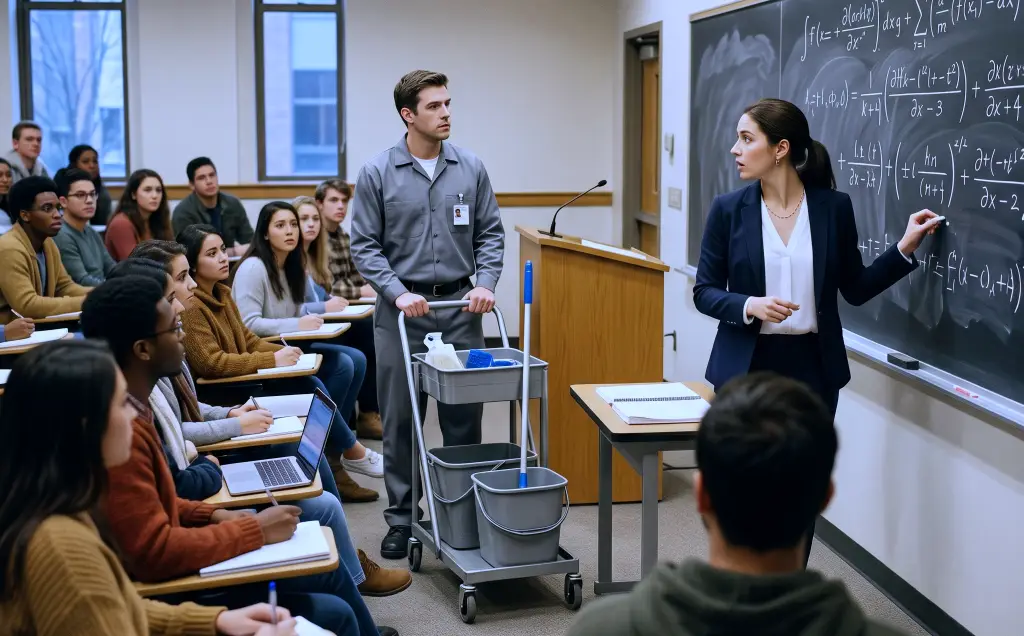
Inside Hall 214, every seat was taken. Students leaned over notebooks with their pens lifted, their faces turned toward the woman at the blackboard. Professor Claire Ellison stood beneath the fluorescent lights in a charcoal dress and narrow heels, her hair pinned so precisely it looked like part of her armor. Chalk dust clung to the side of her hand as she wrote the final line of an equation that spread across three panels like a storm map.
She took one step back, studying it with the private satisfaction of someone who had built a door nobody else could open.
Then she turned to the room.
“Anyone who can solve that,” she said, letting the chalk rest between two fingers, “can have my office, my parking spot, and my hand in marriage.”
A few students laughed because they were supposed to. Others glanced at one another, unsure whether the joke was meant to be funny or cruel. Claire smiled anyway. She liked a room that didn’t know what to do with her.
At the back, Noah stopped with one hand on the cart handle.
He had not meant to look. Looking was where trouble began. For three years, he had cleaned Merritt’s mathematics building by keeping his head down, his earbuds in, and his mind far from the boards he wiped clean each night. But the equation pulled at him with a force he had not felt in years.
His lips moved before he could stop them.
“Curvature form,” he murmured. “But she folded the index wrong.”
Claire’s head snapped toward the rear doors. Her eyes found the mop, the gray uniform, the plastic ID badge, then finally the man holding them.
“What was that?”
Noah’s fingers tightened around the cart handle. His face warmed under the attention now shifting toward him, row by row. He had grown used to being unnoticed; visibility felt almost physical, like a hand pressing against his chest.
“I’m sorry,” he said. “I didn’t mean to interrupt.”
Claire walked two steps down the aisle, not enough to leave the front of the room, just enough to make her displeasure visible. “No, please. Since you’ve joined the lecture, I’d hate to deprive everyone of your contribution.”
The students went still. Noah looked at the board again, then at the floor.
“I just thought there might be another way into it.”
Claire’s smile thinned. “Another way into it.”
He nodded once, already regretting the movement. “Maybe.”
Claire Ellison had built her life on being the person no one dared to correct. Her father, Dr. Julian Ellison, had spent thirty years at the Rutherford Institute of Technology turning dense theoretical physics into papers other physicists read with dictionaries beside them. Her mother, Dr. Marianne Park, was a mathematician whose name appeared in textbooks before Claire learned to drive.
In the Ellison house, achievement was not celebrated for long. It was logged, measured, and used to set the next requirement. Claire’s bedtime stories were proofs. Her childhood toys were logic sets and shape puzzles. By ten, she could sit quietly through a faculty dinner and answer a visiting scholar’s question well enough to make the adults stop chewing.
She learned early that affection came most reliably after performance.
At sixteen, she had already published her first paper. At twenty-four, she finished her doctorate at Waverly University. At twenty-nine, Merritt hired her as the youngest tenure-track professor in the department’s history, and newspapers ran profiles about her “cold brilliance,” a phrase she pretended not to like while saving every clipping.
Her office looked like a museum exhibit dedicated to a person who had never gone home. Degrees lined one wall. Awards lined another. Photographs of her beside famous mathematicians stood in silver frames on the shelves. There were no vacation pictures, no dog-eared novels, no family snapshots tucked beneath magnets. Even the coffee mug on her desk bore the crest of a conference.
She arrived before most people and left after them, but she arranged her schedule so she rarely crossed paths with the custodial crew. The habit had come from childhood, from parents who never said outright that certain kinds of work made people smaller but behaved as if it did. Claire had inherited the lesson before she had the language to question it.
Lately, the lessons that once protected her had begun to fail.
It had been almost two years since her last major publication. Reviewers were asking harder questions. Younger faculty arrived with new ideas and softer manners, and students seemed to like them better. At department meetings, Claire could feel the conversation shifting around her, polite but hungry, as if everyone were waiting to see whether she had already spent the best of herself.
That equation on the board had been more than a teaching demonstration. It was bait. A fortress. Proof that she still belonged above the crowd.
And then a janitor had looked at it for less than a minute.
Noah knew enough about fortresses. He had spent five years living inside one of his own.
His mother, Diane Bennett, had been an English teacher at a public high school in a town where the library closed early and the grocery store kept unpaid tabs for people it trusted. She noticed patterns in him before anyone else did. At four, he lined up cereal pieces in spirals. At six, he asked why numbers behaved differently when they were allowed to be negative. At ten, he sat in the back of a community college calculus class because Diane had written so many letters that the dean finally gave in.
She drove him to every math camp she could afford and some she could not. She graded essays at the kitchen table while he worked through textbooks beside her, both of them pretending not to see how tired she was. When Westhaven University accepted him into a special program at sixteen, she cried in the car with both hands pressed to the steering wheel.
“You’re going to have rooms full of people who understand you,” she said.
For a while, she was right.
At Westhaven, Noah stopped feeling strange. Professors argued with him late into the night. Graduate students left problems outside his dorm room. His work on nonlinear systems brought invitations from Europe, Asia, and every elite research institute that wanted to be associated with a boy genius before he turned into a man with options. At nineteen, he received the Langford Medal, one of the highest honors in mathematics, and his mother wore a blue dress to the ceremony that she had bought on clearance and altered herself.
In every photograph from that night, Diane was looking at him, not the medal.
Then she collapsed in the middle of a sophomore literature class.
The illness had a long name, a short timeline, and a price attached to every possibility. One experimental program at a private clinic outside Zurich offered a chance, but the deposit alone was more money than Diane had earned in several years. Noah sold what he owned, signed loans he barely understood, ignored calls from Westhaven, and took any work that paid cash.
He told himself it was temporary. He told his advisors he would return after the treatment. He told his mother the same thing while helping her lift a paper cup of water to her mouth.
She died in a county hospital six months later, apologizing because the morphine had loosened the truth she had been trying to protect him from.
“I’m sorry, honey,” she whispered. “You were supposed to go so far.”
Noah had wanted to tell her that he had gone as far as he ever needed to go, because he was beside her. The words jammed somewhere inside him. He held her hand instead, feeling the bones beneath the skin, and listened as the monitors kept track of a problem no one in the room could solve.
After the funeral, he disappeared from mathematics with the thoroughness of a man erasing a crime scene. He changed his number. He stopped answering emails. He threw away certificates, packed his books into donation boxes, and took work that required his hands more than his mind.
Eventually, Merritt University hired him as part of the night custodial staff.
The first time he rolled his cart past the mathematics department, he almost quit. By the end of the month, he had learned to clean with his eyes half-closed. By the end of the year, he had learned that no matter how much of himself he buried, numbers still found him. They waited on boards after lectures, patient and gleaming, and when the building emptied, he sometimes stood in the dark and solved them silently before wiping them away.
It felt less like returning to himself than visiting a grave.
Three nights after Claire’s reckless challenge, Noah entered Hall 214 during her advanced analysis class to empty the trash. He moved quietly, hoping to get in and out before she noticed him. The bad wheel betrayed him halfway down the aisle.
Claire stopped writing.
“Can this wait?” she asked without looking at him. “We’re in the middle of something.”
Noah dipped his head. “Sorry, Professor. I’ll come back.”
He turned the cart carefully, but the board caught his eye. Claire had carried a sign through the proof incorrectly. It was small, nearly invisible, but the rest of the argument leaned on it. The whole structure would tilt.
He tried to keep walking.
“The third line should change sign,” he said.
The words seemed to land on every desk at once. Pens stopped. A student coughed once and then didn’t breathe loudly again. Claire turned slowly, chalk still in hand.
“Excuse me?”
Noah closed his eyes for half a second. “I shouldn’t have said anything.”
“No,” Claire said. “By all means. Tell us more about the proof.”
His shoulders lowered. “It’s just the third line. The transformation reverses orientation. The sign should be negative.”
In the front row, Ravi Patel, one of Claire’s strongest graduate students, frowned at his tablet. His stylus moved quickly. Then it stopped.
“Professor Ellison,” he said carefully, “I think he’s right.”
Claire did not move at first. Then she faced the board and checked the line herself. There it was, clean and undeniable. A mistake so small she could have forgiven it in anyone else, and so public she could not forgive it in herself.
She corrected the sign. The chalk clicked too hard against the slate.
When she faced Noah again, her mouth had found a smile that belonged nowhere near kindness. “Since you have such an eye for difficult mathematics, Mr…”
“Bennett,” he said.
“Mr. Bennett,” she repeated, as if testing whether the name deserved a place in her mouth. “Perhaps you should take a real look at the equation from Thursday. The offer remains available. Solve it, and I’ll keep my word.”
Several students gave nervous laughs. A few stared down at their desks.
Noah felt something old stir beneath the fatigue and shame. It was not attraction, and it was not pride exactly. It was anger, but cleaner than the kind that had eaten at him for years. For once, it was aimed outward.
He looked at Claire, then at the board.
“One week,” he said.
Claire’s eyebrows lifted. “A week?”
“That’s what I’ll need.”
The room seemed to lean toward them. Claire laughed once, lightly, but it came out sharper than she intended.
“Then we’ll all look forward to Monday.”
Noah pushed his cart toward the door. Behind him, Claire turned back to the class and resumed her lecture, but her voice had changed. The rhythm was too controlled, each sentence pressed flat.
At the threshold, Noah heard her say, “Let this be a reminder that confidence and understanding are not the same thing.”
He did not look back.
That night, Noah used his custodial key card to enter the Merritt library after midnight.
He had cleaned the building hundreds of times, but he had never gone past the lobby when the lights were dim and the circulation desk sat empty. The mathematics stacks were on the fourth floor, tucked behind journals and bound volumes nobody opened unless they were chasing something specific. Noah stood at the end of the aisle for several minutes before pulling the first book from the shelf…
To read the rest of the story – CLICK the NEXT button 👇👇👇