


Morning settled over Philadelphia’s 30th Street Station in a pale October haze, the kind that made the marble columns look softer than they were. Rolling suitcases rattled over tile. Coffee steamed from paper cups. Somewhere above the crowd, a woman’s voice announced departures in a calm, practiced tone that made leaving sound ordinary. Near Track 6, nothing felt ordinary.
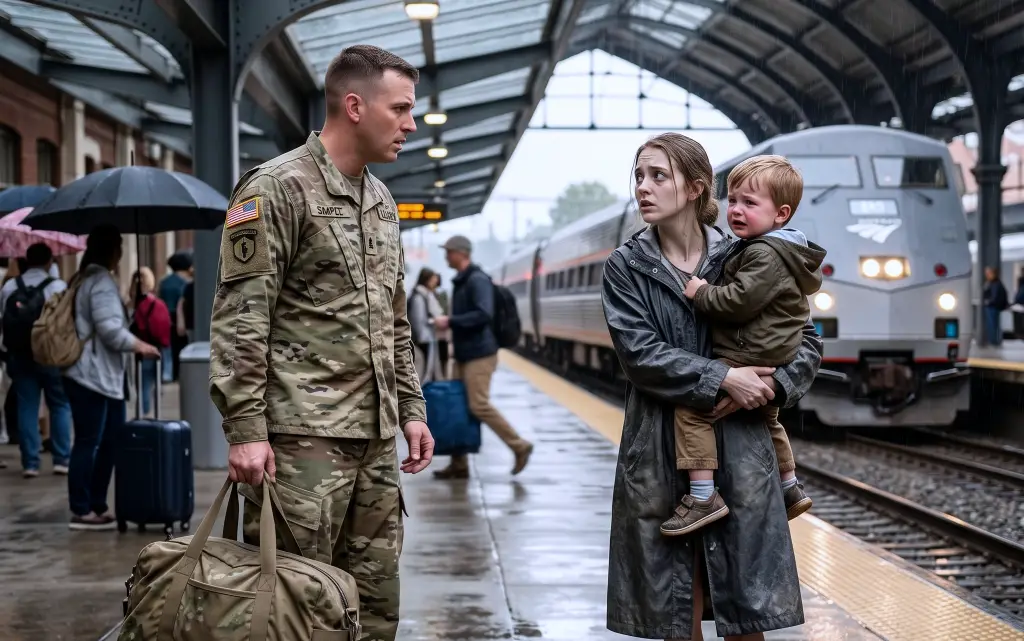
Daniel Harper stood in the middle of a tight circle of relatives, friends, and former classmates, a new olive-green duffel strap cutting across one broad shoulder. His hair had been trimmed short the day before, and the fresh Army jacket made him look older than nineteen, though the grin he kept forcing for everyone was still the same one he’d worn through high school. He shook hands, accepted rough slaps on the back, and promised half a dozen people he would call as soon as he got settled at training.
His left arm never let go of Emily Brooks.
She was folded against him, her face tucked into the front of his jacket, both hands clenched in the fabric like she could hold the train in place if she held him hard enough. Daniel kept his cheek near her hair and murmured little things meant only for her. He told her it was training, not a disappearance. He told her he would write. He told her he loved her, quietly enough that no one else could turn it into a scene.
Emily did not answer much. Every time she tried, her mouth trembled.
They had been together so long that people in the neighborhood spoke of them as if they were one person with two names. They had grown up on the same narrow streets in Fishtown, carrying backpacks past row houses with cracked front steps and window boxes in need of paint. Daniel had been the boy who walked Emily home when the older kids got loud on the corner, the one who carried her science project in seventh grade because the cardboard volcano kept leaning sideways. Emily had been the girl who saved him a seat, rewrote her neat class notes for him after football practice, and waited outside the gym with a granola bar because he always forgot to eat.
By senior year, their friendship had shifted so quietly that neither one could name the day it happened. One afternoon Daniel reached for her hand while they were walking along the Delaware River, and Emily simply let him. After that, the whole world seemed to arrange itself around the space between their fingers.
Standing a few feet away, Margaret Harper watched them with a face arranged into grief for the benefit of the crowd. She was dressed the way she dressed for City Hall: camel wool coat, pearl earrings, polished leather handbag, every gray-blond hair pinned into place. As a deputy commissioner in Philadelphia’s planning department, Margaret had spent years learning how to look sympathetic without surrendering control.
That morning, though, real tears had broken through her makeup. Daniel was her only child. The sight of him boarding a train south for Army training had shaken something loose in her, something she could not scold into silence.
Daniel’s father, Leonard, stood beside her with his hands in the pockets of his overcoat. He was a tall, tired man with a gentle face and a habit of swallowing whatever might upset his wife. Every few minutes he cleared his throat and patted Daniel’s shoulder, as if he could pass courage into his son by touch.
“You keep your head on straight,” Leonard said when the boarding announcement came. “Do what they tell you. Don’t try to be a hero on day one.”
Daniel smiled. “Yes, sir.”
“And call your mother,” Leonard added, glancing toward Margaret. “Often.”
“I will.”
The train slid into the station with a shriek of brakes and a long metallic sigh. The platform seemed to tighten around them. Friends stepped forward with last jokes that came out too loud. Emily’s mother, Janet Brooks, hugged Daniel and pressed a small brown paper bag into his hand.
“Peanut butter cookies,” she said, blinking fast. “Emily made them. I supervised.”
Daniel bent down and kissed her cheek. “Thank you, Mrs. Brooks.”
Margaret’s mouth tightened at that, but she said nothing. Not yet.
Emily finally lifted her face. Her eyes were red, but she had pulled herself together in that brave, stubborn way Daniel knew better than anyone. He cupped her cheek with one hand, and for a second the station, the friends, the parents, even the train seemed to fall back from them.
“I’ll wait,” she whispered.
“I know.”
“No matter how long.”
“It won’t be that long.” He tried to smile again and failed. “First leave I get, I’m coming home. We’ll figure everything out.”
She nodded because she wanted to believe him, because believing him was the only way to stand there and not come apart.
Margaret stepped forward and wrapped both arms around her son. She clung to him with a desperate, almost angry force, her manicured fingers digging into his back. Daniel held her tightly, then kissed her temple.
“I’m okay, Mom.”
“You don’t know that,” she said against his shoulder.
“I do.” He pulled back and tried to soften his voice. “This is what I want.”
That sentence hurt her more than the goodbye.
The conductor called for final boarding. Daniel lifted his duffel, kissed Emily once, hard and lingering, then climbed the metal steps into the train. He turned at the doorway and raised his hand. Everyone waved at once when the cars began to move, the whole little crowd leaning after him as if love could keep pace with steel.
Emily stood until the last window disappeared beyond the curve of the platform.
Only then did the noise of the station come back.
Janet touched her daughter’s shoulder. “Come on, sweetheart.”
Emily nodded, but her eyes stayed on the empty track. She was still looking when Margaret opened her handbag, took out a tissue, and dabbed beneath her eyes. The soft, grieving mother was gone by the time she turned.
“Emily.”
The girl looked up, startled by the sharpness of her name.
Margaret stepped closer, her voice low enough that the others would not hear every word but hard enough to make Emily go still. “The performance is over. You can stop hanging around my family now.”
Emily stared at her. “Mrs. Harper?”
“My son has a future. A real one. You are not part of it.”
Janet’s hand tightened on Emily’s shoulder, but Emily did not hide behind her mother. She stood straight, pale and trembling.
“Daniel and I love each other,” she said. “He knows I’m waiting for him.”
Margaret gave a small, humorless laugh. “You are a sweet girl, I’m sure. Sweet girls are everywhere. But Daniel is not going to throw away his life for the daughter of a woman who hems pants out of a basement sewing room.”
Janet flinched as if Margaret had struck her, but she did not speak. Pride held her chin up. Poverty had taught her silence, not weakness.
Emily’s voice came out barely above a whisper. “Why do you hate me so much?”
“I don’t hate you,” Margaret said. “I know exactly what you are. There’s a difference.”
Leonard appeared at his wife’s elbow, having heard enough to be ashamed but not enough, apparently, to defend anyone. “Margaret,” he murmured. “Let’s go.”
She ignored him for one more moment. “Find somebody from your own block, Emily. Someone who thinks a rented duplex and a coupon drawer are dreams worth having. Stay away from Daniel.”
Then she turned, allowing Leonard to guide her toward the parking garage.
Emily stood among strangers and suitcases, humiliated in front of her mother, the station lights too bright above her. Janet slipped an arm around her waist and held her there until she could breathe.
“She doesn’t get to decide your worth,” Janet said.
Emily nodded, but the words had already gone in. They settled somewhere under her ribs, not because she believed them, but because cruelty has weight even when it is untrue.
Margaret had been watching Emily for years. From the wide windows of the Harpers’ condo near Rittenhouse Square, she had seen Daniel walk the Brooks girl home after school, seen him touch her hair, seen him linger outside her narrow brick house as if leaving were a problem he could not solve. Each small tenderness had felt, to Margaret, like theft.
She had built Daniel’s life with the same precision she brought to zoning meetings and development proposals. He would attend a respected university. He would intern with people who mattered. He would marry someone who understood what kind of doors money and reputation could open. Margaret had already imagined him with Madison Pierce, the glossy, confident daughter of the man who owned a chain of home improvement stores across three states. Madison knew how to sit at a charity dinner. Madison belonged in rooms where decisions were made…
To read the rest of the story – CLICK the NEXT button 👇👇👇