


By four o’clock, the heat had settled so heavily over the north Georgia hills that the air inside the intake barn seemed to have weight. Beyond the block walls, the older elephants in Red Clay Elephant Refuge’s main pasture moved through the haze like gray ships, their low calls passing through the ground before they reached the ear. In the medical wing, though, everything was smaller and harsher: the tick of the wall fan, the plastic shine of IV tubing, the faint medicinal bite of disinfectant.
Dr. Nathan Carver stood outside the padded stall with one hand hooked over the steel gate. At fifty-four, he had learned not to flinch at neglect. He had seen horses with hooves curled like old wood, bears with broken teeth, parrots that had plucked themselves bare in cages too small for turning around. His work had taught him to move slowly, speak plainly, and keep grief out of his hands when an animal needed those hands steady.
The calf on the mat was making that nearly impossible.
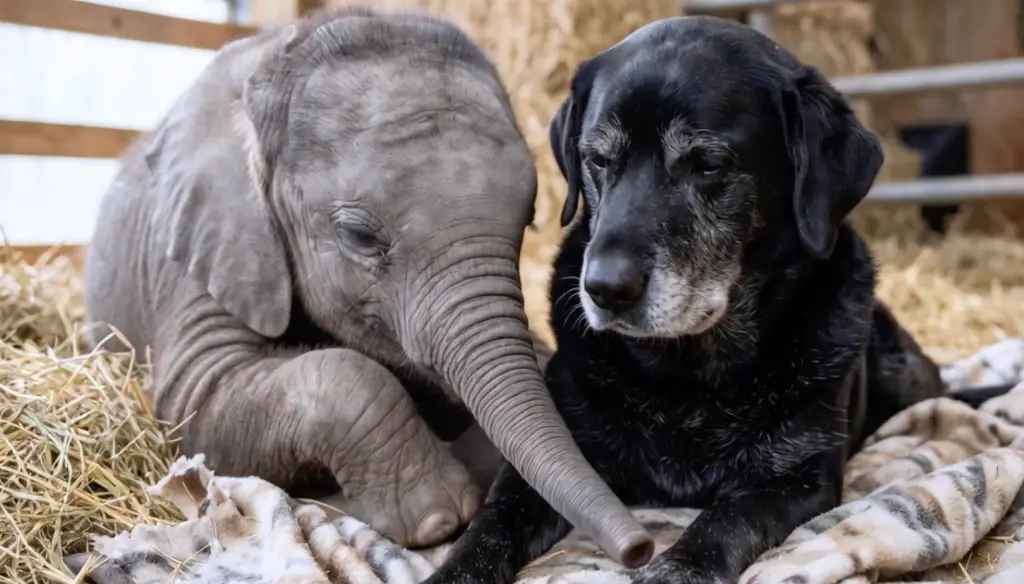
Benny was barely three weeks old, though his body looked even younger from starvation. He lay tucked into himself in the corner, his skin loose over his ribs, his little trunk folded under his chin as if he were trying to disappear inside it. Infection had taken both eyes before the rescue trailer ever reached Red Clay. The team had stopped the fever and brought his blood pressure back from the edge, but nothing could give him sight again. His eyes, swollen and clouded, no longer searched the room. They only wept.
Beside Nathan, Lila Brooks rested her forehead against the rail for half a second before straightening. She was the refuge’s senior elephant keeper, the kind of woman who could read a calf’s mood from the angle of an ear. That week, her shirt had carried a permanent crust of milk replacer, red clay dust, and the sour smell of worry.
“He’s breathing faster,” she said. Her voice was low, as if volume alone might hurt him. “And listen to the rhythm. It’s getting thin.”
Nathan had been listening for the last twenty minutes. “I know.”
“We can’t tube him again.”
He did not answer right away. In his mind he could still feel the terrible strength of Benny’s panic during the last forced feeding, the way the calf had thrashed against the restraint pads until his heart rate shot so high the monitor alarms turned the room into a siren. They had saved him from immediate starvation and stolen another piece of his trust in the same motion.
“We’re not tubing him today,” Nathan said.
Lila let out a breath, but it did not sound like relief. There were only so many ways to keep a baby elephant alive when he refused every one of them. Warm formula. Fresh hay. Mashed bananas. Quiet. Darkness. A matriarch on the other side of the fence, rumbling a reassurance Benny could feel through his feet. Nothing had reached him.
The calf had come in five days earlier, riding north in a climate-controlled livestock trailer after federal wildlife inspectors shut down a failing roadside animal park outside Mobile. His mother had been found down in a concrete pen, too weak to rise, her joints swollen from years on bad flooring. She died before the transport paperwork was finished. Benny arrived at Red Clay blind, orphaned, and already past the point where hunger made an animal frantic. He was in the quieter place beyond that, where the body begins to conserve itself for dying.
The door at the far end of the stall clicked open. Cole Mercer, one of the refuge’s large-animal handlers, stepped inside with a two-quart bottle tucked against his chest. He moved the way good handlers move around terrified animals: without apology, without threat, slow enough that each step asked permission.
Benny’s ears tightened flat against his head.
Cole stopped six feet away and lowered himself onto one knee. He did not reach for the calf. He only loosened the bottle cap a fraction, letting the scent of warmed formula, coconut oil, and supplements drift across the padded room. For one small, suspended moment, Benny’s trunk stirred. The tip lifted from his chest, trembling as it tasted the air.
Nathan felt Lila go still beside him.
The calf shifted forward. His front feet scraped softly on the rubber mat. Hunger, plain and ancient, pulled him a few inches out of himself.
Then memory took him back. Hands. Straps. Needles. The hard wall of a transport crate. Benny jerked away from the smell and drove himself into the corner so hard his hip bumped the padding. His trunk tucked tight again, and the wheeze in his lungs sharpened.
Cole stayed where he was. For nearly half an hour he murmured to the calf, not words so much as tone, the steady backwoods cadence he used with panicked livestock and newly rescued horses. Benny never moved again. At last Cole tightened the bottle and stood, the failure heavy in his shoulders.
When he came out, he did not bother pretending. He only looked at Nathan and shook his head once.
By late afternoon, the refuge’s small conference room smelled of old coffee and overheated copier paper. The window air conditioner rattled in the frame, fighting a losing battle against June. Helen Price, Red Clay’s executive director, sat at the end of the table with Benny’s bloodwork spread in front of her. She had run the refuge for eighteen years and had mastered the art of looking calm while money, weather, boards, and dying animals all pressed on her at once.
“His kidney numbers are moving the wrong way,” she said. “Not a little. Enough that I’m not comfortable pretending fluids are a plan.”
Lila sat across from her, hands folded so tightly her knuckles had gone pale. Cole leaned against the counter, arms crossed, staring at the floor.
Nathan picked up the lab sheet though he already knew every value on it. BUN. Creatinine. Electrolytes. The numbers confirmed what the room smelled like: dehydration, stress, the beginning of a body feeding on itself.
“He needs calories,” Helen said. “Not tomorrow. Not theoretically. Now.”
“We know that,” Nathan said.
“I’m not saying it to punish anyone.” Helen removed her glasses and rubbed the bridge of her nose. “But we have a blind calf with no mother, no herd attachment, and escalating distress every time we intervene. If he keeps refusing food, and the only available interventions make his suffering worse, we have to discuss where the line is.”
No one said the word. They all knew it. It lived in every sanctuary office, every veterinary clinic, every place where mercy sometimes arrived wearing the face of defeat.
Nathan set the lab sheet down. “He’s not gone.”
Helen looked at him for a long moment. “Tell me what you’re seeing that I’m not.”
“When the backup generator kicked on this morning, his left ear tracked the vibration. When Lila moved the feed cart outside the stall, he oriented toward the wheels before he realized people were near him.” Nathan tapped the file with two fingers. “He’s not neurologically absent. He’s not beyond response. He’s trapped in a world that stopped making sense.”
Lila’s eyes lifted to his. “But we’re part of what doesn’t make sense.”
“That’s the problem,” he said. “Every human smell means restraint to him. Every bootstep means something is about to happen to his body. Even kindness is getting translated as danger.”
Helen leaned back. “So what are you asking for?”
“Time.”
“We don’t have much.”
“Two weeks,” Nathan said. He heard how unreasonable it sounded and said it anyway. “If his organs crash, I won’t argue. If he moves into pain we can’t control, I’ll make the call myself. But give me two weeks to find a way into his world that doesn’t look or smell like us.”
Cole’s jaw worked once. Lila looked down at the table, then nodded as if it cost her something.
Helen was quiet. Outside, an elephant rumbled from the far pasture, and the vibration passed faintly through the soles of Nathan’s boots. Finally, Helen gathered the papers into one neat stack.
“Fourteen days,” she said. “Not one more if he starts suffering worse.”
After everyone left, Nathan remained in the conference room until the air conditioner clicked off and the sudden quiet made the building feel abandoned. Through the window he could see the roofline of the intake barn and the red wash of evening light over the paddocks. He had asked for time with the conviction of a man who had a plan.
He had no plan at all.
On his way out, he took the gravel path past the staff parking lot instead of heading straight to his truck. Red Clay shared a fence and a working arrangement with Pine County Animal Services, a low concrete shelter tucked behind a stand of pines. Nathan often stopped there after refuge hours to check stitches, look at a lame hound, or help the shelter staff decide whether a frightened dog was dangerous or only terrified.
That evening, the kennels sounded restless. Fans hummed above the runs, and the sharp smell of bleach clung to the wet floors. Paula Dempsey, the shelter coordinator, was rinsing a drain in the quarantine hall when she saw him.
“You look terrible,” she said.
“Good to see you too.”
“I mean professionally terrible.” She turned off the hose and looped it over one arm. “It’s the calf, isn’t it?”
Nathan leaned against the chain-link gate. “He’s still refusing. I got Helen to give me two weeks, which was either brave or stupid.”
“Those are cousins in your line of work.” Paula studied him for a second, then nodded toward the back kennels. “Come look at somebody.”
“I was hoping for an easy case.”
“You never come here for easy cases.”
She led him past the louder dogs to the last run on the left, where a large black Lab mix lay on a raised cot. He was broad through the chest, heavy in the head, with old working-dog muscle under a coat that still shone despite the shelter light. A fresh scar ran down one shoulder in a ragged pink seam. He did not bark when Nathan approached. He did not rush the fence. He lifted his head, met Nathan’s eyes, and thumped his tail once against the canvas.
“This is Scout,” Paula said.
The dog watched them with a steadiness that did not feel relaxed so much as emptied out.
“He came in from Montana,” she continued. “His owner was a backcountry guide. Took pack trips up near the Absarokas. Family said he and Scout went looking for a mule that slipped its tie line, and they walked into a grizzly on a carcass.”
Nathan crouched slowly. Scout’s gaze followed him, but his body stayed still. “The shoulder?”
“He tried to pull the bear off course.” Paula’s voice changed, losing its shelter briskness. “The guide didn’t make it. Search and rescue found Scout the next morning lying across him. Half frozen, torn open, wouldn’t let anyone touch the body. They had to sedate him before the paramedics could get close.”
Nathan looked at the dog’s paws, the worn pads, the tiny scars around the toes. This was not a pet who had wandered through life on soft carpet. This was a dog built around purpose, and the purpose had vanished.
“The guide’s sister lives outside Atlanta,” Paula said. “She drove all the way out to bring him home, but she’s in a second-floor apartment and works double shifts. He wouldn’t eat. Wouldn’t sleep. Wouldn’t look at her unless she had his old leash in her hand. She surrendered him because she thought we’d know what to do.”
“Do we?”
Paula’s mouth tightened. “He’ll take food from me if I sit on the floor and don’t talk. That’s about it. He’s not aggressive. He’s not fearful. He’s just waiting for a world that isn’t coming back.”
Scout lowered his head to his paws. His eyes stayed open.
Nathan remained crouched by the kennel, and the sounds around him shifted: dogs barking, water dripping, the buzz of a fluorescent bulb near the ceiling. Beneath it all, he thought of Benny folded into the corner of a padded stall, blind and motherless, refusing every human attempt to keep him alive.
A calf with no herd. A dog with no pack.
The idea arrived so suddenly Nathan almost dismissed it as exhaustion. Then he looked again at Scout’s still body, at the absence of tension in his mouth, at the way he did not stare hard or challenge or plead. The dog was not predatory in that moment. He was anchored to grief, and grief had made him quiet.
Paula saw his expression change. “Nathan.”
“I didn’t say anything.”
“You got the same look you had before you asked me whether a goat could donate plasma to a sheep.”
“That worked.”
“That worked once, barely, and I aged five years.” She folded her arms. “What are you thinking?”
Nathan stood, his knees stiff from crouching. He should have walked away before the thought became a plan. He should have gone home, slept three hours, and returned to the refuge with a clearer head.
Instead he looked through the chain link at the black dog who had guarded a dead man through a mountain night.
“I’m thinking Benny may not need another person,” he said. “He may need something alive that doesn’t want anything from him.”
Paula blinked. “That is a very careful sentence.”
“I need to borrow Scout tomorrow morning.”
“For what?”
Nathan did not answer quickly, because once spoken plainly, it would sound exactly as dangerous as it was.
“To meet an elephant.”
Helen Price said no before Nathan finished the second sentence.
They were in the clinic break room at 6:15 the next morning, the first staff meeting of the day still smelling of burnt toast and bitter coffee. Lila stood by the sink with her arms crossed. Cole sat backward in a chair, his forearms braced along the top rail. Helen remained standing, clipboard in hand, as if sitting down would imply the conversation deserved that much comfort…
To read the rest of the story – CLICK the NEXT button 👇👇👇