


The first time I wrote “embrace” in the behavior log, I put it in quotation marks. By the end of the second week, nobody at Pacific Ridge Wildlife Park was smiling about it. Bram, a twenty-eight-year-old silverback, had never been the sort of gorilla who begged for contact. He was calm, powerful, and careful with his attention. He allowed his keepers near him because trust had been built over years, not because he needed constant reassurance from anyone. Then, in late summer, he began reaching for one man again and again.
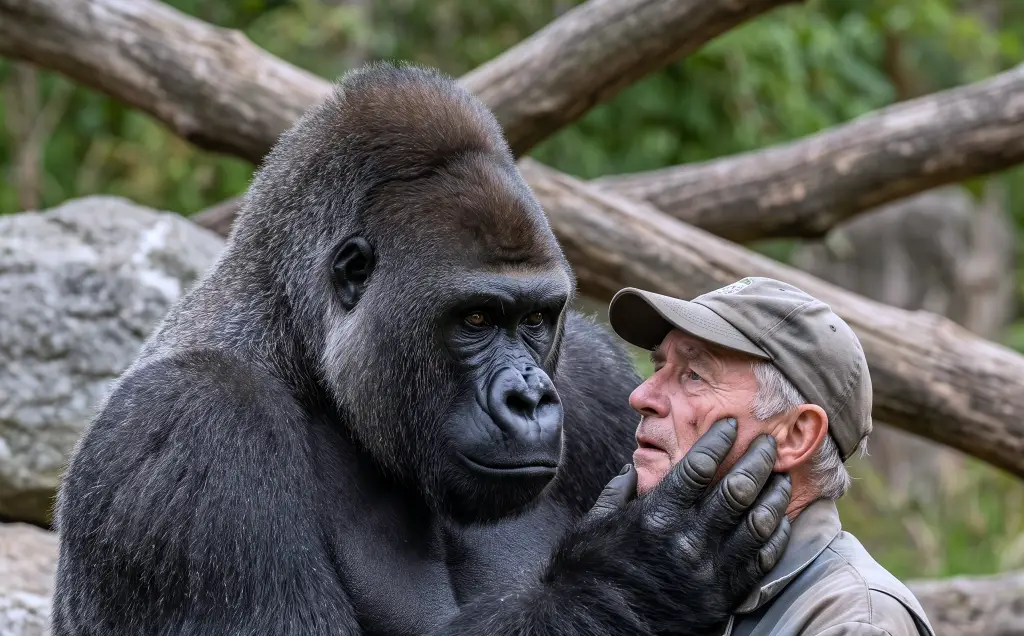
I’m Dr. Claire Mercer, and I had spent enough of my life around great apes to know the difference between a charming habit and a change that deserved a closer look. When the staff called me to the West Mesa Primate Center, I expected stress behavior, maybe a reaction to noise, routine changes, or pain. What I found was a four-hundred-pound silverback holding his keeper as if letting go had become dangerous.
Owen Hayward stood inside the habitat with Bram’s arms locked gently around him. Owen was fifty-five, gray at the temples, and as much a part of that building as the climbing ropes and steel gates. He had cared for Bram for twenty-five years. His hands rested against the gorilla’s back, not pushing, not pulling, only waiting.
I watched from behind the reinforced glass and started the timer on my phone. Four minutes passed. Then five. When Bram finally loosened his grip, he kept one broad hand on Owen’s shoulder and leaned in close, studying the man’s face.
“How often is this happening?” I asked.
Caleb Ortiz, a younger keeper with a tablet under one arm, gave a small, tired laugh that had no humor in it. “That’s the third one since breakfast. Yesterday we logged fifteen.”
“Fifteen touches?”
“Fifteen full holds. Arms around him. Chest to chest. Some quick, some long enough to stop the whole routine.”
He showed me the chart. Three months earlier, Bram had hugged Owen twice in a week. The next month, five. Then ten. Now the behavior was happening many times a day, rising so steadily that the graph looked less like affection and more like an alarm.
Bram did not do it with anyone else. When Caleb entered the habitat, Bram might glance at him and go back to his straw. When the veterinary tech came in, he watched but kept his distance. With Owen, he remained close enough to brush his wrist, tap his back, or rest a hand between his shoulder blades every few steps, as if checking whether the man was still where he was supposed to be.
“Food, medication, construction, new cleaning products?” I asked. “Anything different?”
“We’ve checked all of it,” Caleb said. “Nothing.”
“Owen’s schedule?”
“Same as always.”
“Any conflict between them?”
“No. Bram isn’t angry. That’s what makes it harder to explain. He’s careful with him.”
Inside the habitat, Owen bent toward a bucket and paused. His hand stayed on the handle while his eyes drifted toward the service corridor. It lasted only a few seconds, the kind of hesitation most people would excuse as fatigue. Bram saw it instantly. He crossed the habitat, settled near Owen’s side, and reached for him.
Owen gave the glass an embarrassed look. “Again, buddy? I’ve still got work to do.”
Bram folded him in anyway.
This time, I watched Owen instead of the gorilla. There was effort in his face, a tightness around his eyes that didn’t belong to the moment. He patted Bram’s back twice, trying to soothe him, but his own body had gone still inside the embrace.
“When did Owen start having trouble?” I asked.
Caleb’s face changed. He had been waiting for the question and dreading it.
“Six months ago,” he said. “Misplacing things. Forgetting which door he came through. Asking the same question twice. We all tried to make it normal.”
“And it isn’t normal anymore.”
Caleb looked through the glass, where Bram still held Owen. “Last week he called one of the females by the wrong name. Then he mixed up a feeding protocol he’s done for years. His wife finally got him to see a neurologist.”
The answer arrived before Caleb said it.
“Early-onset Alzheimer’s,” he said. “Stage one, but moving fast.”
For a moment, the only thing I could hear was the low hum of the air system. Bram released Owen and sat back, eyes fixed on him. It was not dominance, play, or a request for grooming. His gaze was steady, almost searching.
People say animals know when something is wrong, and often they mean it in a way science can’t touch. But this was not a pretty guess built on wishful thinking. The timing, the pattern, the way Bram reacted to Owen’s smallest lapses before anyone else moved—it was not proof yet, but it was enough to make my hands feel cold…
To read the rest of the story – CLICK the NEXT button 👇👇👇