


By six in the morning, the wildlife center was already making noise. A bald eagle thumped one good wing against a wooden perch in the raptor barn. Two yearling black bears wrestled over a cracked pumpkin in the lower yard, snorting and shoving until one of them slid through the mud on his backside. Somewhere near the clinic door, a raccoon recovering from a broken pelvis complained through the bars of his enclosure with the irritated confidence of an animal who believed breakfast was overdue.
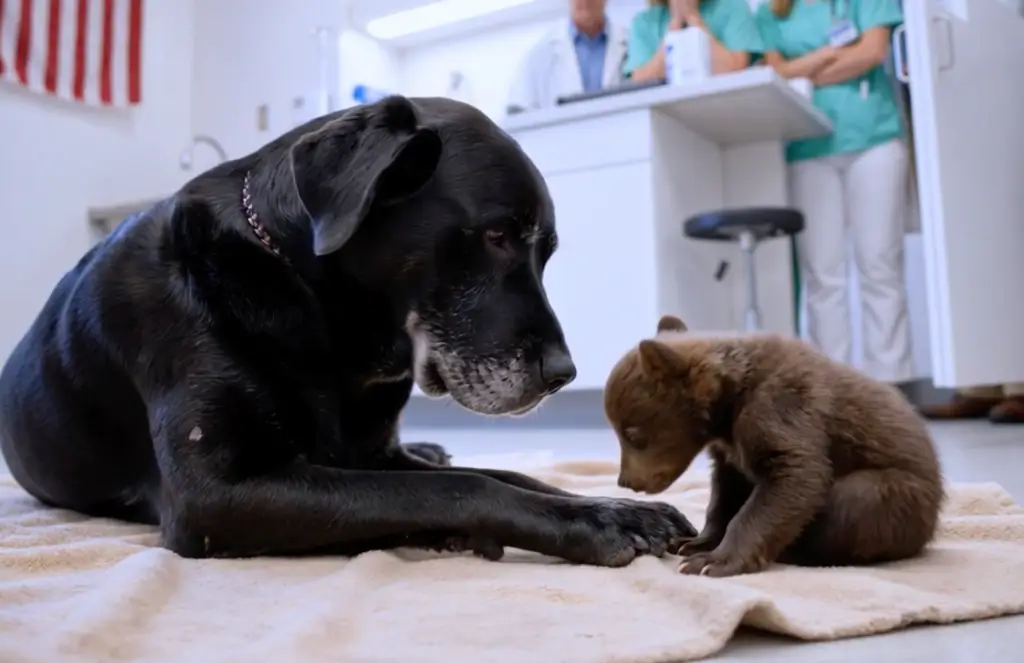
Cedar Hollow Wildlife Recovery sat in the folded green country west of Missoula, where the mountains rose dark and wet behind the service road and October mornings smelled like pine pitch, soaked leaves, and cold metal. Most mornings, the place felt rough but alive, the way a rescue center was supposed to feel. Injured animals were never quiet unless something was wrong.
That was why the silence in the isolation building had begun to frighten everyone.
The small shed stood past the clinic, beyond the feed freezer and the stacked bags of straw, where the fog gathered low against the chain-link fence. Inside, under two red heat lamps, a grizzly cub lay curled in a nest of clean shavings and fleece. He was so small he could have fit inside a laundry basket. His paws looked too large for his body, his ears too round, his ribs too easy to count under the patchy brown fur.
His name was Ash.
Dr. Matthew Hale had named him on the second night, not because the cub looked strong, but because he looked like something left after a fire. The name had come out before Matt could stop it, and by then the staff had already started using it in their charts. Ash, male grizzly cub, estimated three and a half weeks old. Severe dehydration on intake. Corneal rupture and infection, bilateral. No visual prognosis. Failure to nurse.
Failure to fight was what Matt had not written.
He stood outside the mesh barrier with a half-finished coffee in his hand and watched the cub breathe. Each breath seemed to cost Ash something. His narrow chest lifted, trembled, and settled again. Pale discharge crusted below both sealed eyes, and his nose, usually the busiest part of a bear cub, barely moved unless someone came too near.
Rose Bennett stepped into the passage behind Matt without speaking at first. She had been at Cedar Hollow nearly sixteen years, long enough to raise orphaned foxes in her kitchen sink and tube-feed owlets through snowstorms. She could smell trouble in an animal before the lab work confirmed it. That morning, she held a clipboard against her coat as if it were the only thing keeping her hands still.
“He dropped again,” she said.
Matt did not ask what she meant. He could see it.
“Temperature?” he said.
“Low enough that I checked it twice.” Rose glanced through the mesh. “His gums are tacky. He didn’t touch the last bottle. Not even a reflex bite.”
From the far side of the shed, the heat lamps painted the walls a dull red. They had warmed the fleece. They had warmed the air. They had not reached whatever place inside the cub had gone cold.
Five days earlier, two state wildlife officers had carried Ash into the clinic in a plastic crate lined with a sheriff’s department towel. They had found him in a draw above an old logging cut, nosing blindly at the body of his mother. Someone had killed the sow, stripped what they wanted, and left the rest in the brush. The cub had stayed with her until his cries led the officers down the slope.
By then, infection had already taken his eyes.
Matt had seen animals come in worse. He had wired jaws back together, cut snares out of swollen flesh, and sat on the clinic floor at two in the morning counting breaths for animals that hated him for saving them. Pain had a language. Fear had a rhythm. Even shock had patterns a veterinarian could follow.
Ash was different.
His fever had broken. The antibiotics were working. The fluids had brought his blood pressure back from the edge. There was no medical reason, not one that fit neatly on a chart, for the cub to keep refusing milk. Blind grizzlies could not go back to the wild, but a protected sanctuary could give him a life. He could grow, learn, smell his way through timber and water and dirt.
He only had to decide to live long enough to get there.
Luke Hollis came in through the outer door with a bottle tucked under his jacket to keep it warm. He was the lead keeper, broad-shouldered and quiet, the sort of man who could move a sedated bear without raising his voice. With Ash, Luke had become almost unbearably gentle.
He set the bottle on a metal stool, knelt, and waited.
Ash did not lift his head.
“Hey, little man,” Luke murmured. “I’m not asking for much.”
He did not reach straight for the cub. He let the back of his fingers touch the fleece first, then the shavings, then the air beside Ash’s shoulder. The cub’s skin jumped at the change in pressure. His spine tightened. One paw pulled closer under his chin.
Luke stayed where he was.
After several minutes, he brought the bottle down until the nipple touched the edge of Ash’s mouth. Steam lifted faintly from the warmed formula. The smell of milk filled the shed, rich and sweet, and for one second the cub’s nostrils flickered.
Rose leaned forward despite herself.
Ash opened his mouth just enough for Luke to hope.
Then he turned his head and tucked his nose under one foreleg.
No cry. No struggle. No angry swipe of a paw.
Just refusal.
Luke closed his eyes for a moment, not in frustration, but in grief. He held the bottle there until it cooled in his hand. When he finally stood, his knees cracked in the cold.
Matt looked at the bottle. “Anything?”
Luke shook his head once. “He knows it’s food. That’s not the problem.”
No one answered, because they all knew he was right.
Two hours later, the senior staff gathered in the narrow office attached to the clinic. The heater clicked and rattled beneath the window, losing its fight against the damp. Lab sheets lay across the folding table, weighted down by a roll of tape and somebody’s empty travel mug. The numbers were not dramatic. They were worse than that. They were steady, clinical, and clear.
Janice Price, Cedar Hollow’s operations director, read them twice before she set the paper down.
“Matt,” she said, “we need to talk about where this is going.”
Rose looked at the floor. Luke folded his arms and stared out the little window toward the yard, where rain had begun to bead on the glass.
Matt stayed standing. He had not taken off his coat. “Say it.”
Janice rubbed the corner of the lab report between her thumb and forefinger. She had a practical face, not unkind, but built by years of making decisions nobody wanted. “We can keep pushing fluids. We can warm him. We can run another panel tonight. But if he keeps refusing nutrition, this isn’t recovery. It’s a slow shutdown.”
The word they were all avoiding sat in the room anyway.
Matt had signed that form before. Not often, never easily, and only when suffering had become the only future left. He believed in mercy. He believed in limits. But he also believed in the tiny heartbeat he had heard under his stethoscope the day before, stubborn and quick inside a body that had already lost too much.
“Give me a little more time,” he said.
Janice’s eyes lifted to his. “How much?”
“Two weeks.”
Rose made a small sound, almost a protest.
Matt looked at each of them. “If he won’t drink voluntarily by then, I won’t drag this out. I’ll make the call myself.”
No one spoke for several seconds. Rain tapped the trailer roof. Outside, one of the yearlings barked at a raven stealing scraps from a feed bucket.
Janice pushed the lab report back toward him. “Two weeks is a long time when an animal is starving.”
“I know.”
“Do you?”
That landed harder than Matt expected. He had known Janice for twelve years. She did not accuse people unless she had run out of softer ways to protect them.
He sat down finally, the chair legs scraping against the cheap linoleum. “I know exactly what I’m asking. But there’s something under the fear. He’s not gone. Not yet.”
Rose looked up then, and for a moment the exhaustion in her face made her look older. “We’ve tried the sow recordings. We tried the scent cloths. We tried putting Willow in the neighboring pen, and he almost quit breathing from panic. What’s left?”
Matt had no answer he was ready to say out loud.
But he had heard something that morning from a volunteer at the county shelter. A dog, she had said while dropping off towels. Big old Lab mix. Sweet as anything, or used to be. Lost his person up in the timber. Won’t eat unless someone feeds him by hand.
At the time, Matt had only nodded. Now the comment sat in his mind like a match waiting for air.
When the meeting broke up, he did not go back to his office. He walked through the clinic, past the refrigerator of vaccines, past the whiteboard with feeding schedules and medication times, and stopped outside the isolation shed. Through the mesh, Ash had not moved. His little body had tightened into the smallest shape it could make.
Matt stood there until Luke came up beside him.
“You’re thinking too loud,” Luke said.
Matt almost smiled. “There’s a dog at Granite County Animal Services.”
Luke turned his head slowly. “A dog.”
“A grieving dog.”
“That’s not a protocol.”
“No,” Matt said. “It’s not.”
Luke did not answer right away. His eyes went to the cub, then back to Matt. “A canine scent could scare him bad.”
“I know.”
“And if the dog reacts wrong?”
“I know that, too.”
Luke let out a tired breath. “Then why are you looking at me like you’ve already decided to drive down there?”
Because Matt had spent his life learning the difference between a desperate idea and a reckless one. He did not yet know which this was. He only knew that medicine had reached the edge of what it could do, and the cub on the floor had no mother, no sight, no map of the world that remained.
“I’m going to meet him,” Matt said. “That’s all.”
Luke nodded once, though neither of them believed it was all.
The county shelter sat behind the fairgrounds, in a low concrete building where the wind pushed dry leaves against the fence and the outdoor kennels rang with barking. By the time Matt pulled in after evening rounds, the sky had gone dark purple over the mountains. A sodium light buzzed above the gate.
Nora Delgado, the shelter manager, came out with her keys already in her hand. She had worked enough emergencies with Matt to skip small talk. One look at his face and she unlocked the side entrance.
“He’s in medical,” she said. “Not because he’s contagious. He just can’t handle the main runs.”
“What’s his name?”
“Boone.”
The name fit before Matt saw him.
The dog lay on a folded army blanket inside the last kennel, black coat dulled with shelter dust, head resting between his paws. He was large, deep-chested, with the blocky skull of a Lab and something heavier in his build. Stitches ran along one shoulder where the fur had been shaved clean. At the sound of Nora’s voice, his tail gave one polite tap against the blanket, then went still.
“He belonged to a man named Walt Mercer,” Nora said softly. “Retired timber cruiser. Lived alone above Lolo Creek. Boone went everywhere with him. Grocery store, gas station, every trail Walt could still walk.”
Matt crouched outside the kennel door. Boone did not bark. He did not rise. His brown eyes shifted toward Matt with the dull courtesy of a dog who remembered manners but no longer saw the point of using them.
“What happened?”
Nora hooked her thumbs in the pockets of her shelter vest. “Cougar came into the yard after dark. Walt went out with a flashlight. Boone got between them.” She paused, not for drama, but because she had probably told the story too many times already. “Deputies found Walt the next morning. Boone was lying across him, bleeding through the porch boards. Wouldn’t let anybody close.”
Matt watched the dog’s side rise and fall.
“We patched him up,” Nora continued. “He should be improving. Physically, he is improving. But he waits. That’s all he does. If I sit with him and hand him food, he’ll take a little. If I leave the bowl, he ignores it.”
The parallel was so sharp Matt felt it under his ribs.
A blind cub in a red-lit shed. An old dog on a shelter blanket. Two animals whose bodies had survived the first blow, only to find the world afterward unlivable.
Boone turned his head toward the corridor, where a man’s boots had struck the concrete somewhere out of sight. The dog listened, ears lifting with sudden focus. For three seconds, something almost alive returned to his face.
Then the footsteps passed.
Boone lowered his head again.
Matt stood slowly. The idea in him, foolish and dangerous an hour ago, began to take on shape. Not certainty. Never that. But shape.
Nora watched him carefully. “You’re not here about a consult, are you?”
“No.”
“What are you thinking?”
Matt looked at the old dog, at the stitches, at the tail that did not move again. “I’m thinking grief recognizes grief sometimes.”
Nora’s mouth tightened. “That sounds like something people say right before they do something they can’t put in a report.”
He gave a small, humorless laugh. “I can put anything in a report.”
“Doesn’t mean the report will make sense.”
No, Matt thought. It probably wouldn’t.
But when he left the shelter an hour later, after sitting on the concrete outside Boone’s run and watching the dog take three pieces of kibble from Nora’s palm and refuse the fourth, Matt knew he would not sleep. He drove back through the dark with the wipers beating time against the windshield, thinking of scent, stress, maternal absence, canine calming signals, controlled rooms, escape routes, liability forms, sedation plans, and the little cub whose body had begun to cool under a heat lamp.
At home, he opened his laptop at the kitchen table and searched until the coffee in his mug went cold. He read about cross-fostering, neonatal stress, dogs used as social bridges for cheetah cubs, livestock guardians, trauma responses, and every strange exception he could find where one species had helped another remember how to be alive…
To read the rest of the story – CLICK the NEXT button 👇👇👇