


Marcus Bell had imagined the arrivals hall so many times that the picture had started to feel dangerous. Tessa would be near the railing, trying not to cry in public. Ava would be bouncing on her toes with a handmade sign, her missing front tooth showing when she smiled. He would drop his duffel, scoop both of them into his arms, and for the first time in fourteen months, no one would be bleeding, shouting, or calling for a medic.
By the time his plane dipped toward Riverton, his eyes burned from lack of sleep. Twenty-two hours of travel had wrinkled his uniform and hollowed out his face, but his phone buzzed in his palm, and for a few seconds the fatigue loosened its grip.
A text from Tessa waited on the screen.
Ava says your plane better not be lost. She used half a bottle of glitter on your sign. Please hurry.
Marcus smiled with his head against the window. The city lights below blurred through the oval glass, gold and white in the dark. He typed back with his thumb.
Landed soon. Fifteen minutes after bags. Tell my girl I’m coming.
Ava had been five when he left. She was six now, which felt impossible and unfair, as if the world had kept raising his child without asking permission. He had missed the unicorn birthday cake, the first loose tooth, the first day of kindergarten, and too many bedtime calls where her face froze on the screen while her voice kept talking from a continent away.
In the duffel above him was a lavender stuffed bunny, soft as a secret and already a little worn from being carried across half the world. He had bought it in a small exchange in Kuwait because Ava loved purple and because he needed something to hold on to that had nothing to do with war. It had traveled with him through dusty tents, hot cargo holds, and one night when a mortar landed close enough to shake grit down from the roof.
Beside the bunny, tucked inside a folder, was the citation for his Bronze Star.
He did not like looking at it. The paper made a clean thing out of a day that had not been clean. Four months earlier, a convoy outside Forward Operating Base Sparrow had hit an explosive buried beneath the road. Marcus remembered the sharp white flash first, then the heat, then the ringing that swallowed every sound except screaming.
A vehicle lay on its side, burning at the edges. A young lieutenant was trapped beneath twisted metal, pale under the dust, one leg bent wrong, blood spreading too fast through the sand. Marcus had not paused to measure courage or fear. He had moved because training lives in the body before thought can catch up.
The lieutenant grabbed at him with a hand slick from blood. “Don’t leave me. Please, man. My name’s Caleb.”
“I’ve got you, Caleb,” Marcus said, pressing both hands where the bleeding was worst. “Look at me. Keep looking at me.”
The medevac could not land right away. Smoke rolled low across the road, and someone shouted coordinates Marcus barely heard. His arms cramped. His fingers went numb. The lieutenant begged him not to let go, and Marcus kept saying the same thing, steady as he could make it.
“I’m here. I’m not moving.”
Eleven minutes was not long in ordinary life. In the sand, with a man trying not to die beneath your hands, eleven minutes became a country of its own. By the time the helicopter finally took Caleb away, Marcus’s sleeves were soaked through, and his knees shook when he stood.
Two weeks later, Brigadier General Samuel Whitaker came out to the base for a medal ceremony. Marcus stood in line with the other soldiers and tried not to think about how badly he wanted to be home. When the general reached him, he pinned the Bronze Star to Marcus’s chest with fingers that trembled only once.
“You did more than your duty, Staff Sergeant,” Whitaker said.
“Thank you, sir.”
The general held his hand a second longer than regulation required. His eyes shone in a way Marcus did not understand, not from weakness but from something held too tightly for too long. Then the ceremony moved on, and Marcus put the moment away with all the other things he did not have room to carry.
Thirty rows ahead of him now, in seat 2A, that same general sat in a navy blazer and khakis, his posture too straight for a commercial flight. Whitaker had noticed Marcus during boarding, exhausted in a window seat, already half asleep. He had almost gone back to speak to him, then stopped himself.
Let the man rest, he had thought. There would be time.
The plane touched down at 6:34 p.m. Marcus waited for the aisle to clear, shouldered his duffel, and followed the slow river of passengers into Riverton International Airport. Terminal C smelled like floor polish, coffee, and fast food grease. Suitcases clattered over seams in the tile, and the monitors above baggage claim flickered with delayed flights and carousel numbers.
Flight 2187: Carousel 6.
Marcus descended the escalator with one hand on the rail and one thumb resting over Tessa’s last message. He was already picturing Ava’s glitter sign when he stepped onto the baggage level and turned toward the carousel.
Across the hall, Sergeant Frank Harlan watched him.
Harlan was forty-two, square through the shoulders, with a face that had learned to look bored while enjoying itself. He had been with the Riverton Airport Police for nearly two decades. Fourteen civilian complaints sat in his file, all dismissed, all smoothed over by people who knew which forms to lose and which witnesses not to call.
Officer Evan Crowe stood beside him, young enough to still believe cruelty could look like confidence. Officer Miles Denton lingered half a step back, uneasy but quiet. He saw Harlan’s gaze lock onto Marcus and knew, without being told, that the evening had just narrowed around one person.
“That one,” Harlan said.
Crowe followed his line of sight. “The soldier?”
“Uniform’s too clean in the wrong places and too wrinkled in the others.” Harlan’s mouth tilted. “I’ve seen this act before.”
Denton shifted. “Maybe he’s just tired.”
Harlan glanced at him. “Did I ask you?”
Denton looked away.
Twenty yards behind Marcus, General Whitaker pulled a black roller bag from a neighboring carousel. Nothing about him announced rank. No ribbons, no stars, no aides trailing behind. But his eyes stayed on the three officers as they began moving, and the old instinct in him tightened.
He stopped beside a column.
Marcus did not notice any of them until Harlan stepped into his path.
“Sir,” Harlan said, with a politeness too sharp to be real. “Identification.”
Marcus turned, surprised but not alarmed. “Sure, officer.”
He set the duffel down, reached into his pocket, and handed over his military ID. His movements were careful. He had learned long ago that careful could keep a situation from becoming something worse.
Harlan took the card between two fingers as if it were dirty. He looked from the photo to Marcus’s face, then back again. The baggage carousel hummed to life behind them.
“Where’d you get this?”
Marcus blinked. “It’s mine.”
“That wasn’t the question.”
“I’m active-duty Army. Staff Sergeant Marcus Bell, Second Brigade, Ninety-Fourth Airborne.”
Crowe stepped closer. Denton moved to Marcus’s other side because Harlan expected it, not because he wanted to. Travelers flowed around them at first, annoyed at the obstruction, then slowed as the tone of the exchange changed.
Harlan turned the card in his hand. “This is supposed to impress me?”
“No, sir. It’s just my ID.”
“Looks fake.”
Marcus felt the first cold thread of worry move through him. “It isn’t. You can scan it. The hologram’s on the back.”
“I know how to spot a fake.” Harlan let the card drop. It skidded across the tile and landed near Marcus’s boot. “Putting on a uniform doesn’t make you a soldier.”
A woman behind them stopped walking. A man in a business suit lifted his phone, then pretended he was checking a message. Marcus looked down at the ID and then back at Harlan, measuring every breath.
“Officer, I’m just trying to get home to my wife and daughter.”
Harlan smiled then, small and flat. “You hear that, boys? Family man.”
Crowe reached for Marcus’s duffel before Marcus could stop him. “Mind if we take a look?”
Marcus did mind. He minded with every part of himself. But Harlan was close enough that Marcus could smell stale coffee on his breath, and Crowe’s hand was already on the zipper.
“I have nothing illegal in there,” Marcus said.
“Then you won’t mind,” Harlan replied.
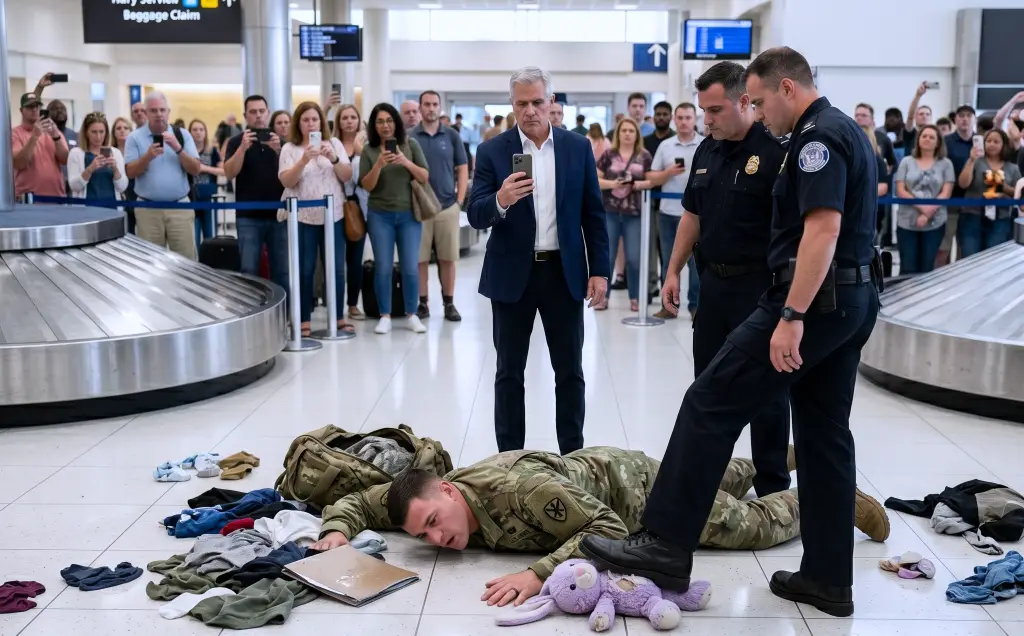
Crowe unzipped the duffel and dumped it upside down. Socks, T-shirts, a shaving kit, a paperback, the folder, and the lavender bunny spilled across the polished floor. Shampoo popped open and leaked in a clear streak toward the Bronze Star citation.
Marcus’s chest tightened. “Careful with that folder.”
Crowe laughed under his breath. “He’s got paperwork.”
The bunny rolled once and stopped beside Denton’s boot. Its stitched smile faced up, one ear bent from travel. Marcus looked at it and thought of Ava asleep with both hands tucked under her cheek, waiting for morning because he had missed too many nights.
“That’s for my daughter,” he said quietly.
Denton looked down. For one second he seemed embarrassed. Then Harlan’s eyes found him, and whatever small decency had surfaced in him disappeared under the need to belong. Denton pressed his boot onto the bunny’s soft foot.
He did not stomp. He ground down slowly.
Marcus’s hands curled at his sides and opened again. His daughter’s gift flattened under airport grime while a dozen phones rose around him. He could feel the shape of the trap closing.
“Pick up my ID,” he said.
Harlan stepped nearer. “What did you say?”
“I said pick up my ID, please.”
“Get on your knees.”
The words fell between them, and all the movement in Marcus’s body stopped. He saw Crowe’s hand drift toward his cuffs. He saw Denton’s jaw working. He saw Harlan waiting, hungry for the smallest wrong motion.
Marcus thought of Tessa at arrivals with Ava’s glitter sign. He thought of the men he had worked on in dust and smoke. He thought of all the ways a story could be written afterward if he gave them even one twitch to use against him.
So he lowered himself to his knees.
“Hands behind your head,” Harlan said.
Marcus obeyed.
The crowd had thickened into a loose half-circle. People held their phones at chest height, eye level, shoulder height. A teenage boy whispered something about views. An older woman covered her mouth, then turned away as if distance could excuse silence.
“Face down,” Harlan said.
“I’m cooperating.”
“Face down.”
Marcus lowered himself, but not fast enough for Harlan. A boot struck the back of his knee, and his cheek hit the tile hard enough to send pain through his teeth. The floor was cold. A smear of spilled shampoo touched his sleeve. Ava’s damaged bunny lay inches from his face.
Crowe pulled Marcus’s wrists back and cuffed him tighter than necessary. The metal bit into skin. Marcus breathed through his nose and held still, because stillness was the only defense left to him.
Harlan circled him with the lazy confidence of a man performing for an audience. “You people think a costume gives you respect. You think nobody’s going to ask questions if you walk around dressed like a hero.”
Marcus stared at the bunny’s plastic eye and said nothing.
“Got quiet now, didn’t you?” Harlan crouched. “No speeches? No brave soldier routine?”
Behind them, General Whitaker lifted his phone and began recording.
He was close enough now to read Marcus’s name tape. Close enough to see the scrape blooming red on the soldier’s cheek. Close enough to hear the word costume and understand that this was not confusion, not caution, not procedure gone wrong.
This was pleasure.
Crowe picked up the folder from the shampoo and shook it once. “What’s this supposed to be?”
Marcus closed his eyes briefly. “Don’t damage that.”
Crowe opened it anyway. His voice rose, mocking the formal language. “Awarded for gallantry in action. That’s rich.”
He dropped the paper back onto the floor, and when his boot came down over one corner, Marcus felt something in him go very quiet. Not peaceful. Not calm. Just sealed off.
Harlan turned toward the watchers. “Folks, step back. We’ve got a possible impersonation situation. Stolen military property, fraudulent identification, maybe more. We’re taking care of it.”
A few people shifted backward. Nobody left.
Crowe picked up the bunny by one ear. “This part of the act too?”
Marcus lifted his head a fraction. “Please. That’s my little girl’s.”
Crowe tossed it. The bunny struck Marcus near the temple and landed in front of him, dusty now, its foot crushed flat. Something in the crowd moved, a soft collective discomfort, but still no one stepped forward.
Harlan began to speak again, and then a voice came from behind him.
“That’s enough.”
It was not loud. It did not need to be.
Crowe spun first. Denton followed, one hand dropping from his belt as if he suddenly remembered where he was. Harlan turned last, irritated at being interrupted, and found himself facing a tall man in a navy blazer with silver hair and eyes that did not blink.
“Sir, back up,” Harlan said. “This doesn’t concern you.”
General Whitaker looked past him to Marcus on the floor. Then he looked at Harlan again.
“You’re wrong about that.”
“I said move back.”
“I heard you.” Whitaker held up his phone. “I’ve also heard the last three minutes. Every word.”
Harlan’s expression tightened. “This is an active police matter.”
“And that is an active-duty soldier under my command.”
For the first time, Harlan really looked at him. The irritation drained out of his face and left something stranger behind, a flicker of recognition so quick most people would have missed it. Whitaker did not miss it. He had spent thirty years noticing what men tried to hide.
Denton’s voice came out thin. “Who are you?”
“Brigadier General Samuel R. Whitaker, United States Army. Commanding officer, Second Brigade Combat Team, Ninety-Fourth Airborne Division.”
The terminal seemed to draw in around them. Phones shifted. Someone whispered, “Oh, man.”
Whitaker stepped closer to Harlan, not touching him, not raising his voice. “Get those cuffs off him.”
Crowe looked at Harlan. Harlan said nothing. Denton moved first, kneeling beside Marcus with hands that had begun to shake. Crowe fumbled with the cuffs, and when they finally opened, Marcus pushed himself up slowly, every movement measured.
“Staff Sergeant,” Whitaker said, his voice changing. Softer now, but no less firm. “Stand up.”
Marcus rose. His cheek burned, his wrists ached, and his uniform was stained with whatever had spilled from his bag. He looked at Whitaker and swallowed once.
“General.”
Whitaker turned back to the officers. The crowd had gone silent in the way people do when they realize they are witnessing consequences arrive in real time.
“Staff Sergeant Marcus Bell is a combat medic,” Whitaker said. “He returned tonight from a fourteen-month deployment. He has saved seven soldiers under fire. Four months ago, outside Forward Operating Base Sparrow, he pulled a lieutenant from burning wreckage and kept that man alive with his hands until evacuation arrived.”
Harlan’s face had gone gray at the edges.
“Eleven minutes,” Whitaker continued. “That’s how long he held pressure on a severed artery while rounds were still being called in and smoke covered the landing zone. I pinned a Bronze Star on him for it. The citation your officer just stepped on is not a prop. It is a record of what this man did when someone else was dying.”
Crowe looked at the paper on the floor as if he had never seen it before.
Whitaker lowered his phone. “You threw his identification on the ground. You dumped his belongings. You damaged a child’s toy. You put a decorated soldier face-down on an airport floor while people filmed him like an animal in a cage.”
Harlan opened his mouth. “General, we had reason to believe—”
“No.” Whitaker cut him off quietly. “You had an opportunity. There’s a difference.”
No one moved.
“This recording has already been uploaded to secure storage,” Whitaker said. “Copies are going to Army legal, civilian counsel, and federal oversight offices. I’d choose my next words with care.”
Harlan looked over Whitaker’s shoulder, searching for an exit that was not there. Crowe stared at the floor. Denton’s face had settled into the pale misery of a man realizing too late that silence had been a choice.
Whitaker turned to Marcus. “Gather your things.”
Marcus bent down. The movement hurt more than he expected. He picked up his ID, the damp folder, his clothes, and finally the bunny. He brushed at its flattened foot with his thumb, but the dirt did not come off.
For a moment, he looked at Harlan.
He had words for him. Plenty of them. But Ava was waiting, and Tessa was waiting, and Marcus had spent fourteen months learning which battles kept a person alive and which ones swallowed him whole.
He said nothing.
Whitaker took the duffel from him without asking and walked beside him toward arrivals. Behind them, three officers remained where they were, surrounded by phones, scattered shame, and the first sound of their own undoing…
To read the rest of the story – CLICK the NEXT button 👇👇👇