


By 8:30 that morning, every bench in Courtroom 4 had already filled. Reporters sat along the back wall with their notebooks balanced on their knees. A sketch artist had taken the seat nearest the aisle. Out in the hallway, two local news vans idled beside the curb, their satellite masts pointed toward a pale Ohio sky. Inside, nobody spoke above a whisper. Even the bailiff moved carefully, as if a careless footstep might disturb something that had not yet found the courage to happen.
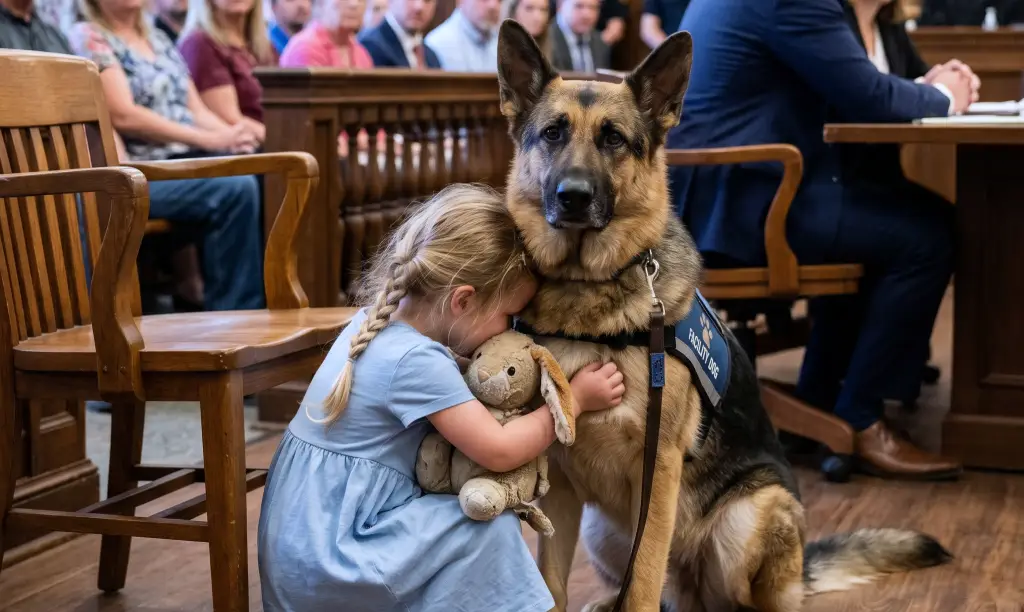
Assistant District Attorney Claire Donnelly stood at the prosecution table, rereading notes she had nearly memorized. The file in front of her was thick with photographs, hospital reports, 911 transcripts, statements from neighbors, and conflicting timelines. Still, the whole case had narrowed to one impossible question.
Would a three-year-old child talk?
Emma Reed had been the only person awake in the apartment the night her mother, Hannah, was found on the kitchen floor, barely conscious and badly hurt. For six weeks afterward, Emma had not said a single word about it. Not to police. Not to doctors. Not to the emergency foster mother who tucked her in every night and sat beside her bed until she finally slept.
The defendant, Evan Porter, sat at the defense table in a navy suit that looked too new for him. He had been Hannah’s boyfriend for almost a year. The police had arrested him quickly after neighbors reported hearing them argue days before the assault. But his attorney, Preston Wade, had built his defense around a timeline that made the case feel less solid with every hearing.
Claire had never liked Wade. He was too polished, too certain, too quick to smile when someone else was cornered. He was the sort of lawyer who made jurors feel chosen when he looked at them, and small when he turned away.
Judge Marion Kline entered from chambers at exactly 9:00 a.m. She was known for patience, but not softness. She had spent twenty-three years on the bench and did not tolerate courtroom theatrics, especially when children were involved. That morning, though, even she paused before taking her seat.
The side door opened, and Linda Carver stepped in with Emma.
The little girl wore a yellow cardigan over a denim dress, white socks folded neatly above her Mary Janes. One of her braids had already begun to loosen. Under her arm, she carried a stuffed rabbit with one cloudy plastic eye and a patch sewn crookedly across its belly. Her other hand held Linda’s fingers with a grip so tight the woman’s knuckles had gone pale.
A murmur passed through the gallery, then disappeared as soon as it began.
Behind Emma came Ranger.
He was a German Shepherd, large enough that his shoulders nearly reached Emma’s chest, but he moved with practiced quiet. A blue facility-dog vest covered his back, the Millstone Police Department patch sewn over one side. Detective Marcus Hale held the leash loosely, though Ranger did not need much guiding. He crossed the courtroom with his head low, ears relaxed, eyes watchful.
Emma stopped just inside the rail.
Her gaze moved over the jury box, the flags, the judge’s bench, the rows of strangers. She looked at the witness chair and then at the defense table. Evan Porter stared down at his clasped hands. Preston Wade watched her with a polite expression that did not reach his eyes.
Claire felt her own breath slow.
For weeks, people had debated whether it was right to put Emma in this room. A child trauma specialist had testified that forcing her to speak could cause harm. The defense had argued she was too young to understand truth from imagination. Judge Kline had agreed to a careful arrangement: Ranger could sit beside Emma, questions would be simple, and the court would stop the moment Emma showed distress.
Everyone had prepared for silence.
Ranger walked to the small rug placed near the witness chair and sat. He did not wag his tail or nose around the floor. He simply waited, steady and unbothered, as if the courtroom had been built around him.
Emma’s eyes landed on him.
For the first time since entering, she let go of Linda’s hand.
Linda did not move. Claire did not move. No one did.
Emma took three small steps toward Ranger, then crouched beside him and buried her face in the thick fur at his neck. Her shoulders rose and fell once, fast, like she was holding back a sob too old for her tiny body. Ranger leaned his weight slightly toward her, just enough for her to feel him.
The court reporter’s fingers hovered above the keys.
Emma whispered something into Ranger’s ear.
It was too quiet for the microphones. Too quiet for the judge. Ranger only blinked and stayed still while Emma’s hand twisted gently in his fur. Then the little girl lifted her head and looked across the courtroom.
Her eyes went to the defense table.
Claire saw Wade’s smile thin. Evan Porter raised his face, startled, and for one fragile second Emma seemed to be looking at both men at once, as if the whole space around them frightened her.
Then she spoke.
“That’s the scary man.”
The words were small, but they carried.
Someone in the back row made a sound and covered it with a cough. One juror shifted forward in his seat. Linda pressed a hand to her mouth.
Preston Wade shot to his feet. “Objection, Your Honor.”
“Sustained,” Judge Kline said at once. Her voice remained even, but her eyes had not left Emma. “The jury will disregard the child’s statement unless and until proper testimony is established.”
It was the kind of instruction a judge had to give. It was also the kind no human being could truly obey. The jurors had seen Emma’s face. They had seen the way she shrank against Ranger after speaking, as if the words themselves had made the room dangerous.
Claire walked slowly toward the witness chair and lowered herself to one knee. She kept enough distance that Emma would not feel trapped.
“Hi, Emma,” she said softly. “Do you remember me?”
Emma looked down at Ranger’s collar tag and flicked it once with her fingertip.
“That’s okay,” Claire said. “You don’t have to answer fast. You can talk to Ranger if that feels easier.”
Emma leaned into the dog again. Her lips brushed his ear.
“He knows,” she said.
Claire let the sentence sit there. She had learned from Dr. Nathan Miles, Emma’s trauma therapist, that rushing a frightened child often closed the door adults were trying to open. Children did not hand over terror in neat paragraphs. Sometimes they offered it in crumbs…
To read the rest of the story – CLICK the NEXT button 👇👇👇