


By late May, Clara Whitaker knew the shape of every row in her vegetable garden without looking. She had planted tomatoes along the back fence, beans beside the wire trellis Hank had patched twice already that spring, and a crooked little line of marigolds because her mother had always sworn they kept pests away. At fifty-six, Clara moved slower than she used to, but she still liked the honest ache of work done with both hands.
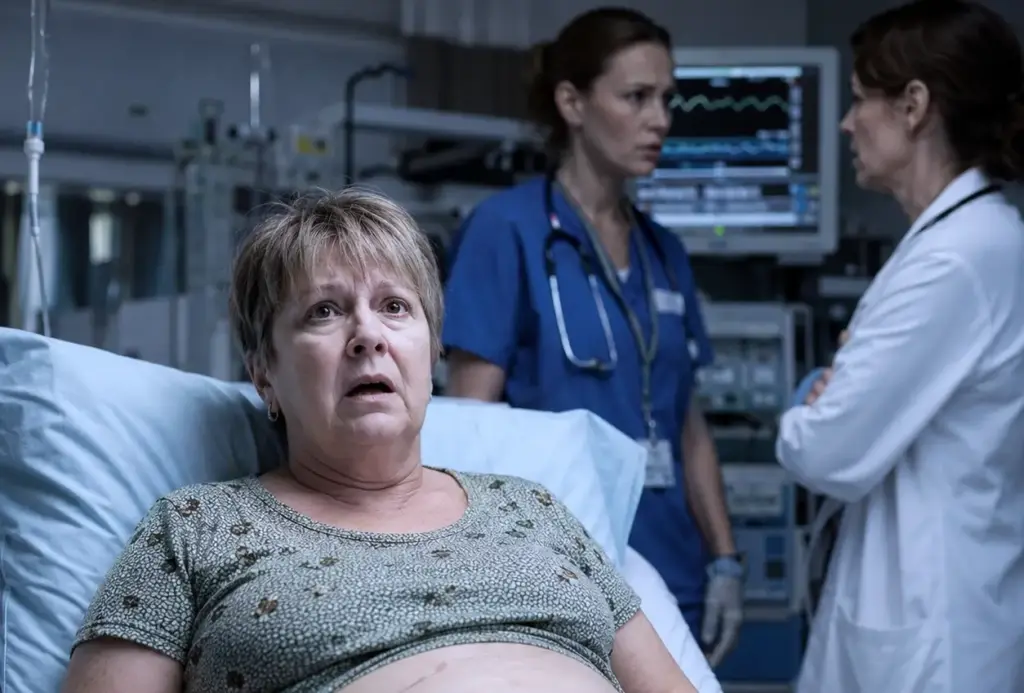
That morning, the sun had already warmed the dirt in Pine Creek, Kentucky, and sweat gathered beneath the brim of her old straw hat. Clara pressed a seedling into the earth, patted soil around its fragile stem, and tried to straighten up. Halfway there, pain clamped low in her belly and wrapped around her back so sharply that her breath left her.
She gripped the handle of the hoe and froze.
For a few seconds she could not even call out. The garden blurred at the edges, the bean poles leaning and swaying as if the whole yard had tilted. When the pain loosened, Clara stayed bent over, one hand pressed against her stomach, waiting for her body to explain itself.
It did not.
“Oh, Lord,” she whispered. “What is happening to me?”
The pain came again before she could reach the porch. This time it was lower, heavier, almost like something inside her had shifted. She stood between the garden rows with dirt on her knees and fear crawling up the back of her neck. She had not felt right for months—tired all the time, hungry in strange waves, swollen through the middle until her skirts pinched—but she had explained it away the way women her age often did. Age. Hormones. Too much bread. Too many evenings sitting after supper instead of walking.
Now she thought of her neighbor, Ruth Ann, who had gone thin as kindling before anyone knew she was sick. Clara had not gone thin. She had gone the other way, round and breathless and ashamed of how quickly she tired. Still, sickness came in all kinds of disguises.
By the time she made it inside, she had dirt on her shoes and tears on her face.
Hank was at the kitchen table with the local paper folded beside his coffee. He was a careful man, a man who liked clocks, lists, and supper at the same time every night. He had never been cruel to Clara, but he had never been easy either. His love showed itself in repaired hinges, stacked firewood, and the exact way he sharpened the kitchen knives every Sunday, not in soft words.
“What’s for lunch?” he asked without looking up.
“There’s soup in the fridge,” Clara said.
Her voice came out so small that Hank finally raised his eyes. Clara made it three steps toward the living room before she lowered herself onto the couch and began to cry, not politely, not quietly, but with the helpless sound of someone who had been holding herself together for too long.
Hank pushed back his chair so fast it scraped the linoleum.
“Clara?” He came to her side, awkward with worry, and took her hand. “What happened? Did you fall?”
“I’m dying, Hank.”
He blinked at her. “What?”
“I’m dying. I know I am.” She pressed her palm to her belly and tried to breathe through the panic. “I keep getting these pains. My back, my stomach. I can barely walk. Something’s wrong in me.”
Hank stared at her, frightened but trying not to show it. He had always believed panic was a thing a person could organize their way out of. He sat beside her and frowned the way he did when a tractor part would not fit.
“Now hold on,” he said. “Don’t go burying yourself before a doctor’s even looked at you.”
“You don’t understand.”
“I understand enough to know you need to go see Lydia at the clinic.” He glanced at her middle, then away, embarrassed by his own observation. “And for what it’s worth, Ruth Ann got thinner than a fence rail when she was sick. You’ve been putting weight on, not wasting away.”
Clara gave a wet, startled laugh despite herself. “That’s supposed to make me feel better?”
“I’m saying it might be something else.”
“What else is there at my age?”
Hank had no answer for that. He squeezed her hand once, then stood because tenderness made him restless. “You eat first. Then tomorrow morning you call the clinic. No arguing.”
Clara nodded because she was too tired to argue anyway.
The next day, she drove Hank’s old blue pickup three miles down the county road to Pine Creek Family Clinic, a low brick building tucked between the pharmacy and the feed store. The waiting room smelled faintly of hand sanitizer and coffee. A bulletin board near the door advertised flu shots, blood pressure screenings, and a grief group that met every other Wednesday in the basement of the Methodist church.
Lydia Benton came out herself to call Clara back.
Lydia was thirty-two, slim, dark-haired, and gentle in a way that made older people trust her before she had even taken their blood pressure. She was a nurse practitioner, though half the town still called her “the clinic girl” because she had arrived only two years earlier and rented the little apartment above the hardware store. She knew who needed their pills explained twice, who pretended they did not smoke, and who was lonely enough to make an appointment for a cough just to sit with someone for fifteen minutes.
“Mrs. Whitaker,” Lydia said with a warm smile. “I was starting to think you’d forgotten us.”
“I wish I had,” Clara said, trying to joke and failing.
Inside the exam room, Lydia listened without interrupting. Clara described the pain, the swelling, the tiredness, the odd nausea that came and went like a mean little tide. She left out the worst fear at first, then finally whispered it.
“Cancer runs through my mind,” Clara said. “I know I shouldn’t say it, but it does.”
Lydia’s face softened, though her eyes sharpened with clinical attention. “We’re not going to jump there. I want to run some labs, check your urine, maybe schedule imaging depending on what comes back. We’ll take it step by step.”
“Do you think it’s serious?”
“I think it’s worth taking seriously,” Lydia said. “That’s different from assuming the worst.”
Clara clung to that sentence all the way home.
Two days later, on a Saturday morning, Clara was washing breakfast dishes when the phone rang. Hank had gone out to fix a loose board on the back steps, and the kitchen was quiet except for the running tap. Clara dried her hands on a dish towel and picked up.
“Mrs. Whitaker? It’s Lydia from the clinic.”
Something in Lydia’s voice made Clara turn off the water.
“I have your results,” Lydia said. “Could you come in today?”
Clara stared at the sink. A spoon lay at the bottom, shining under a skin of soap bubbles. “Is it bad?”
A pause came through the line. Not long, but long enough.
“I’d rather talk in person,” Lydia said gently.
Clara drove to the clinic with both hands locked on the wheel. She parked crookedly and forgot to take the keys out of the ignition until the warning chime snapped her back. By the time she entered Lydia’s office, her mouth had gone dry.
“Tell me,” Clara said from the doorway. “Please don’t make me sit and guess.”
Lydia stood behind her desk, one hand resting on a folder. She had checked the lab report three times that morning, then called the lab and asked them to confirm patient identifiers. She had even opened Clara’s chart and gone through the dates again, searching for some simple clerical error that would let her spare the woman standing in front of her.
There was no error.
“Clara,” Lydia said, using her first name without meaning to. “Your pregnancy test came back positive.”
For a moment, Clara only looked at her.
Then she laughed once, a hard little sound. “No.”
“I know this is a shock.”
“No.” Clara backed up until her legs struck the chair. “I’m fifty-six years old.”
“I know.”
“I haven’t had a regular period in years.”
“I know.”
“Then somebody mixed up my sample.” Clara’s voice rose. “That’s what happened. You call them right now. You tell them they put another woman’s name on my results.”
“I already checked.” Lydia came around the desk slowly, as if approaching someone standing near a ledge. “The sample was yours.”
Clara lowered herself into the chair. Her face had gone gray. “That’s impossible.”
“It’s rare,” Lydia said. “Very rare. But not impossible.”
Clara’s hands flew to her stomach, not in wonder but in horror. The swelling she had hated, the nausea she had feared, the pain she had named as death—all of it rearranged itself in her mind. Her body had not been ending. It had been hiding something from her.
“How far?” she asked.
“We need an ultrasound to be certain, but based on your exam and labs, I think around sixteen weeks.”
“Sixteen weeks.” Clara repeated the number like it belonged to a stranger. Her eyes filled, and this time the tears came silently. “No. I can’t do this. I raised my child. I’m done. I’m too old.”
“We’ll get you to a high-risk OB. You need careful monitoring.”
“I don’t want monitoring,” Clara said, suddenly fierce. “I want it over.”
Lydia lowered her gaze for one second. She had expected panic, disbelief, maybe even anger. Still, the words landed hard. “This clinic can’t handle that kind of care, Clara. And with how far along you are, and your age, and the risks involved, you need to be seen by specialists before any decision is made.”
Clara leaned forward. “You’re telling me I don’t even get a choice?”
“I’m telling you that nothing about this can be handled quickly or casually. You need an ultrasound today if we can arrange it.”
The ultrasound was done that afternoon at the county hospital in Ashland, forty minutes away. Hank drove because Clara had called him from the clinic parking lot and said only, “Come get me.” He arrived with his shirt misbuttoned and his face pale beneath his cap.
He sat beside her in the dim room while the technician moved the wand across Clara’s belly. Clara kept her eyes closed. She could not bear to look at the screen, could not bear to see proof of something she had not invited and did not understand.
Then the technician went very still.
“What?” Hank asked.
The woman smiled carefully. “I’m going to get the doctor to review this, but there appear to be two heartbeats.”
Clara opened her eyes.
Hank reached for her hand and missed the first time.
Two heartbeats.
By evening, everyone who needed to confirm it had confirmed it. Clara Whitaker, fifty-six years old, from a county where news traveled faster than weather, was pregnant with twins.
Lydia went home after the clinic closed and sat on the edge of her bed without turning on the light. Outside, pickup trucks rolled slowly through the town square, and somebody laughed below her window near the hardware store. Life continued with its ordinary noise, but Lydia could not shake the look on Clara’s face.
For most people, two heartbeats would have been a miracle. For Lydia, who had spent years trying to have a child with a husband who eventually stopped looking at her with kindness, the word miracle had a bruise on it. She had once worked in the pediatric wing of a hospital outside Louisville, where coworkers joked too easily and too often about the nurse who could soothe every baby except her own because she did not have one. Her marriage had thinned under disappointment until there was nothing left to hold.
She had come to Pine Creek to disappear from all that.
Now Clara Whitaker had been handed the one thing Lydia had prayed for until prayer itself became painful, and Clara looked at it like a sentence.
Lydia hated herself for that thought the moment it came.
Clara did not tell Hank everything she had thought in Lydia’s office. She told him the facts—the pregnancy, the twins, the specialist appointment, the risks—and then she sat at the kitchen table while he walked from stove to sink to doorway and back again, as if motion might make sense of it…
To read the rest of the story – CLICK the NEXT button 👇👇👇