


By the third month, Leah Morgan had learned the sounds of the pediatric ICU the way other mothers learned the sounds of their babies. She knew the soft gasp of the ventilator before it pushed air into Caleb’s lungs. She knew the clipped warning tone that meant his oxygen had dipped, and the calmer, steadier beep that let her unclench her hands for a few seconds. She knew which nurses walked softly, which doctors paused outside the door before coming in with bad news, and which fluorescent light above the sink flickered once every hour as if even the building was too tired to keep pretending.
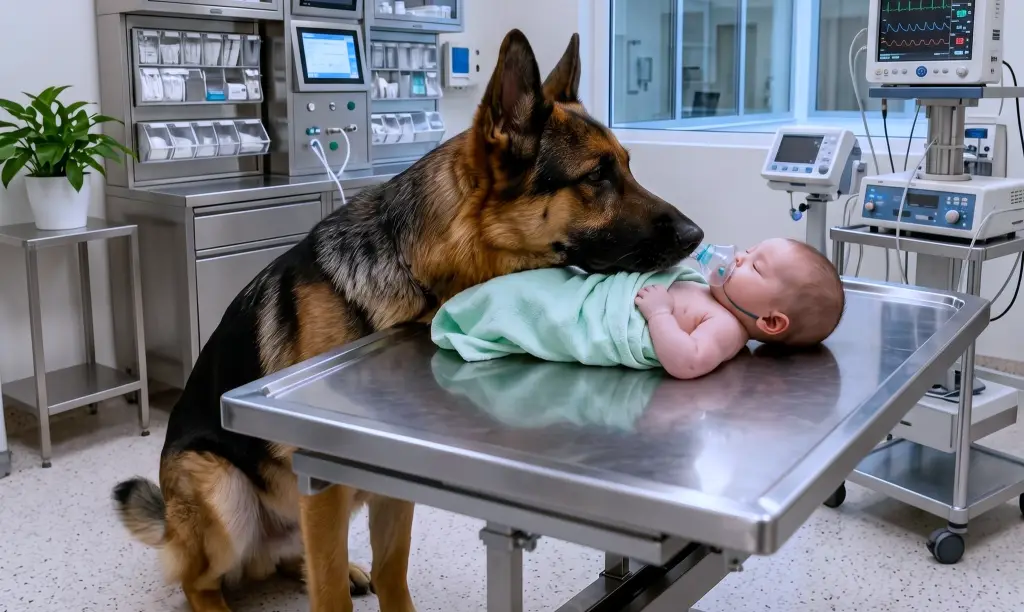
Caleb was six months old and still looked newborn in the hospital crib. Clear tubing ran under the tape on his cheeks. A feeding line disappeared beneath a tiny blanket printed with blue whales. His fingers, once strong enough to clamp around Leah’s thumb, now rested open against the sheet, pale and still.
Leah sat beside him in the chair that had become hers by occupation, not comfort. Her sweatshirt had a coffee stain at the cuff. Her hair was twisted into a knot she had redone too many times without a mirror. The hospital bracelet around her wrist had softened at the edges from showers taken in the family restroom down the hall.
She reached through the round opening in the crib wall and laid one finger lightly against Caleb’s foot.
“Hey, bug,” she whispered. “I’m right here.”
His eyelids fluttered, but he didn’t wake. The machines answered for him.
A few minutes later, Denise came in for morning vitals. She was one of the older nurses, square-shouldered and calm, with reading glasses on a chain and a voice that never changed whether Caleb was stable or crashing. Leah trusted her more than she trusted half the doctors, not because Denise promised miracles, but because she never lied with her face.
Denise checked the monitor, adjusted the IV pump, and studied Caleb’s color for a long moment.
Leah watched her hands. “Is he worse?”
Denise didn’t answer right away. That told Leah enough.
“Dr. Pierce is coming in after rounds,” Denise said gently. “He’ll talk with you.”
Leah swallowed. Her throat felt lined with dust. “That bad?”
Denise rested her hand on the back of Leah’s chair. It was a brief touch, warm and heavy. “I’m going to be right outside if you need me.”
After she left, Leah turned back to her son and tried to sing the song she used to hum when he was still home, before the fevers, before the ambulance, before the infection that had dug itself into his small body and refused to leave. The tune came out broken. She stopped after two lines and pressed her knuckles against her mouth.
Dr. Aaron Pierce arrived just after nine. He was usually brisk, the kind of doctor who entered with purpose and left before emotions could tangle around his ankles. That morning, he closed the door behind him and pulled a chair close enough that Leah could see the creases at the corners of his eyes.
She hated him for sitting down.
“Leah,” he said, and the use of her first name made her stomach fold in on itself. “I wish I had better news.”
She stared at Caleb. If she looked at the doctor, she would have to receive whatever he was about to say.
“The infection hasn’t responded the way we needed it to,” he continued. “We’ve gone through every standard treatment available to us here, and we’ve consulted with specialists in Denver, Cincinnati, and Boston. His kidneys are under more strain today. His liver numbers are worse. His body is getting tired.”
“No,” Leah said. It came out quietly, but it filled the room.
Dr. Pierce waited.
“He had a better night two days ago,” she said. “You said his pressure looked better.”
“It did. For a while.”
“So do that again. Whatever you did, do it again.”
He leaned forward, elbows on his knees. “We can keep supporting him. We can keep him comfortable. But I don’t want to pretend we still have a curative path when we don’t.”
Leah’s fingers tightened around the plastic rail of the crib. She felt the edge bite into her palm and welcomed it. Pain meant she had not floated away yet.
“You’re talking about hospice,” she said.
“I’m talking about comfort care,” he answered. “About making sure he isn’t suffering. About giving you time with him without more procedures that won’t change the outcome.”
Leah looked at Caleb’s face, at the tape on his cheeks and the little dark curl stuck to his forehead. People kept telling her about time as if it were something they could hand her in a folded blanket. She wanted years. She wanted scraped knees and preschool drawings and the way he might say her name when he was old enough to run toward her.
“What about Ranger?” she asked suddenly.
Dr. Pierce blinked. “Ranger?”
“The shepherd. From the therapy dog program.” Her voice picked up speed, because hope, even a foolish kind, had found one thin crack in the wall. “The big German shepherd. He used to come in with his handler. Caleb knew him. He always knew him.”
Dr. Pierce’s expression changed, not into hope, but into the careful sadness of a man who understood why she had reached for this.
“Leah—”
“No, listen to me.” She turned toward him fully. “When Ranger came, Caleb’s heart rate settled. You can check the charts. He smiled at him. He actually smiled. If you’re telling me there’s nothing else to do, then let him have that. Please. Just one visit.”
The doctor rubbed a hand over his jaw. “The therapy animal program was suspended last month.”
“I know that.”
“Administration shut it down during the infection-control review. They’re being extremely strict right now, especially with the foundation inspection coming up.”
Leah gave a short, disbelieving laugh. “The foundation inspection.”
“It’s not my rule.”
“My baby is dying in that crib, and somebody upstairs is worried a dog might shed on the floor?”
Dr. Pierce flinched, but he did not defend the hospital. That frightened her more than if he had. “I can ask,” he said. “I’ll take it to Dr. Vale myself.”
“Then ask like it matters.”
His eyes stayed on hers. “It does matter.”
Hours passed after that. Leah watched the hallway through the glass wall of Caleb’s room, reading movement like weather. Denise came and went. A respiratory therapist adjusted Caleb’s tubing. Another mother cried somewhere down the corridor, the sound muffled by heavy doors and professional mercy.
At two in the afternoon, Dr. Miriam Vale arrived.
Leah had seen her before at a distance, crossing the ICU with a tablet tucked against her side, never touching a patient, never looking into a room unless there were donors nearby. She wore a cream-colored suit that did not belong within ten feet of a hospital sink. Her silver-blond hair was pinned into a smooth knot, and her badge identified her as Chief Administrative Officer, though everyone on the floor simply called her Dr. Vale in that careful tone people used around power.
She stopped near Caleb’s crib and gave Leah a polished expression that wasn’t quite a smile.
“Ms. Morgan,” she said, “Dr. Pierce brought your request to my attention.”
Leah stood too quickly, her knees stiff from sitting. “Then you know why I’m asking.”
“I understand that you’re under immense emotional strain.”
Leah had come to hate that sentence. It was the door people closed before refusing you.
“Ranger was part of Caleb’s care for weeks,” Leah said. “He’s certified. His handler knows the rules. He wouldn’t even have to stay long.”
Dr. Vale glanced at Caleb, but only for a second, the way someone might glance at a chart. “The program was discontinued for valid operational reasons. We cannot introduce animals into a critical care environment simply because a family requests it.”
“This isn’t simply anything.”
“We have other patients to consider,” Dr. Vale said. “Many of them are medically fragile.”
“So is my son.”
“And that is precisely why we have protocols.”
Leah could hear her own breathing. She tried to slow it, because the moment she looked too angry, too loud, too desperate, they would decide that was the problem instead of the cruelty.
“Please,” she said. “I’m not asking you for money. I’m not asking for special treatment. I am asking you to let my little boy see the one thing in this place that ever made him happy.”
Dr. Vale’s face remained composed. “Next week, the Whitmore Family Foundation will be visiting this wing. Their grant is expected to fund major renovations, new equipment, and additional staffing. We are not in a position to risk a preventable incident before that review.”
Leah stared at her. “You’re saying no because rich people are coming to look at the walls.”
“I’m saying no because I’m responsible for the safety and reputation of this hospital.”
“The reputation.”
Dr. Vale’s eyes cooled. “I know this is painful, Ms. Morgan, but grief does not exempt anyone from policy.”
For a moment, Leah wanted to scream loud enough to bring every camera, every donor, every board member to Caleb’s door. Instead, she looked down at her son. His mouth was slightly open around the tube. His eyelashes rested against his cheeks. He had no idea that strangers in clean offices were deciding what comfort he was allowed to receive.
When Leah spoke again, her voice was low. “Do you have children?”
Dr. Vale’s mouth tightened. “That’s not relevant.”
“It is to me.”
The administrator stepped back. “I’m sorry for what your family is facing. The answer is no.”
Her heels clicked away down the hall, sharp and measured. Leah stood in the middle of the room until Denise came in and quietly guided her back into the chair.
“I heard,” Denise said.
Leah let out a sound that was not quite a sob. “He’s six months old.”
“I know.”
“He doesn’t even understand what’s happening. He just knows he hurts, and I’m here, and that dog made him feel safe.” Leah wiped her face with the sleeve of her sweatshirt. “How can that be too much?”
Denise checked the door before she answered. “It isn’t.”
Leah looked up.
The nurse busied herself with the IV pump, though there was nothing wrong with it. “Ranger’s handler was Jack Callahan. Retired fire captain. Search-and-rescue before he did hospital visits. He was sick over it when they shut the program down.”
Leah’s whole body went still.
Denise kept her eyes on the pump. “Now, I can’t give out anyone’s personal number. That would get me fired, and probably worse.”
“Denise…”
“But I’m an old woman with a bad habit of leaving my phone on the break room table.” Her voice stayed casual, almost bored. “Sometimes I forget to lock it. Sometimes I take exactly fifteen minutes to drink terrible coffee at the nurses’ station.”
Leah stared at her, hardly breathing.
Denise finally looked at her. There were tears in her eyes, but her mouth was steady. “I didn’t say anything. You didn’t hear anything.”
Leah pressed both hands over her face. For the first time all day, the room tilted toward something other than defeat.
“Thank you,” she whispered.
Denise patted Caleb’s blanket. “Don’t thank me yet.”
Fifteen minutes later, Leah walked down the hall with the strange calm of a person who had stepped outside the rules and found there was still air there. The staff break room door stood cracked open. Inside, beneath the hum of a vending machine and the stale smell of reheated soup, Denise’s phone lay faceup beside a paper napkin.
Leah copied the number with shaking hands.
She called from the family restroom because it was the only place in the hospital where nobody could watch her mouth move. Jack Callahan answered on the third ring, his voice rough and cautious.
When Leah said Caleb’s name, he went quiet.
“I remember him,” Jack said after a moment. “Little guy with the whale blanket.”
Leah leaned against the wall and closed her eyes.
She did not cry while she explained. She had learned to save crying for places where it would not be used against her. She told him what the doctors had said, what Dr. Vale had refused, and what Ranger had meant to Caleb. She expected hesitation. She expected apologies. She expected another adult to tell her their hands were tied.
Instead, Jack said, “Where can I meet you?”
The courtyard behind Fairview Regional was almost empty the next afternoon. It sat between the main building and the old outpatient entrance, a square of brick pavers, bare maple branches, and a fountain that had been dry since summer. Leah wore her winter jacket over hospital clothes and kept rubbing the scrap of paper in her pocket as if Jack’s number might vanish.
She saw him before he saw her. He was tall and broad through the shoulders, with a gray beard trimmed close and the kind of face that looked carved by weather rather than age. His navy jacket had an old fire department patch on the sleeve. He walked with a slight limp, but nothing about him seemed weak.
“Leah?” he asked.
She nodded, and for some reason the kindness in his voice nearly undid her.
“Thank you for coming,” she said. “I know this is a lot to ask.”
“I left Ranger in the truck,” Jack said. “Windows cracked, engine running. He’s fine. I figured we should talk first.”
They sat on a stone bench cold enough to bite through Leah’s jeans. She pulled up a photo on her phone: Caleb two months earlier, tiny hands buried in Ranger’s thick black-and-tan fur, his face turned toward the dog with an open, gummy smile that looked impossible now.
Jack took the phone carefully, as if it were something breakable. His thumb hovered near the screen but did not touch the baby’s face.
“He liked the ears,” Jack said softly.
Leah nodded. “Ranger would put his head right there on the crib rail, and Caleb would reach for him. Every time. Even when he was too tired to open his eyes all the way.”
“Ranger liked him, too,” Jack said. “Some kids he visited because I asked him to. Some kids he chose. Caleb was one of the ones he chose.”
The words entered Leah in a place medicine had not reached.
She told Jack what the doctors had said, though saying it out in the open air made it feel both more real and less survivable. “They think he has days,” she said. “Maybe a week. Dr. Pierce didn’t say it like that, but I understood him.”
Jack handed the phone back. His jaw worked once, tight and controlled.
“I’m sorry,” he said.
“I don’t want him to be scared at the end.” Leah looked toward the hospital windows, all of them shining with reflected sky. “That’s all I’m asking for. One thing that doesn’t hurt him.”
Jack rested his forearms on his knees. “Vale won’t approve it.”
“No.”
“And security?”
“She’ll use them if she has to.”
He looked at her then, not like she was fragile, and not like she was foolish. He looked at her like she was someone standing in front of a burning building deciding whether to go in.
Before he could answer, another voice came from behind the brick archway.
“I can help with security.”
Leah turned sharply. A young nurse stood half in shadow, wearing light blue scrubs under a puffer coat. Leah knew her from night shift—Natalie Cruz, the one who warmed her coffee without being asked and taped Caleb’s feeding tube with hands gentler than anyone else’s.
Natalie stepped closer, nervous but determined. “I’m sorry. I wasn’t trying to listen. I saw you out here and guessed what this was about.”
Jack stood. “You need to walk away from this conversation.”
Natalie gave him a quick, humorless smile. “Probably.”
“I’m serious. You could lose your license.”
“I know exactly what I could lose,” she said. “I also know what that baby loses if everyone keeps hiding behind policy.”
Leah stared at her. “Natalie, you don’t have to—”
“I’ve taken care of him since admission,” Natalie said. “I know what Ranger did for him. I also know Dr. Vale has the whole unit acting like a showroom because Celeste Whitmore is coming with cameras and a checkbook.”
Jack’s eyes sharpened. “What are you suggesting?”
Natalie glanced toward the glass doors. “Tomorrow night, I’m charge nurse after seven. The donor people will be gone by then, and Dr. Vale never stays late unless there’s press in the building. There’s a service entrance near the supply corridor that doesn’t get much traffic after shift change. I can meet you there and walk you through.”…
To read the rest of the story – CLICK the NEXT button 👇👇👇