


The first thing Judge Celeste Harper noticed was the way people looked toward the sound before they looked at her. A sharp whistle cut across the sunlit parking lot outside Arden Crossing, the kind of outdoor shopping center built to make errands feel expensive. Mothers paused with strollers. A man loading paper bags into the trunk of his SUV straightened slowly. Two teenagers near the coffee shop turned with their drinks halfway to their mouths.
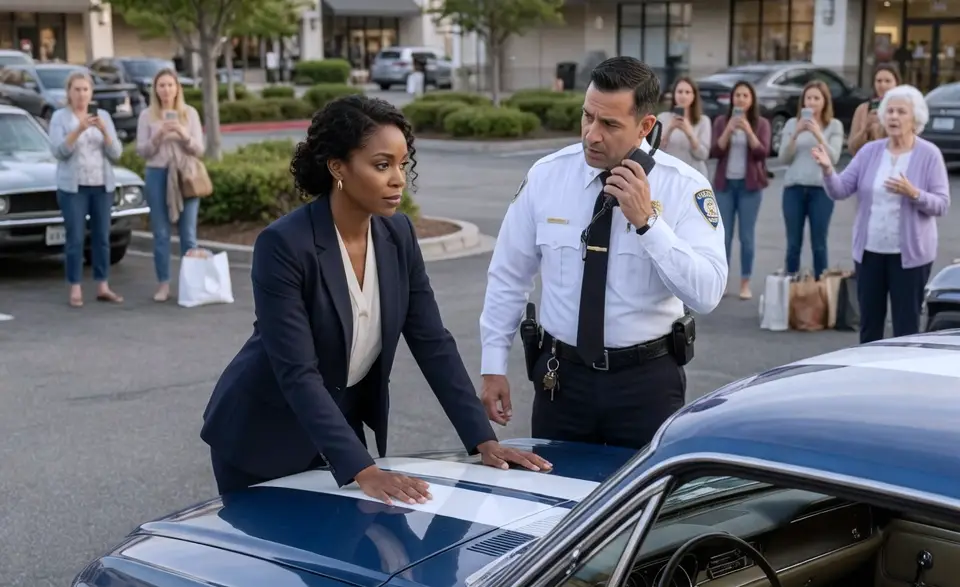
Celeste had just closed the driver’s door of the blue 1967 Mustang when a uniformed officer stepped off the curb and pointed at her like he had been waiting for her to make one wrong move.
“Ma’am, move away from the car,” he called. “Keep your hands where I can see them.”
For half a second, she thought there had been an accident behind her. Some danger she had not yet seen. Then she saw his eyes move from her face to the Mustang, and something cold settled beneath her ribs.
“Officer,” she said carefully, “is there a problem?”
“There is if this vehicle isn’t yours.” His right hand rested near his belt. Not on his weapon, not exactly, but close enough that everyone watching understood the meaning. “Step around to the front. Hands on the hood.”
The Mustang still held the afternoon heat. Celeste felt it through her palms when she obeyed. She did not move quickly. She had spent too many years in courtrooms watching people get punished for panic.
Her purse slid down her shoulder and bumped against her hip. Through the passenger-side window, her leather folio sat open beneath a scatter of papers. A corner of the gold court seal showed between a folded agenda and an airline boarding pass from the conference she had returned from the night before.
The officer came closer, his nameplate catching the light.
Maddox.
Grant Maddox, badge 6192.
Celeste memorized it automatically, the way she memorized docket numbers and witness names and the pauses between answers. Her father had taught her that details mattered most when people were trying to make you feel powerless.
“What are you accusing me of?” she asked.
“I’m not accusing you of anything yet.” Maddox’s voice carried, practiced and hard. “I’m asking how you came into possession of a vehicle that matches the description of one reported stolen.”
A woman near the storefront lifted her phone. Then another. Within seconds, screens rose around Celeste like small, bright windows.
The Mustang had always attracted attention. Her father had restored it over seven patient years, piece by piece, after long days on the bench. As a child, Celeste had sat cross-legged on the garage floor and handed him sockets, rags, screws he pretended he could not find. Back then, the car had smelled like old leather, motor oil, and his aftershave.
Now it smelled faintly of hot metal and humiliation.
“This car belonged to my father,” Celeste said. “It was transferred to me after he passed.”
Maddox gave a short laugh without smiling. “That’s a convenient answer.”
“It’s the truth.”
“Then you should have no trouble proving it.”
Twenty feet away, a college student in a faded university sweatshirt held her phone with both hands. Her name was Brianna Cole, and she had come to Arden Crossing for a birthday gift for her younger sister. She had started recording because something about the officer’s tone made her stomach tighten.
At first, only a few people watched her live stream. Then the number began climbing. A hundred. Four hundred. Nine hundred. Comments filled the bottom of her screen so quickly she could barely follow them.
Who is she?
Why is he talking to her like that?
Stay live. Don’t stop recording.
Celeste could not see the comments. She could only hear the murmur growing behind her and the officer moving around her father’s car as if it were evidence instead of inheritance.
“License and registration,” Maddox said.
“My identification is in my wallet,” Celeste replied. “The registration is in the glove compartment, and additional paperwork is in my briefcase on the back seat. I can retrieve it if you allow me to do so.”
“No sudden movements.”
“I wasn’t planning on any.”
His eyes narrowed. “You’ve got a mouth on you.”
A few people in the crowd reacted, softly but audibly. Celeste kept her gaze on the hood ornament. The little chrome horse had been polished by her father’s hands until it looked ready to run.
Her phone vibrated in her blazer pocket.
Once.
Then again.
She did not need to see the screen to know who it was. Chief Justice Elena Marrow had called three times already that morning, first from chambers and then from the emergency session. The State Judicial Council had been pulled into a Saturday vote because a civil rights matter had deadlocked, and Celeste’s vote was the one no one could predict with certainty.
She had stopped at Arden Crossing for fifteen minutes to pick up a replacement charger and a sympathy card for a clerk whose mother had died. Fifteen minutes. That was all.
Maddox leaned toward the windshield, peering inside. “Nice bag. Nice papers. Nice car.”
Celeste turned her head just enough to see him. “Is that part of your investigation?”
“I’m trying to understand the situation.”
“No,” she said, keeping her voice even. “You’re making one.”
His jaw flexed. He looked toward the crowd, perhaps remembering the cameras. “Ma’am, this vehicle is worth a significant amount of money. You understand why questions are being asked.”
“I understand exactly why questions are being asked.”
The words landed differently than she intended. A few people murmured again. Maddox’s face hardened.
“Empty your pockets.”
Celeste went still.
She had handled hearings where officers described commands like that in bland language. Subject was asked to comply. Subject became argumentative. Subject refused lawful order. From the bench, she had learned to listen for the missing pieces. The fear. The power imbalance. The command given not because it was necessary, but because the officer wanted to feel the person shrink.
“Officer Maddox,” she said, reading his nameplate again, “I am willing to provide identification and proof of ownership. I am not consenting to a search of my person.”
“People with nothing to hide don’t usually make it complicated.”
“People with rights are allowed to know they have them.”
He took a step closer. Behind him, a woman with silver hair and a cane pushed slowly through the widening circle of bystanders. Her face changed when she saw Celeste, not with curiosity but recognition.
“Oh,” the woman said under her breath. “No, no, that’s—”
“Back up,” Maddox snapped without turning. “Everyone back up.”
The woman stopped, one hand braced on her cane. “Officer, I know her.”
“I said back up.”
Celeste looked at the woman more closely. The face was older, rounder, framed by soft white curls now, but something about her stirred memory. Courthouse lobby. Records window. A laugh that carried down marble halls.
Alma Price.
For more than three decades, Alma had worked in the clerk’s office at Riverton County Superior Court. She had known Celeste’s father before Celeste was old enough to understand why everyone stood when he entered a courtroom.
Alma lifted her chin. “Young man, you need to listen.”
Maddox finally glanced at her. “Ma’am, interfering with a police investigation can get you arrested.”
The crowd drew in a breath. Alma’s mouth tightened, but she stepped back, not out of fear for herself. Celeste saw the calculation in her eyes. One more Black woman in handcuffs would not help anyone.
Maddox keyed his radio. “Unit Twelve requesting backup at Arden Crossing, east lot. Possible stolen vehicle. Subject is being difficult and crowd is forming.”
Being difficult.
Celeste closed her eyes for a brief moment, not to pray and not to compose herself. She was counting. The call from chambers. The drive back. The vote window. The remaining time before her absence stopped being inconvenient and became a crisis.
Her father used to say the law was a room built of words. Change one, and the whole room could tilt.
Difficult. Hostile. Suspicious. Noncompliant.
She had seen those words turn citizens into threats.
“Officer,” she said quietly, “you are creating a record right now.”
He smiled as if she had said something amusing. “Good. Then make sure you behave for it.”
Brianna’s live stream jumped past six thousand viewers. She swallowed hard and adjusted her grip. Her arm was starting to ache, but she refused to lower the phone.
“She’s not yelling,” Brianna said softly to the screen. “She’s not doing anything. He just keeps escalating.”
A man behind her muttered, “Probably stole it. You never know.”
Brianna turned sharply. “You don’t know anything either.”
The man looked away.
Celeste’s phone vibrated again. It was almost continuous now, a low insistence against her hip. She imagined the conference room at the courthouse: polished table, bottled water, binders open, legal assistants whispering along the wall. She imagined Chief Justice Marrow looking toward the empty chair with Celeste’s nameplate in front of it.
The case on the agenda was not abstract. It concerned departmental accountability, qualified immunity arguments, patterns of racially biased stops, and an officer whose conduct had become impossible to ignore.
Celeste knew the file well.
She did not yet know the officer in that file was standing beside her father’s car.
Two patrol cars entered the lot with lights flashing but no sirens. The blue strobes moved across store windows and bright shopping bags, turning an ordinary Saturday into something people would remember with uneasy precision.
A sergeant climbed out of the first car, broad-shouldered and gray at the temples. He surveyed the scene before he approached, and Celeste saw a different kind of officer in the way he took in the crowd, the phones, the Mustang, Maddox’s posture.
“Sarge,” Maddox said, too quickly. “Potential vehicle theft. Subject claims it was her father’s but has refused to cooperate with a search.”
Celeste turned her head. “That is not accurate.”
Maddox pointed at her. “Face forward.”
The sergeant looked from him to Celeste. “Ma’am, I’m Sergeant Nolan Mercer. We’re going to slow this down.”
“Please do,” Celeste said.
Maddox’s mouth tightened, but he said nothing.
A second officer, a younger woman with dark hair pulled into a tight bun, began moving bystanders back with both hands raised. “Give them space,” she said. “You can record, but you need to stay behind the line.”
The line was imaginary, but people obeyed. Mostly.
“Officer Lin,” the sergeant called, “keep the sidewalk clear.”
“Yes, Sergeant.”
Brianna backed up two steps but kept streaming. The viewer count passed twelve thousand. Someone in the comments wrote that local news had been tagged. Someone else claimed they recognized the woman. Then the name appeared once, then again.
Is that Judge Harper?
No way.
That’s Celeste Harper. Criminal Division.
Brianna looked up from the screen to the woman with her hands on the Mustang hood.
Judge?
Sergeant Mercer lowered his voice. “Ma’am, can you tell me where the registration is?”
“Glove compartment,” Celeste said. “My driver’s license is in my purse, which Officer Maddox instructed me not to touch. My judicial identification and estate transfer documents are in the leather folio on the passenger seat. There is also a briefcase in the back containing confidential court materials.”
At the word judicial, Mercer’s expression shifted.
Maddox noticed. “She’s been saying a lot of things.”
“I heard her,” Mercer said.
Celeste’s phone rang again. This time the sound was loud enough for Maddox to hear.
“Don’t answer it,” he said.
“I am required to take that call.”
“No, ma’am, you’re required to follow directions.”
Celeste inhaled slowly through her nose. “Sergeant Mercer, I am Judge Celeste Harper of Riverton County Superior Court. I am due at an emergency judicial session. I need to retrieve my identification and take that call.”
For the first time, Maddox hesitated.
Then pride came back over his face like a door closing.
“Anybody can say they’re a judge,” he said. “Especially after a crowd starts filming.”
Alma Price pushed forward again, anger giving speed to her careful steps. “I worked in that courthouse before you were out of high school,” she called. “That is Judge Harper. Her father was Judge Nathaniel Harper, and he drove that Mustang for years. Everybody in that building knew that car.”
Officer Lin moved toward her. “Ma’am, please stay back.”
Alma planted her cane on the pavement. “I am back. I’m also telling the truth.”
Maddox rounded on her. “One more word and you’re coming with us too.”
Celeste felt the moment sharpen. Not because he had threatened her. She could endure that. She had been enduring versions of it her entire life.
But Alma was seventy-four years old, and her hand trembled on her cane, and still she had tried.
“Officer Maddox,” Celeste said, louder now, “do not threaten a witness for offering relevant information.”
He turned back to her with a look she had seen from defendants, lawyers, even colleagues who disliked being corrected by a woman who did not raise her voice.
“That’s it,” he said. “Hands behind your back.”
No one moved for one suspended second. Even the parking lot seemed to lose its ordinary sounds—the carts, the traffic at the far intersection, the music leaking from the boutique doorway…
To read the rest of the story – CLICK the NEXT button 👇👇👇