


My name is Kate Mercer. I was thirty-two years old when I learned that the people I had trusted most with my child had turned her into a burden on paper while spending her money in real life. For nine months, I worked as a U.S. Army medic attached to a United Nations stabilization mission in Central Africa. The field hospital was a collection of canvas, plywood, sandbags, and exhausted people trying to keep other exhausted people alive. Red dust found its way into everything: IV tubing, boot laces, pillow seams, the corners of your mouth. At night, when the generators coughed and the floodlights buzzed, the tents smelled like bleach, blood, sweat, and fear that had nowhere to go.
I did not spend those months dreaming about a resort or a soft mattress. I did not fantasize about sleeping past dawn or eating food that had not come from a supply crate. I wanted one thing. I wanted to put both arms around my daughter and feel that she was still real.
Sophie had turned fourteen while I was gone. Every first of the month, before the heat got too heavy and before the wounded started coming in, I opened my banking app and sent two thousand dollars to my parents’ account. That money was for Sophie’s food, clothes, school supplies, rides, activities, therapy if she needed it, and whatever small teenage joy could soften the fact that her mother was half a world away.
To me, each transfer was more than a number.
It was a promise.
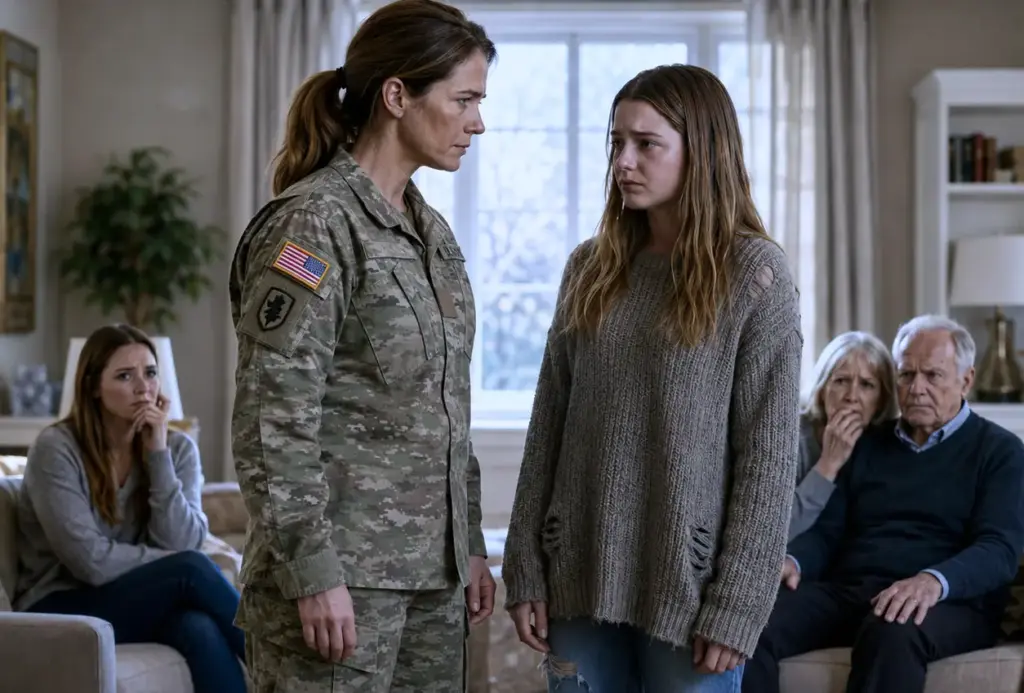
So when I finally came home three days before New Year’s and asked my daughter whether the money had been enough, I expected her to roll her eyes and tell me I worried too much.
Instead, Sophie stopped folding the sweater in her hands and looked at me as if I had spoken in another language.
“What money, Mom?”
Across my parents’ upstairs hallway, my mother went so pale the blush disappeared from her cheeks. My father looked down at the hardwood floor like he had suddenly discovered something fascinating between the planks. My younger sister, Lauren, who had been passing by with a basket of towels, jerked to a stop and said too loudly, “Anybody want hot chocolate? I can make hot chocolate.”
That was the moment the room changed shape around me.
Eighteen thousand dollars had gone somewhere.
But it had not gone to my daughter.
I had never planned on being a widow. I had never planned on learning how to raise a little girl and bury a husband in the same year. Daniel and I had been the kind of couple people joked about because we had known each other too long to have any mystery left. We met in high school outside Chicago, got married young, and had Sophie while I was still finishing my medical assistant program. He worked construction management. I worked clinic hours and weekend shifts wherever I could pick them up. We were tired all the time, but we were building something.
Then one icy November evening, a semi slid through a median on I-94 during a lake-effect storm and took Daniel from us before dinner.
Sophie was nine. She still had a missing tooth in the front and a habit of sleeping with one sock on and one sock off. The night the police came to the door, she sat on the stairs in her dinosaur pajamas and watched my face because she knew before anyone said it. Children know when the air has gone wrong.
After Daniel died, I did what people do when grief gives them no room to collapse. I signed papers. I answered calls. I packed his work boots in a box and then took them back out because the closet looked too empty without them. I learned which bills were automatic and which ones he had always handled quietly. I made breakfast. I helped with homework. I cried in the shower where Sophie could not hear me.
The Army had been hovering at the edge of my life for years. My father, Robert, had served before starting his contracting business, and though he and I had never been easy together, I respected the steadiness military life had once given him. After Daniel’s death, steadiness mattered more than pride. Health insurance mattered. A dependable paycheck mattered. A path forward mattered.
I enlisted and trained as a combat medic, later moving into a medical detachment that handled deployments, disaster response, and humanitarian missions. The work fit me in a way I had not expected. I knew how to keep my hands steady when everything around me was not. I knew how to talk to scared people. I knew what it was to look at loss and still move.
For three years, I managed to avoid long overseas assignments. My commander had four kids of his own and understood that Sophie was not a scheduling detail. We built a careful little life in a two-bedroom apartment on Chicago’s North Side, close enough to my unit that I could get to work fast and close enough to the lake that Sophie and I could walk when one of us needed air.
It was not fancy, but it was ours. We painted her bedroom a soft blue, hung string lights over her desk, and filled the kitchen windowsill with stubborn little plants that survived on neglect and tap water. On school nights, we made tea and argued over algebra. On weekends, we watched old movies, went grocery shopping with coupons, and took long walks through the park even when the wind came mean off Lake Michigan.
Slowly, Sophie started laughing again.
Then the orders came.
It was late February, gray and dirty with thawing snow, when my unit was told we were sending a medical team overseas for nine months. A UN-backed field hospital needed experienced medics. The assignment was not optional.
I remember holding the packet in my hand and staring at my name. My body went very still, the way it does when bad news arrives and your mind tries to catch up politely. Sophie had just turned thirteen then, long-limbed and tender, balancing between childhood and whatever came next. It was the exact age when a girl needs her mother close, even if she acts like she doesn’t.
My parents lived in Hawthorn Ridge, a wealthy suburb west of Chicago where every lawn looked professionally forgiven and every house had more bathrooms than people. My father had sold his contracting company early and well. My mother, Elaine, kept a spotless house and spoke about “downsizing” while buying new furniture she insisted was practical. They adored Sophie in the way grandparents often do when love can be scheduled around holidays, birthdays, and photo albums.
My father was softer with her than he had ever been with me. He let her win at cards. He kept her favorite sparkling lemonade in the garage fridge. My mother fussed over her hair and bought her little things when the mood struck. They were not my first choice for nine months, but they were family, they had space, and they were retired.
Lauren, my younger sister, lived ten minutes from them with her husband. She had no children and a talent for making every conversation sound like she had just been excluded from something. We were polite. We were not close.
I went to my parents with a folder, a calendar, Sophie’s school information, medical cards, and a list so detailed it probably looked unhinged. We sat around their huge oak dining table while my mother poured coffee and my father told me to relax.
“We’ve got her,” he said. “She’s our granddaughter.”
“I know,” I said. “But I need the details clear.”
We talked through everything: school drop-off, volleyball, dental appointments, allergies, therapy contacts, screen-time rules, how Sophie sometimes shut down when she missed Daniel, how she pretended she was fine when she was not. My mother nodded through all of it, making little notes in her slanted handwriting. My father leaned back in his chair and told me I worried like it was a full-time job.
When we got to money, I was firm. I would send two thousand dollars every month.
My mother put a hand to her chest. “Kate, that’s ridiculous. We’re not charging you to love our granddaughter.”
“You’re not charging me,” I said. “I’m paying for her life. Groceries, clothes, school fees, activities, rides, everything. I don’t want her feeling like she has to ask for basics.”
Dad gave a dismissive little wave. “We’re not hurting.”
“I didn’t say you were. But this is my responsibility, and I’m not putting it on you.”
They protested for a while because people like my parents enjoyed the theater of refusing money before accepting it. In the end, I opened the banking app at the table and set up the automatic transfer to my father’s First Meridian account. Two thousand dollars on the first of every month. I showed them the confirmation screen.
My mother patted my hand. “She’ll be spoiled rotten.”
“Good,” I said, because I meant it.
That last week before I left moved too fast and too slowly at the same time. I signed paperwork, updated powers of attorney, packed uniforms, checked medical records, and tried not to cry in front of Sophie every time she walked into a room. We packed her things into two big suitcases and a duffel bag. We drove out to see the high school she would attend near my parents, at least temporarily. She picked which corner of the guest room would be hers and arranged her books by color because organizing gave her hands something to do.
The night before my flight, I gave her a journal with a little lock on it. The cover was soft brown leather, and her initials were stamped in gold on the bottom corner.
“For when calls don’t work,” I told her. “Write to me. Even if I can’t read it right away.”
She held it against her chest. “That’s kind of old-fashioned.”
“You love old-fashioned.”
“I love making fun of old-fashioned.”
But she packed it beside her pillow.
After midnight, she came into my room the way she had in the first months after Daniel died. She slid under the blanket without asking and tucked herself against me, all elbows and cold feet.
“Are you going to be safe?” she whispered.
I had been asked that question by adults who wanted comfort, by children in clinics, by soldiers pretending not to be scared. It is a terrible question because the honest answer is almost never useful.
“I’m going to be careful,” I said. “I’m going to think before I move. I’m going to listen to people who know more than I do. And I’m coming home to you.”
She was quiet for a long time. “Nine months is forever.”
“It’ll feel long,” I said, brushing her hair back from her face. “But we’ll count it down. We’ll call whenever I can. You’ll write. I’ll write. And when I come back, we’ll take a whole week and do nothing useful.”
“What if I’m different by then?”
I swallowed. “Then I’ll get to know the new parts.”
The next morning, snow lay in soft ridges along my parents’ driveway. Sophie stood on their porch in a red coat, trying to be brave and failing with her whole face. My father kept one hand on her shoulder. My mother fussed with her scarf. Lauren had come to say goodbye and kept crying into a tissue even though she was not the one leaving her child.
I hugged Sophie so hard she made a little sound.
“I love you,” I said against her hair.
“I love you more,” she whispered.
When I got into the car for O’Hare, she lasted exactly three seconds. Then she broke away from my father and ran down the driveway after me, sobbing, her boots slipping on the packed snow. My father caught her before she reached the street and held her back while she reached both arms toward the car.
That image followed me across the ocean.
For nine months, in the worst moments, I saw my daughter on that driveway.
And every first of the month, I sent the money.
My flight home landed at O’Hare under a low gray sky that made Chicago look tired and beautiful. I had managed to get leave three days before New Year’s, earlier than Sophie expected. I wanted to surprise her, but I had only told Lauren the exact arrival time. If a connection failed or weather trapped me somewhere, I could not stand the thought of Sophie waiting at a window for me again…
To read the rest of the story – CLICK the NEXT button 👇👇👇