


Every afternoon, when the weather allowed, Laura Chance walked the same loop through Riverside Park with a German shepherd at her side. She kept the leash wrapped twice around her wrist, not because the dog pulled, but because the habit steadied her. The shepherd moved with a faint hitch in his front leg, graceful anyway, his dark ears alert to every squirrel, stroller wheel, and child calling from the playground.
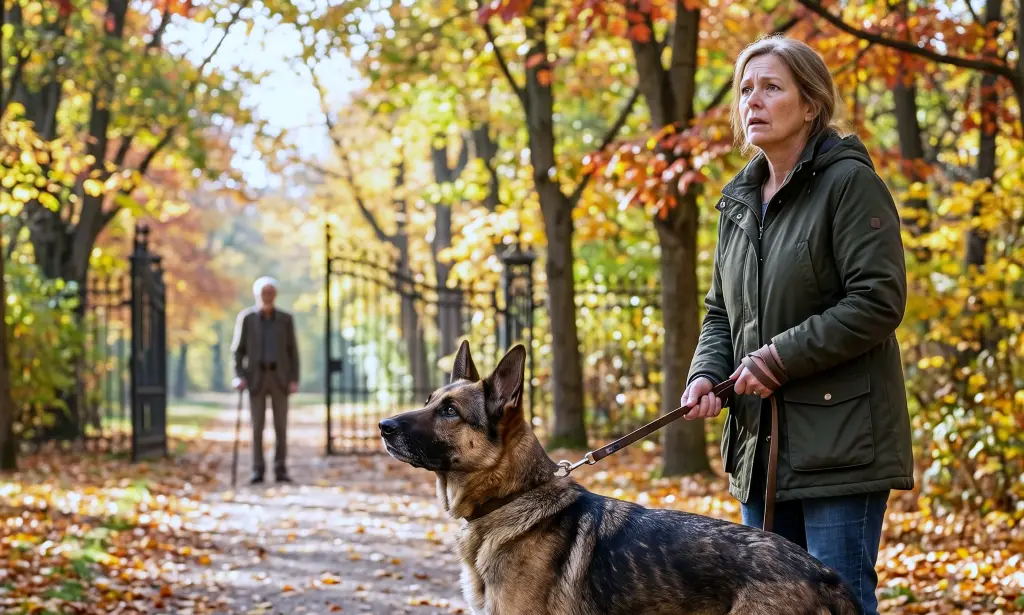
People in Maple Falls learned to make room for them. They saw a woman in her early fifties, gray at the temples, and a scarred dog who never barked unless there was a reason. What they could not see was the son who should have been walking between them.
Laura still spoke to the dog as if that son were only half a block ahead. “Easy, Trouble,” she would say at the crosswalk. “Your knee’s better than mine, but neither one of us needs to show off.” The shepherd would glance up, solemn and patient, and Laura would almost smile.
Trouble had not always been solemn. When Nick brought him home at sixteen, the puppy had feet too large for his body and a talent for wrecking anything softer than a brick. He chewed one of Laura’s garden gloves, dragged a dish towel down the hall, and fell asleep in the laundry.
“You little piece of trouble,” Laura had muttered, standing over the mess with a laundry basket tucked against her hip.
Nick had appeared in the kitchen doorway, still wearing his muddy soccer cleats. He looked from his mother to the puppy, and the grin that opened across his face was so much like his father’s that Laura had to grip the basket a little tighter.
“That’s it,” Nick said. “That’s his name.”
“Absolutely not.”
“Too late. Trouble Chance. Sounds official.”
Laura tried not to laugh, because laughing made surrender too easy. The name stayed, partly because the puppy answered to it by the second day and partly because Nick said ordinary names were for ordinary dogs.
Nick had never wanted an ordinary dog. His clearest memories of his father came from photographs: Daniel Chance in a soot-marked fire jacket, Daniel kneeling beside a sable German shepherd named Ranger, Daniel holding four-year-old Nick on the back steps. The real memories were softer—his father’s hand, the smell of smoke in his coat, the deep voice that told Ranger to stay.
Daniel had been a firefighter and a search-and-rescue K-9 handler. When a major earthquake struck overseas, his task force was sent to help search collapsed buildings. The official report used careful language, but Laura knew only the part that mattered: Daniel and Ranger entered a shattered hotel looking for survivors, and neither of them came home.
After that, Laura raised Nick by herself in the white house on Chestnut Street. She worked at the county library, saved coupons in a kitchen drawer, and kept Daniel’s dress uniform sealed in a garment bag at the back of the closet. She never learned how to make room for another life beside the one she was guarding.
At fourteen, Nick asked to join a junior K-9 club behind the sheriff’s station on Saturday mornings. Laura signed the form with a stiff hand and told herself it was discipline, responsibility, a boy needing something that connected him to his father without swallowing him whole.
But by sixteen, Nick was reading military working-dog manuals at the kitchen table. By seventeen, he and Trouble were running obedience drills before school, tracking scent trails through wet grass, and practicing hand signals in the backyard until dusk blurred the fence line. Laura would stand at the sink and watch them through the window, proud and afraid in the same breath.
After graduation, Nick sat across from her with enlistment papers folded beside his plate. He explained that the Army had a working-dog program, that Trouble could be evaluated because of his certifications, and that it was rare but not impossible. He had already spoken to people who knew the process.
“You did all that before telling me?” Laura asked.
“I wanted to know if it was real before I scared you with it.”
The answer should have made her angry. Instead, it showed her how carefully he had carried her fear while walking toward the thing that frightened her most. When Trouble rested his chin on Nick’s boot, Laura saw the line from Daniel to Ranger, from Nick to this dog with the impossible name.
The Army took both of them after months of evaluations and warnings that nothing would be promised. Officially, Trouble became part of the program. In every way that mattered, he remained Nick’s dog.
Their training center in Missouri turned them leaner and quieter. Nick wrote home about mud, sore muscles, and a kennel sergeant who said Trouble looked smarter than half the recruits. By the time they were assigned to a joint security outpost overseas, the men in Nick’s unit had given them a nickname that followed them everywhere.
“Here come Trouble and Chance,” they would call whenever Nick and the shepherd crossed the yard.
Nick pretended to hate it. In his letters, he admitted that he didn’t.
The outpost sat in a dry mountain valley where dust got into zippers, boots, coffee, and sleep. Nick’s unit worked with allied forces along a tense stretch of border, checking roads and watching places where armed groups moved through the dark. The work was mostly waiting, which was its own kind of pressure…
To read the rest of the story – CLICK the NEXT button 👇👇👇