


The courthouse had made room for the dog before it made room for the child. A square of blue carpet lay beside the witness chair in Courtroom 6A, close enough for a small hand to reach without leaning too far. Beside it sat a metal water bowl, a folded towel, and a laminated sign the bailiff had placed on the gate: COURT FACILITY DOG WORKING — PLEASE DO NOT DISTRACT. The sign looked oddly gentle among the polished wood, brass nameplates, and old portraits of judges who had never imagined a German Shepherd would one day become part of the machinery of justice.
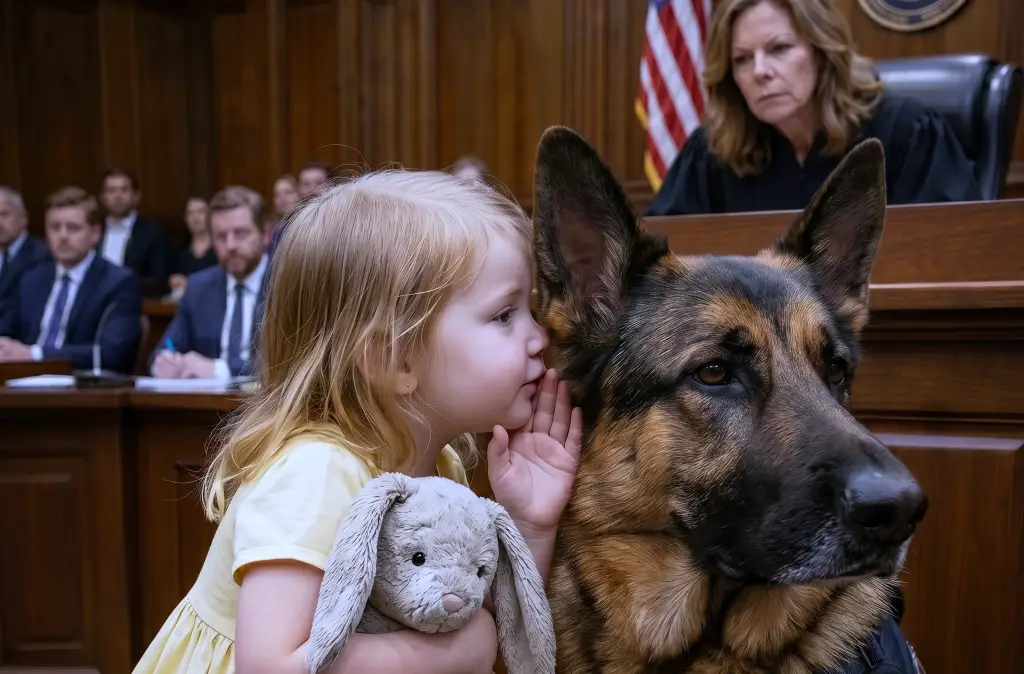
By 8:20 a.m., every bench was filled. Local reporters stood shoulder to shoulder along the back wall, their phones muted, their faces alert in that particular way people looked when they had come for someone else’s pain. A courtroom sketch artist sat near the aisle, sharpening a pencil over a paper cup. Even Deputy Harris, who could usher a room through arraignments, plea hearings, and shouting relatives without blinking, kept checking the side door.
Assistant District Attorney Ava Bennett watched it all from the prosecution table and tried not to look at the empty chair.
She had spent three weeks preparing for this morning. She had met with doctors, child advocates, and the judge in closed hearings. She had rewritten her questions until they sounded less like legal questions and more like the careful language adults used when they were trying not to frighten a child who already knew too much. In her trial binder, the questions took up six pages. Ava had a feeling she would use almost none of them.
Across the aisle, Tyler Reed sat with his shoulders hunched inside a charcoal suit that still had a faint crease from the store. He was twenty-eight, lean, restless, and angry in a way that had helped the State’s original theory more than it helped him. Jenna Carter’s neighbors had heard him yell before. Friends had seen bruises Jenna explained away. His alibi for the night she was attacked was thin enough to tear with one good tug.
Beside him, Graham Pierce looked as if he had never been uncomfortable in his life.
Graham had the smooth posture of a man who billed in six-minute increments and made court clerks nervous. His silver pen sat parallel to his legal pad. His navy suit fit perfectly. His dark hair was swept back from his forehead, not a strand out of place, and his burgundy tie was knotted with clean, expensive precision. He had built his career on making witnesses doubt their own memories. Ava knew because she had watched him do it.
At 8:31, Judge Helen Whitcomb entered from chambers and took the bench. She was not a dramatic judge. She did not perform severity for juries or soften herself for television cameras. Her authority came from stillness, from the unhurried way she opened a file and read a room before speaking.
“This court is back on the record in State v. Reed,” she said. “Before the witness is brought in, I’ll remind everyone present that no photography, recording, visible reaction, or attempt to communicate with the child will be tolerated. Anyone who violates that order will be removed.”
No one moved. Ava saw several reporters lower their phones into their pockets.
The case had started as a brutal assault in a two-bedroom apartment on the east side of Fairmont, a working-class Ohio town where everyone seemed to know someone who knew Jenna Carter. She had been found unconscious on her kitchen floor by responding officers after a neighbor called 911. The dining table was cracked through one leg. A ceramic lamp lay shattered across the tile. A laundry basket had been knocked into the hallway.
And Lily Carter, Jenna’s three-year-old daughter, had been found under a blanket near the hall closet, curled around a stuffed rabbit and making no sound at all.
She had not spoken to the police that night. She had not spoken to nurses, detectives, social workers, or her foster mother. She had cried in her sleep, refused certain foods, and flattened herself against walls whenever voices rose too quickly, but she had kept every word locked somewhere adults could not reach.
Then she met Boone.
The side door opened.
Lily came in holding Denise Alvarez’s hand. She was smaller than Ava remembered from the child interview room, with solemn brown eyes and a yellow cardigan buttoned wrong over a blue dress. One of her white shoes had a sticker on the side. Her stuffed rabbit dangled from her elbow by one worn ear, its fur rubbed thin where her thumb had worried it down.
Boone followed at her pace.
The German Shepherd moved without the theatrical nobility people liked to imagine in working dogs. He was simply steady. Big paws, dark muzzle, gray around the eyes, navy vest fitted snugly over his shoulders. His handler stayed several feet behind, close enough to step in if needed, but Boone did not look for instruction. He crossed the courtroom, found the blue carpet, lowered himself beside the witness chair, and rested his head on his front paws.
Lily stopped when she saw him.
Until that moment, she had been shrinking into Denise’s side, her eyes skipping over flags, railings, strangers, and the raised bench where Judge Whitcomb sat. When she noticed Boone, something in her face changed—not joy, exactly, but recognition of a safe shape in a room full of wrong ones. Denise bent and whispered near her ear. Lily let go before Denise finished.
She walked to the dog in small, careful steps. No one told her to hurry. No one told her where to stand. Ava held still with one hand resting on her binder, because any movement felt too large.
Boone lifted his head. Lily paused in front of him and studied his face with a seriousness that made several adults look away. Then she dropped to her knees, pressed her forehead into the thick fur at his neck, and closed her eyes.
Ava had seen juries react to photographs, confessions, bloody clothing, and lies that collapsed under their own weight. She had never seen twelve people become so careful with their breathing.
Judge Whitcomb leaned back slightly, not distancing herself, only making herself smaller for the child. The clerk’s fingers hovered above the keyboard. Graham Pierce sat motionless beside Tyler, his expression arranged into polite concern.
Lily’s lips moved against Boone’s ear.
At first, Ava thought the child was whispering nonsense, the private murmur of a toddler using sound to calm herself. Then Lily pulled back and looked across the room. Her gaze landed on the defense table—on the place where Tyler Reed sat with his lawyer beside him—and her body tightened.
“He hurt Mama,” she said.
The words were soft. They were also clear.
Graham was on his feet before the court reporter finished typing.
“Objection, Your Honor.”
Judge Whitcomb’s gavel struck once, not hard enough to scare the child, but enough to stop the rustle that had started in the gallery. “The jury is instructed to disregard any statement not made in response to a question. Mr. Pierce, sit down.”
Graham sat. Tyler stared at the tabletop, his face drained of color.
Ava did not look at the jury. She did not need to. They had heard Lily. They had seen where she looked. They had seen the dog remain exactly where he was, one quiet shoulder available beneath the child’s hand.
It took almost ten minutes to get Lily into the witness chair. Denise stood nearby until Lily climbed up sideways, keeping one foot tucked under her and one hand in Boone’s fur. Judge Whitcomb spoke to her first, using a voice that belonged less to the bench than to a grandmother at a kitchen table.
“Lily, my name is Judge Whitcomb. Do you know where you are?”
Lily rubbed Boone’s ear between two fingers and did not answer.
“That’s all right,” the judge said. “You don’t have to look at me. You can talk to Boone if that helps.”
Lily leaned toward the dog’s head and whispered something no one else could hear.
Ava rose slowly. She did not approach the stand yet. The six pages of questions in her binder now seemed like something written for a different child.
“Hi, Lily,” she said. “I’m Ava. We met in the little room with the blocks. Do you remember the blocks?”
Lily’s eyes stayed on Boone’s collar.
“I had the red one,” she murmured.
Ava almost missed it. “You had the red block?”
Lily nodded once.
“Okay. I’m going to stay right here. You can tell Boone anything you want, and if you want me to hear it, I’ll listen.”
Graham shifted in his chair, but he did not object. Not yet.
For a long minute, nothing happened. The room developed an ache around the waiting. Adults were bad at silence; they wanted to fix it, fill it, interpret it, win it. Dr. Marcus Bell, Lily’s trauma therapist, had warned Ava that silence might be the only bridge Lily trusted. Ava kept her mouth shut and let the child decide whether to cross.
Lily bent until her cheek rested on Boone’s head.
“He knows,” she said.
Ava kept her voice low. “Boone knows?”
“I told him.”
“What did you tell him?”
Lily’s fingers disappeared into the long fur at the dog’s shoulder. She opened her mouth, closed it, and made a small frustrated sound, as if the words were stuck behind something bigger than her throat.
“The house got loud,” she said.
A juror near the end of the box lowered his pen.
“Was that at your house?” Ava asked.
Lily nodded.
“Can you tell Boone about the loud?”
The child turned into the dog’s neck. Her next words were muffled, but the microphone caught them. “Mama said no. The table broke.”
Ava felt the words in her stomach before she allowed herself to think about them. The table had been photographed before anyone knew Lily would ever speak. Its cracked leg had been logged, measured, and bagged for evidence. No one had shown those photographs to Lily. Ava had asked Denise, the caseworker, and Dr. Bell more times than was polite.
“What happened after the table broke?” Ava asked.
Lily did not answer. Instead, she reached into the tiny pocket of her cardigan and pulled out a folded square of paper.
Denise made a soft sound from the first bench. She had not known it was there.
Lily offered the paper to Boone first, holding it near his nose as if asking whether it was allowed to leave her hand. Then she stretched her arm toward Ava.
Ava stepped forward only far enough to take it. She unfolded the paper on the witness stand, careful not to smooth it too quickly. The drawing had been made in crayon, the colors pressed hard enough to leave wax ridges. A small blue figure crouched under a brown table. A larger black figure stood nearby with red marks scribbled around both hands. On the floor, a jagged shape lay in pieces.
Ava did not show the jury immediately. She looked at Lily.
“Did you make this?”
Lily nodded.
“Is this a place you know?”
“Our kitchen,” Lily whispered.
“And the little person under the table?”
“Me.”
Ava pointed to the larger figure without touching the paper. “Who is this?”
Lily looked toward the defense table again. Tyler’s hands tightened around each other until the knuckles stood out. Graham watched the child with a careful softness that Ava had seen him use on elderly witnesses, injured witnesses, grieving witnesses—anyone whose pain he planned to turn into uncertainty.
“The loud man,” Lily said.
Graham rose. “Your Honor, the State is asking the jury to treat a three-year-old’s drawing as identification evidence. This is precisely the danger we raised.”
Ava kept the drawing in her hand. “No one asked Lily to bring it. No adult prompted the content. The details in the drawing correspond with physical evidence collected at the scene.”
“Or with things she overheard in the weeks since,” Graham said.
Judge Whitcomb looked from one attorney to the other. “Approach.”
The bench conference was brief, tense, and conducted in voices low enough that the jury could only watch posture. Graham argued contamination. Ava argued spontaneity and corroboration. The judge allowed the drawing to be marked for identification with a limiting instruction that sounded necessary and insufficient at the same time.
When questioning resumed, Ava did not push for more than Lily could give. She asked about the blanket. The hallway. The rabbit. Lily answered in pieces, each piece first delivered into Boone’s fur. Mama fell. Lily crawled. The lamp was sharp. Loud made loud people worse. She hid where the coats were because Mama told her to get small.
By the time Ava sat down, her six pages of questions remained mostly untouched.
Graham stood for cross-examination and buttoned his jacket. His face softened as he approached, though he stopped several feet away because Judge Whitcomb raised one finger before he got closer.
“Lily,” he said, “do you know what it means to tell the truth?”
Lily turned the metal tag on Boone’s collar.
“You can answer,” Graham said. “I’m not upset with you.”
Ava rose halfway. “Give her time.”
Judge Whitcomb nodded. “Mr. Pierce, slow down.”
Graham’s smile adjusted by a fraction. “Of course.”
Lily finally said, “Truth is what happened.”
A few jurors looked down at their notebooks, not writing.
“That’s a good answer,” Graham said. “And sometimes children tell stories, right? Like with drawings. Like when you pretend your rabbit can talk.”
Lily frowned and pulled the rabbit closer to her side.
“Stories aren’t bad,” Graham continued. “They can feel very real when you’re little.”
Boone shifted, pressing his shoulder against the chair. Lily’s fingers tightened in his fur, but she did not disappear into herself the way Ava had feared.
Graham tilted his head. “Boone wasn’t in your kitchen that night, was he?”
“No.”
“So Boone didn’t see anything happen.”
Lily stroked the top of the dog’s head slowly, from between his ears down to his neck, the way Denise had taught her during nightmares.
“He didn’t see,” she said. “I saw.”
Graham’s expression held. Barely.
“And I told him,” Lily added. “He doesn’t make my words wrong.”
Ava looked at the jury then. No one was writing.
Graham asked a few more questions, each one careful, each one designed to separate Lily’s fragments from the physical evidence around them. He did not raise his voice. He did not need to. His method was quieter than that: a small doubt placed after every answer, like grit in a wound.
Lily retreated into Boone after each question, but she kept coming back.
When Judge Whitcomb called the lunch recess, Lily slid down from the witness chair and wrapped both arms around Boone’s neck. The dog accepted the full weight of her small body as if that, too, had been part of his training.
In the hallway, Ava leaned against the wall near the drinking fountain and closed her eyes for one breath. When she opened them, Dr. Bell was standing a few feet away, watching Denise kneel in front of Lily with a juice box.
“She said more than I thought she would,” Ava said.
“She said as much as she could,” Dr. Bell replied. “That’s not the same thing.”
Ava looked through the small window in the courtroom door. Boone had stretched out on the carpet, and Lily was curled against his side, her cheek pressed to his vest as if it were a place on a map she could trust.
“I’m afraid of hurting her,” Ava said.
“Then don’t chase the testimony,” he told her. “Let her lead you to it.”
That afternoon, Ava followed. She placed a fresh sheet of paper and a box of crayons on the edge of the witness stand, then stepped away.
“Would you like to show Boone where you were?” she asked.
Lily chose blue first. She drew herself as a small oval beneath the table. Then she picked red and made hard circles near the larger figure’s hands. Brown became the broken table. Gray became the hallway. She pressed so hard on the black crayon that it snapped in two.
“What’s the red?” Ava asked.
Lily looked at Boone before answering. “Mad.”
“Where was your mom?”
The child drew a long shape on the floor. She stared at it for several seconds, then placed one palm over it, covering the picture as though she could keep the drawn mother warm.
“She didn’t get up,” Lily said.
Ava swallowed before asking, “Did you stay under the table?”
Lily shook her head. “I went to coats.”
“The closet?”
“Blanket was there.”
The blanket had appeared in one police photograph and one first responder report. It had not appeared in news coverage, because Ava had fought to keep details involving Lily out of the press.
Graham objected again. Foundation, competency, contamination, prejudice. Judge Whitcomb allowed the answer but narrowed the next questions. Her face had tightened in the way it did when the law and a child’s safety both stood before her and neither could be fully satisfied.
At the end of the day, Lily did not wave at the jury or respond to the reporters calling questions outside the courthouse doors. She walked between Denise and Boone with her rabbit dragging by one ear.
As she passed Ava, she stopped.
Ava crouched. “You did good today, Lily.”
Lily looked toward the courtroom behind them, then leaned close enough that Ava had to turn her ear.
“Boone knows where I hide now.”
Ava felt that sentence settle somewhere no legal victory could reach.
“Yes,” she said. “He knows.”
Lily’s hand moved to Boone’s head. “He comes tomorrow?”
Ava glanced back. Judge Whitcomb had paused near the courtroom doors, her robe folded over one arm. The judge heard the question. After a moment, she nodded.
“He comes tomorrow,” Ava said.
Lily accepted that answer with the solemn trust of a child who had learned to ration belief. Then she took Boone’s vest in one hand and Denise’s fingers in the other, and walked out without looking back.
Ava did not leave the courthouse when the first day ended.
She sat in a third-floor conference room long after the reporters had packed up and the cleaning crew had begun rolling trash cans down the hall. Lily’s crayon drawing lay inside a clear evidence sleeve on the table. Ava had meant to review it as an exhibit, to think about foundation and admissibility and the jury instruction Judge Whitcomb might give. Instead, she kept seeing the small blue figure beneath the table and Lily’s palm covering the drawn shape on the floor…
To read the rest of the story – CLICK the NEXT button 👇👇👇