


By the time the hospital security guard told Hank Lawson he couldn’t leave an eighteen-wheeler in the ambulance bay, Hank had already forgotten the truck was there. He stood inside the ER entrance of Briar County Regional with rainwater dripping from his jacket sleeves and mud drying in the seams of his boots. His hands were empty now, which somehow felt worse than when they had been full. A few minutes earlier, he had been holding a baby boy against his chest, trying to keep one hand over the child’s back to make sure that faint, broken little breath kept coming.
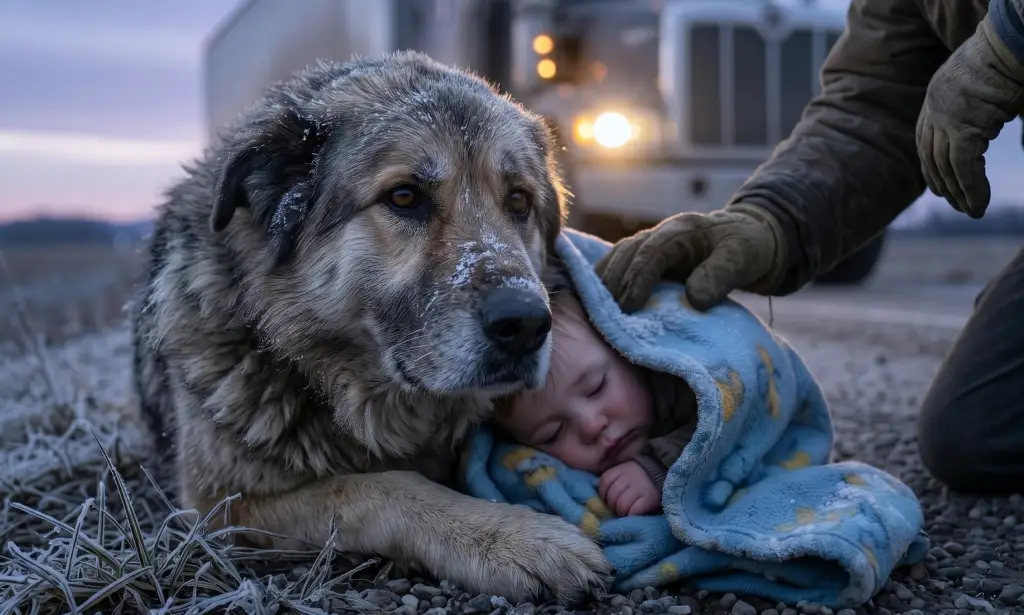
Now a pair of swinging trauma doors had swallowed the baby whole.
“Sir,” the guard said again, not unkindly. “I need you to move the rig. And the dog can’t be in the building.”
Hank blinked at him, slow and heavy, as if the words had to travel a long road before reaching him. Beyond the automatic doors, the storm was still beating against the glass. Inside the vestibule, a soaked gray dog sat on the black rubber mat, ribs showing beneath clumped fur, eyes fixed on the hallway where the nurses had taken the child.
“He came in behind you,” the guard added.
Hank looked at the dog. The animal’s whole body was trembling, but he would not lie down. He had the stubborn, exhausted posture of someone refusing to leave a post.
“He’s the reason that kid’s breathing,” Hank said.
“I believe you,” the guard replied, lowering his voice. “But I still need you to move the truck.”
A few hours earlier, Hank had been forty miles from home, crossing the last ugly stretch of western Pennsylvania before his exit. Late November had turned the night mean. The rain wasn’t falling so much as slicing sideways, hard enough to make his wipers useless every few seconds. His old Kenworth groaned through the weather, heater blasting, dashboard lights glowing a tired green against the dark.
He had been running freight for twenty-eight years. He knew how to drive through sleet, mountain fog, whiteout snow, and the kind of rain that made blacktop look bottomless. He also knew when a man was too tired to be on the road, and that night he had been past tired for more than an hour. The coffee in his thermos had gone stale and metallic. His shoulders ached from holding the wheel too tight.
Home was waiting for him, but home had not felt like relief in a long time.
Five years had passed since Ellen died, and the house outside Briar Falls still carried her absence in every room. Hank could haul through three states on four hours of sleep, but he could not stand in his own kitchen after dark without hearing the refrigerator hum and nothing else. The road had become easier than the silence. Out there, the engine talked. The tires talked. The CB crackled and faded. Nobody expected him to answer questions he didn’t know how to survive.
On County Road 28, there were no towns for miles, only wet fields, bare trees, and a ditch that ran along the shoulder like a black seam. Hank saw the shape just after a curve, caught for one second in the truck’s headlights.
At first he thought it was a trash bag.
Then the shape lifted its head.
Hank’s foot stayed on the accelerator. Every driver learned the same brutal lesson eventually: you could not stop for every broken thing on the side of the highway. There were too many miles, too many wrecks, too many animals people dumped when they got inconvenient. He had already seen more cruelty than he could fix.
But the dog looked straight at him.
It was big, some kind of shepherd mix maybe, though starvation had narrowed it and rain had flattened its coat until it looked half its size. The animal did not bolt from the sound of the truck. It did not bark. It lay pressed into the mud near the ditch with its body curved around something Hank couldn’t see.
Hank passed it.
In the side mirror, the dog’s head stayed up. One thin, desperate sound cut through the engine, so small he might have imagined it if he hadn’t already heard too much pain in his life to mistake it.
Hank cursed under his breath and hit the brakes.
The Kenworth shuddered, air brakes hissing as the trailer settled behind him. He flipped on his hazards, grabbed his canvas coat, and climbed down into rain so cold it seemed to slap the breath out of him. The wind pushed against his back as he walked along the shoulder, boots sinking into gravel and mud.
“Easy,” he called, though he wasn’t sure whether he was talking to the dog or himself. “I’m not here to hurt you.”
The dog watched him with brown eyes rimmed in exhaustion. Up close, Hank could see how bad it was. The animal’s hip bones stood out beneath soaked fur. One ear was torn. Its paws were raw, and when it tried to rise, its legs shook and folded under it.
Hank crouched beside it. The mud soaked through his jeans almost immediately.
“What happened to you, huh?” he murmured. “Somebody hit you?”
The dog stretched its neck and licked Hank’s wrist once, quick and weak. Then it shifted its body, not away from Hank but away from the little bundle it had been guarding.
Hank saw blue fleece.
For one stupid second, his mind refused to understand what his eyes were telling him. He thought it was a jacket, maybe a child’s blanket someone had thrown from a car. Then he pulled the edge back and saw a cheek, a closed eyelid, a tiny hand curled against a soaked cotton sleeve.
A baby boy lay tucked against the dog’s belly.
Hank stopped breathing. The child was small, not newborn but still helpless, six or seven months old at most. His lips had a bluish cast. His skin felt colder than any living thing should feel. Hank pressed two fingers against the side of the child’s neck and waited through the longest few seconds of his life.
There was a pulse.
Weak. Slow. There.
“Dear God,” Hank whispered.
The dog made a broken sound when Hank lifted the baby. Hank tucked the child inside his coat, against the heat of his chest, then looked down at the animal still trying to lift itself from the mud.
“You’re coming too,” he said.
The dog was heavier than it looked. Hank got one arm under its chest and hauled it up with a grunt, stumbling once on the slick shoulder. He carried the baby inside his coat and half-carried the dog back to the truck, rain blowing in his eyes so hard he could barely see the steps. The dog did not fight him. It only kept its nose pressed toward the lump beneath Hank’s jacket, whining whenever the baby shifted.
Inside the cab, Hank shoved the dog onto the passenger seat and turned the heater as high as it would go. Warm air roared from the vents. He held one palm over the baby’s back while he drove, feeling each shallow rise beneath the wet fleece.
“Stay with me,” he said, though the child could not hear him. “Come on, little man. Stay with me.”
The dog lay curled on the seat, shaking so hard its teeth clicked. Every few seconds, it lifted its head and looked at Hank’s coat. Its eyes were not wild anymore. They were pleading.
Briar County Regional was twenty minutes away in good weather. Hank made it in fourteen.
He pulled straight into the ambulance bay and left the truck running. The automatic doors opened, and Hank walked into the ER shouting before anyone had time to tell him where to stand.
“I need help. I found a baby.”
A triage nurse looked up from her station. Whatever she saw in Hank’s face made her move fast. She took the child from his arms, asked one sharp question, then called for a trauma team before Hank had finished answering. Blue scrubs came from everywhere. Someone cut the wet blanket away. Someone else took the baby’s temperature and swore softly.
Then the doors closed.
That was where the guard found him, minutes later, standing in the lobby with nothing left to do but shake.
Hank moved the truck because rules were rules and because he had spent his life understanding what happened when big rigs blocked where they shouldn’t. He drove to the far end of the visitor lot and parked under a buzzing light. The dog, who would not leave the ER vestibule until Hank clipped a length of rope to a makeshift collar, climbed into the cab and immediately turned to stare through the windshield toward the hospital doors.
Hank found an old towel behind the sleeper and rubbed the dog down as best he could. The animal endured it for a minute, then nudged Hank’s hand aside and kept watching the entrance.
“You got a name?” Hank asked.
The dog’s ear twitched.
“No collar. Of course not.” Hank leaned back against the driver’s seat, exhausted enough that his bones seemed hollow. “Fine. I’ll call you Ranger for now. You sure as hell earned something better than ‘dog.’”
Ranger put his chin on the edge of the seat and kept his eyes open.
They waited through the rest of the night. Hank did not sleep. Each time someone walked out of the ER, he sat up straighter. Each time it was not news about the baby, he settled back into the seat and rubbed one thumb over the cracked vinyl of the steering wheel. By morning, the rain had thinned into mist and the parking lot reflected the hospital lights in dull, trembling pools.
A sheriff’s cruiser pulled in just after seven. A deputy stepped out first, followed by a woman in a navy raincoat carrying a county folder against her chest. Hank climbed down before they reached the truck.
“Hank Lawson?” the woman asked.
“That’s me.”
“I’m Marlene Price with County Children and Family Services. This is Deputy Calder.” She glanced toward Ranger, who had risen behind the passenger window. “The hospital said you were the one who brought in the infant.”
“How is he?”
Deputy Calder answered, and Hank understood why. The woman from Children and Family Services had the careful face of someone trained not to give hope too quickly.
“He’s alive,” the deputy said. “Severe hypothermia. Dehydrated. Some exposure injuries. Doctors say you got him here just in time.”
Hank closed his eyes for a second. He had not realized how tightly he had been holding himself until his lungs finally took in a full breath.
“They know who he is?” he asked.
“Not yet,” Marlene said. “No missing infant reports that match so far. No disabled vehicles found near the shoulder. No witnesses. We’re checking hospitals, motels, traffic cameras, anything that might help. Until we identify him, he’s Baby Boy Doe.”
The phrase landed badly. Hank looked past her toward the brick hospital building.
“What happens to him?”
“He stays here until he’s stable,” Marlene said. “After that, he’ll go into emergency placement while we continue the investigation.”
“Placement meaning foster care.”
“For now, yes.”
Hank nodded once, though he was not agreeing. He was only hearing. “I’ll take him.”
The deputy shifted his weight. Marlene’s expression changed in a way Hank knew too well: sympathy rising to cover refusal.
“Mr. Lawson,” she said gently, “what you did last night matters. Nobody is minimizing that. But children don’t get placed because someone asks at the right moment.”
“I’ve got a house. Three bedrooms. Paid off.”
“And you drive long-haul freight,” she said. Her tone stayed kind, which somehow made it harder. “You’re gone days or weeks at a time. Infants need routine care, medical appointments, approved child care, background checks, home study, licensing classes. Even relatives have to go through a process. You’re not a relative.”
Hank looked at his hands. He could still feel the baby’s cold weight, the strange fragility of him under that soaked blanket. In the truck behind him, Ranger pressed his nose to the glass…
To read the rest of the story – CLICK the NEXT button 👇👇👇