


The winter swap meet outside Abilene, Kansas, looked less like a market than a place where broken things came to wait out the cold. Old pickup trucks sat in crooked rows along the gravel shoulder. Their hoods were up, their beds full of greasy parts, busted alternators, dented rims, and cardboard boxes marked in black marker. Men in insulated coveralls stood around with paper cups of gas-station coffee, stamping their boots and pretending the wind did not cut straight through denim, wool, and bone.
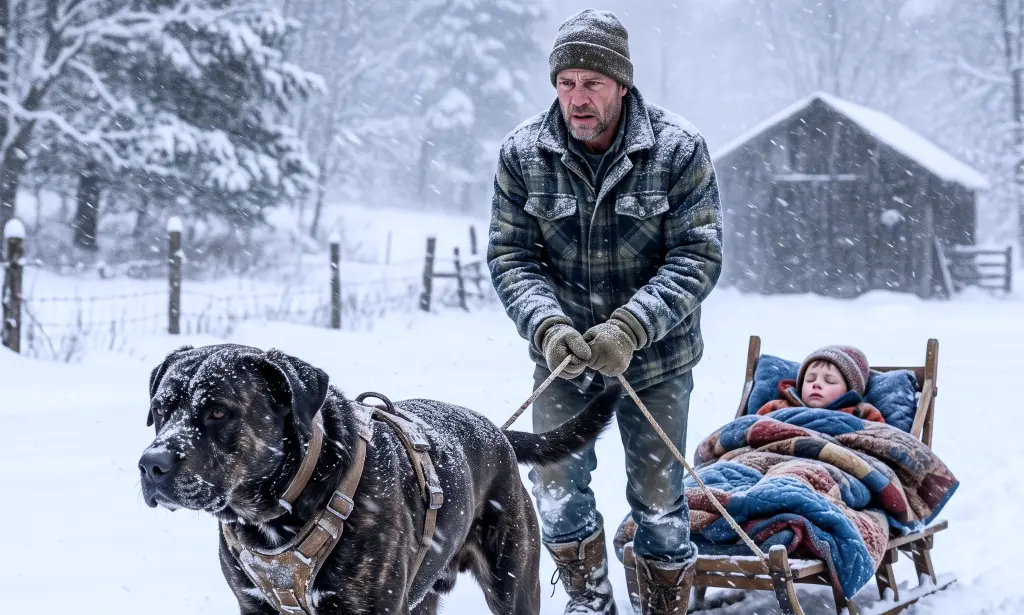
Sam Walker had driven there before sunrise because he did not have the luxury of waiting.
The water pump on his old Chevy Blazer had been leaking since October. He had patched it twice with gasket sealant, prayed over it more times than he wanted to admit, and kept a jug of coolant behind the seat like a man carrying medicine for a failing heart. The Blazer was ugly, loud, and old enough to vote, but it was the only vehicle he had. Without it, the thirty miles between his farmhouse and the county hospital might as well have been an ocean.
He found the part near the back of the lot, sitting on a stained towel beside a stack of used belts. Earl Perkins, a gray-bearded scavenger who knew every junkyard in three counties, picked it up and turned it in his hand.
“Two hundred and fifty,” Earl said.
Sam took off one glove and rubbed his thumb across the cracked skin at his knuckles. “I can do two hundred.”
Earl shook his head. “Two-fifty. That’s not me being hard. That’s me knowing you won’t find another one till spring.”
Sam believed him. In a county where everyone drove trucks older than their kids, parts had a way of disappearing the minute the weather turned bad. He reached inside his coat and pulled out a plastic sandwich bag folded flat and tucked into the inner pocket. Three hundred dollars. That was what remained after the electric bill, Noah’s medication, and groceries bought as cheaply as shame allowed.
He was already counting out the money when he heard the sound.
It was not a bark. It was not even a whimper, exactly. It was a thin, torn breath, dragging itself out of something too tired to cry properly. Sam looked over Earl’s shoulder, past the last row of pickups and trailers, toward the empty edge of the lot where the weeds stuck through the snow like wire.
A dog was tied to a bent fence post.
At first Sam did not recognize it as a dog. It was too large and too hollow at the same time, a huge animal collapsed in on itself. Its ribs showed beneath dirty tan fur that had matted into hard ropes. One ear hung in a ragged half shape. Scars marked its side in pale round patches, old injuries healed badly beneath the coat. Its head rested on the frozen ground, and only the shallow rise of its chest proved it was still alive.
A heavy man in a stained Carhartt jacket sat on an overturned bucket beside it, smoking. A bottle stood between his boots.
Sam put the water pump down.
“That yours?” he asked.
The man looked up with the bored irritation of someone interrupted in the middle of nothing. “For now.”
“What happened to him?”
“Nothing worth talking about.” The man blew smoke sideways. “You want him?”
Sam stared at the dog. It did not lift its head, but one eye opened, cloudy and flat. There was no plea in it. That was worse somehow. A begging animal still believed there was someone to beg.
The man took another drag. “Hundred bucks and he’s your problem.”
Earl gave a short laugh behind Sam. “Don’t tell me you’re thinking about it.”
The man on the bucket smirked. “Imported shepherd. Central Asian, or close enough. Was worth real money once. Big, mean, tough. Then he got soft.” He nudged the dog’s rope with the toe of his boot. “Ain’t worth feeding now.”
Sam felt his jaw tighten. He understood enough. Everyone in that part of Kansas had heard rumors about the old packing plant outside Clay Ridge, about men gathering there on Friday nights with cash in their pockets and dogs in cages. No one said much. Saying things out loud did not always make them safer.
“You leaving him here?” Sam asked.
“Depends.” The man shrugged. “You got a hundred?”
Sam thought of the pump. He thought of the Blazer coughing on cold mornings. He thought of Noah, six years old and small for his age, waking with a cough that sounded too deep for a child’s chest. He thought of the medicine bottles lined up beside the sink, the unpaid clinic bill folded under a magnet on the refrigerator, and the boy who had not spoken since the day they buried his mother.
Then he looked back at the dog.
The animal’s cloudy eye had shifted toward Sam’s hand. Not toward the money. Not toward the truck. Just toward his hand, hanging open at his side.
Sam returned the bills to the plastic bag. He peeled off five twenties and laid them on the bucket.
“Leave the rope,” he said.
Earl stared at him. “Sam.”
The man on the bucket snatched up the money before the wind could take it. “Suit yourself.”
Sam crouched slowly, careful not to crowd the dog. “Easy,” he murmured, though the dog had not moved enough to require caution. He loosened the rope from the post and slid both arms beneath the animal’s body. For something so large, the dog weighed almost nothing. Sam had carried feed sacks heavier than that…
To read the rest of the story – CLICK the NEXT button 👇👇👇