


The Briar Creek County Stockyards had a smell Wade Callahan could have recognized blindfolded: hot diesel, trampled hay, old manure, and the sour tang of frightened animals packed too close together. By late morning the summer heat had settled over the auction yard like a lid, pressing the smell down into the gravel and rusted gates.
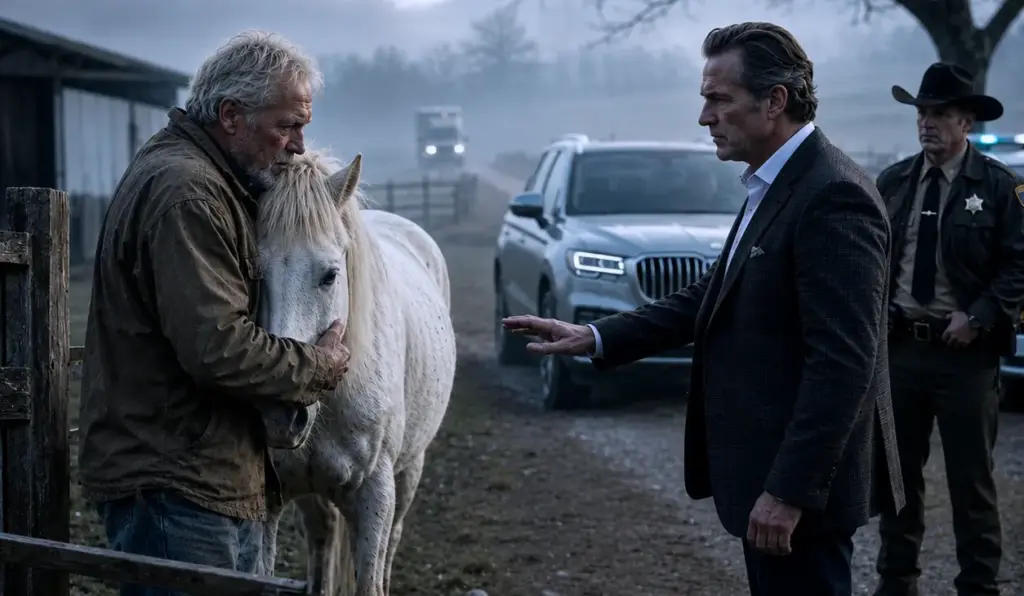
The loudspeaker over the main barn crackled and whined as the auctioneer’s chant spilled across the property in one long, breathless ribbon. Men in ball caps leaned against pipe fencing with Styrofoam cups of coffee. Trailers backed up with sharp metallic shrieks. Somewhere near the loading chutes, a steer bellowed so hard the sound seemed to shake loose from its own body.
Wade stood at the edge of the crowd with both hands buried in the pockets of his work jacket, though it was too warm for a jacket. The canvas had been washed thin at the elbows and darkened with oil near the cuffs. He wore it because the inside pocket held his wallet, and the wallet held two hundred and forty dollars he could not afford to spend wrong.
He had not come for an animal.
The old Massey Ferguson had died three days earlier in the lower pasture, coughing once before the electrical system went dead and the engine gave up in a patch of thistle. Wade had spent two afternoons tracing wires with a flashlight and a screwdriver, hoping it was something simple. It wasn’t. The alternator was shot, and if he didn’t get the pasture cut before the weeds went to seed, he’d be fighting it all the way into fall.
So he had driven twelve miles to the equipment swap beside the stockyards, hoping somebody had a rebuilt alternator cheap enough to keep him from having to choose between the tractor and the county tax bill sitting unopened on his kitchen table.
That was how his life had narrowed in the past fourteen months: one impossible choice followed by another.
After Maggie died, people kept telling Wade to ask for help. They said it kindly at first, with casseroles and awkward pats on the shoulder after church, then with worried looks at the feed store when they realized he had stopped shaving every day and stopped answering the phone. But help was a word people liked better than they understood. Help did not bring back a wife. It did not milk a dead account into paying the mortgage. It did not make a quiet house easier to enter at dusk.
Wade had learned to keep his head down. He moved through town like a man passing through bad weather, polite enough not to draw attention, distant enough that nobody felt invited to ask how he was doing. At sixty-eight, he was still strong in the way old farmers are strong, all bone and habit, but grief had pulled something downward in him. His shoulders stooped even when he was standing still.
He crossed behind the main pens, past yearling calves shining with health, past hogs lying in the shade with their sides heaving, past cages of nervous hens and a row of goats chewing through their boredom. The equipment tables were set up in the north lot, but Wade found himself walking the other way, away from the auctioneer, away from the men laughing over coffee, away from the bright noise of buying and selling.
At the far end of the property, the gravel thinned into dust and weeds. The fencing was older there, orange with rust where the rails had been welded and rewelded over the years. No one lingered in that part of the yard unless they had a reason to. It was where the stockyards kept the animals that were not going to bring a decent price: lame cattle, exhausted broodmares, skinny horses nobody wanted to feed through winter.
Wade stopped beside the last pen.
At first he thought the mare was gray. Then she shifted slightly and the sunlight caught a cleaner patch along her shoulder, and he saw that under the mud and dried sweat she was white. Or had been white once. Her coat hung dull and filthy over a body that had used up nearly all its reserves. Her ribs showed in hard lines beneath the skin, and her hip bones stood out with a cruelty that made Wade look away before he forced himself to look back.
She stood alone in the center of the pen with her head so low her muzzle almost touched the dirt. Her mane had tangled into ropes. Flies worried at the wet corners of her eyes, and she did not flick them away.
Then Wade saw the leg.
Her front left knee was swollen beyond reason, blown out and misshapen, pulling the rest of the limb into a crooked angle. She kept the hoof lifted just above the ground, trembling from the effort. Every few seconds her body swayed, not enough to fall, but enough to show how close falling had become.
“Don’t waste your time, old-timer.”
The voice came from behind him, flat and rough around the edges. Wade turned and saw a thin man leaning against a dented livestock trailer, smoking down to the filter. He had the sharp, restless look of a man who did not plan to care about anything long enough for it to cost him.
The man nodded toward the mare without truly looking at her. “She’s done.”
Wade said nothing.
“I’m serious,” the man went on. “That leg’s rotten with trouble. She’ll be lucky if she makes the drive north. Plant might turn her away if she goes down in the trailer.”
The mare’s ear twitched at the sound of his voice. She did not lift her head.
The man pushed away from the trailer and spat into the dust. “Unless you’re in the market for a hole to dig, keep moving.”
Wade looked at him for a moment, then looked back through the rails. He had spent most of his life around animals, and he knew when suffering had passed into something quieter. The mare was not fighting the pen, not calling out, not striking at the gate. She was standing in the thin shadow of her own body as if she had already stepped halfway out of the world.
He thought of Maggie in the hospice bed by the living room window, because she had refused to die in a hospital if there was any choice left to her. He thought of the last week, when her hands had gone weightless in his and her eyes had stopped searching the room for what came next. She had not been afraid then. Wade almost wished she had been. Fear would have meant she still had something left to resist.
This mare had that same emptied-out look.
Wade moved closer to the fence. The broker snorted behind him, but Wade ignored him and slid one scarred hand between the rails. His knuckles were swollen from work and age, the nails cracked and dark at the edges no matter how often he scrubbed them.
The mare saw the movement. Her whole body shuddered. It was not a dramatic flinch, not the wild startle of an animal with enough strength to flee. It was smaller than that and worse. She had expected pain because pain was what hands had come to mean.
Wade did not reach farther. He simply held still.
The loudspeaker faded behind him. Men shouted somewhere near the barns, a gate slammed, a trailer engine turned over. In the small space between Wade’s palm and the mare’s lowered face, the rest of the yard seemed to fall away.
After a long while, she shifted her weight. Her bad leg shook hard when she moved, and for one awful second Wade thought she would collapse where she stood. Instead she made a short, awkward hop forward. Then another.
Her muzzle stopped inches from his palm. She breathed out against him, warm and damp and faintly sweet beneath the smell of sickness.
Wade closed his eyes.
He had not been able to save Maggie. No man could bargain with cancer, though God knew he had tried in every private, foolish way. He had sat beside her bed and listened to the clock tick and the oxygen machine hum. He had memorized the shape of helplessness.
But this creature was still standing.
Wade pulled his hand back and reached into the inside pocket of his jacket. The broker straightened when he saw the wallet. Wade opened it with stiff fingers and took out the money: two hundreds folded behind a twenty and two tens. He kept the forty back without thinking, because the habit of survival was too old to disappear entirely.
“How much?” Wade asked.
The broker looked amused. “For her?”
“How much?”
The man glanced at the mare, then at the bills. “Two hundred. Cash. No guarantees, no complaints, no bringing her back when she dies before supper.”
Wade held out the money.
The broker laughed once, mean and short, but he crossed the dirt fast enough to snatch the bills before Wade changed his mind. “You farmers and your soft heads,” he muttered. “She can’t even load right. You got a trailer?”
Wade nodded toward the battered two-horse stock trailer hitched to his Ford.
The broker folded the cash into his pocket. “You bought yourself a problem.”
Wade looked through the fence at the mare, who had lowered her head again but had not backed away from him.
“I already had plenty,” he said.
It took nearly forty minutes to get her from the pen to the trailer. Wade would not let the broker whip her or crowd her with a sorting board. He took the frayed lead rope himself and moved slowly, giving her time to decide each step. The mare sweated from the pain of it, and once her injured leg buckled so suddenly that a young man by the chute cursed and jumped back.
Wade put both hands against her shoulder and spoke into her tangled mane. “Easy, girl. I’ve got you.”
It was a foolish thing to say. He did not have much of anything. Not the money to treat her, not the hay to spare, not the strength he’d had twenty years ago. But the mare listened to his voice, or maybe she listened to the absence of force in it. After a while she lurched up the ramp and stood trembling inside the trailer, her sides fluttering with shallow breaths.
The broker swung the gate shut and slapped the latch. “Wouldn’t take the long way home.”
Wade climbed into the truck and started the engine. He sat there a moment with both hands on the wheel, staring through the dusty windshield at the auction yard. The alternator he had come to buy was still sitting somewhere in the north lot, if it existed at all. The tax bill would still be on the table when he got home. The tractor would still be dead in the pasture.
Behind him, in a rusted trailer with bad tires, stood a dying white mare he had bought with the last bit of cash he had.
Wade pulled slowly out of the yard and turned toward home.
The drive took more than an hour, though his farm was only twelve miles away. He kept the truck at a crawl with the hazard lights clicking on and off, on and off, while cars stacked up behind him and whipped around when the road straightened. Every pothole seemed to rise up under the trailer wheels. Every dip in the pavement made the mare shift her weight, and each shift traveled through the hitch into Wade’s spine.
He kept glancing in the side mirror, though he could see only the trailer’s dented fender and a sliver of road. Once he pulled onto the shoulder and got out just to listen. The mare was still upright. He could hear her breathing in there, uneven but steady.
“That’s it,” he murmured through the slats. “Almost there.”
The Callahan place sat at the end of a gravel drive lined with maples that had not been trimmed in years. The mailbox leaned sideways. One gate hung lower than the other. The white farmhouse, which Maggie had once kept bright with flower boxes and clean curtains, had begun to surrender around the edges. Peeling paint curled from the porch rail. The back gutter sagged loose at one end. A rusted hay rake sat where Wade had left it last fall, half-swallowed by grass.
He did not take the mare to the main barn. It was too open, too drafty, and too full of things he had let slide. Instead he eased the trailer behind the house toward the old foaling shed under the oak trees. Maggie had used it years before for a pair of orphan calves and then for storage, but it was small, tight-walled, and protected from the wind.
Before he unloaded the mare, Wade went inside and moved fast in the dim, dusty space. He shook out two bags of pine shavings he had been saving, then spread old coastal hay over the top until the floor was deep and soft. He filled a bucket with warm water from the mudroom sink and set it inside the stall. The work made his bad knee ache, but he welcomed the pain. Pain had a place. It made sense.
Getting the mare down the ramp was harder than loading her. She stood at the edge, swaying, the injured leg lifted high and shaking. Wade did not pull the rope. He stood to one side with his shoulder near her neck and let her look at the ground.
“It’s grass,” he said softly. “That’s all. Just grass.”
When she finally stepped down, her bad leg folded. Wade dropped the rope and threw himself against her ribcage, bracing his whole weight beneath her shoulder. For a second they both leaned there, old man and ruined mare, trembling in the evening air.
Then she caught herself.
Wade stayed pressed against her until her breathing slowed. His face was buried in the coarse, filthy hair of her neck, and the smell of neglect filled his lungs. He did not move away.
“I know,” he whispered. “I know it hurts.”
Inside the shed, the mare stopped as soon as her hooves sank into the bedding. She did not explore. She did not lower her head to the hay. She simply stood in the center of the stall, eyes half-lidded, as though comfort itself was something she no longer trusted.
Wade stayed with her until dark.
He brought the water bucket to her lips when she would not lower her head. At first she only mouthed the rim. Then she drank, deep and desperate, pulling half the bucket down in long swallows. She would not touch the oats he set in an old rubber pan, so he took them away. A starving horse could be killed with kindness if a man fed too much too fast. Wade knew that much.
He washed her leg under the yellow light of the bare bulb. The joint was hot through the cloth when he pressed a wet rag to it, and the mare’s skin jumped, but she did not kick. He cleaned dried mud from the folds around the swelling, working slowly, stopping whenever her breath sharpened. He had no business pretending to be a vet, but he knew infection, knew heat, knew when a poultice might pull a little mercy from an angry limb.
By midnight he had wrapped the knee in cotton soaked with warm Epsom water and an old drawing salve he found at the back of the tack cabinet. Then he dragged an overturned feed tub into the corner, laid Maggie’s old wool barn blanket over it, and sat down.
The house was thirty yards away. The bed upstairs was made. Maggie’s robe still hung on the hook behind the bathroom door because Wade had never found the courage to move it.
He stayed in the shed.
The mare breathed in the darkness. Wade listened to every uneven pull of air, every shift of her good hooves in the shavings. Whenever the rhythm faltered, he sat forward with his hands on his knees, waiting for the heavy sound of her falling.
She did not fall.
Near dawn, just as the sky began to pale behind the oak trees, Wade leaned back against the stall wall and let his eyes close. The mare stood a few feet away, head low, leg wrapped, still alive.
For the first time in over a year, Wade was tired for a reason that was not grief.
By the second morning, Wade had learned the mare did not like sudden movement, metal buckets, men’s voices outside the shed, or the sound of a latch snapping shut. She tolerated his hands if he moved slowly and always came from the side. She drank well if he held the bucket. She ignored dry feed but would mouth warm bran mash from his palm, more out of exhaustion than appetite…
To read the rest of the story – CLICK the NEXT button 👇👇👇