


Judge Miriam Whitaker had already placed her hand on the gavel when the back doors opened. Courtroom 3A, on the third floor of the Cedar County Courthouse, was not a room that welcomed interruption. Its high windows were frosted at the edges from the January cold. Its old oak benches held defendants, attorneys, clerks, and relatives who had learned to sit with their coats buttoned and their hopes kept small. Even the fluorescent lights seemed to flatten people into case numbers and docket entries.
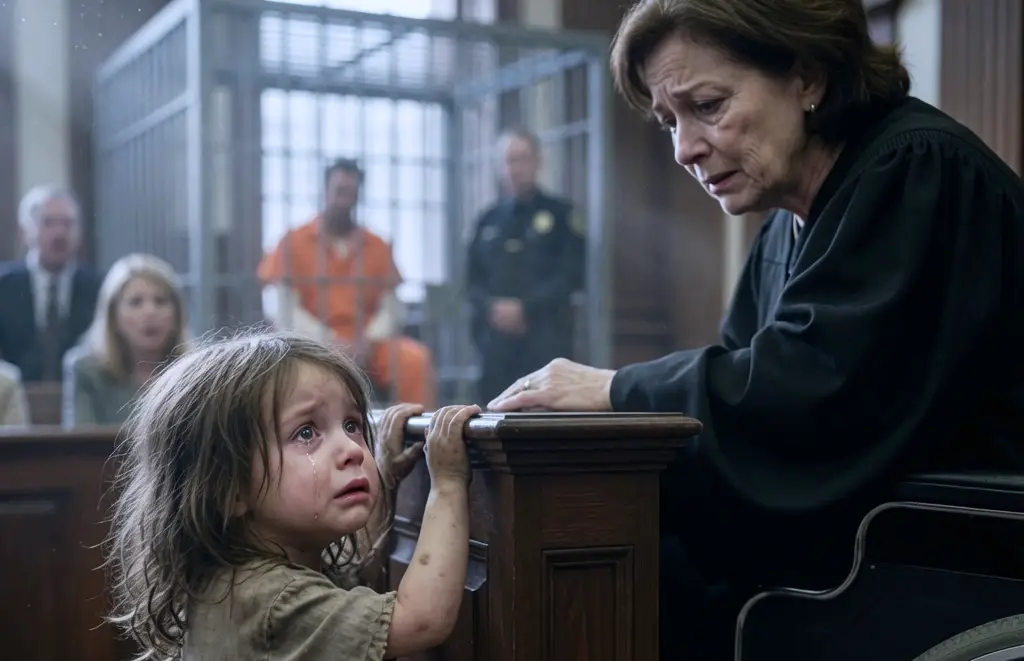
Miriam looked up from the file in front of her. She expected a late attorney, maybe a deputy escorting someone from holding. Instead, a little girl stepped into the aisle.
She could not have been more than five. Her brown hair had been gathered into a crooked ponytail that was giving up strand by strand. Her leggings were too short at the ankles, her winter boots were scuffed white with salt, and the pink sweater under her coat had a small unraveling thread at the cuff. She walked as if she had been told not to run and had taken the instruction seriously, though every part of her face was searching the room.
A bailiff shifted from the wall. The public defender at the front table turned sharply. At the defense table, Caleb Turner rose halfway from his chair, and the sound that left him was not quite a word.
“Lily,” he whispered.
The child found him then. Her face opened with relief so sudden it hurt to watch, but she did not run to him. Not yet. She looked past him, up toward the bench, where Miriam sat in her black robe with her wheelchair tucked behind the heavy paneled front.
The girl took three more steps down the aisle and stopped near the clerk’s desk.
“Miss Judge,” she said, in a small voice that carried because no one else was breathing loudly enough to cover it, “if you let my daddy come home, I can help your legs remember what to do.”
A few people in the gallery stirred. Someone gave a soft, embarrassed laugh and swallowed it immediately. The prosecutor, Graham Ellis, lifted his head as if he had misheard. Tessa Brooks, the public defender, shut her eyes for one second, the way overworked attorneys do when the facts of a case have just become even more impossible to manage.
Miriam did not move. Her fingers remained on the gavel, but the pressure in them changed. For three years, most people had made a polite effort not to look at the wheelchair. This child had seen it from twenty feet away and spoken about it as plainly as if she were pointing out snow on the steps.
“Who brought her in?” Miriam asked, though her voice was softer than she intended.
An elderly woman in a puffy blue coat stood in the doorway, breathing hard, one hand pressed against her chest. “I did, Your Honor. Ruth Benton. I live across the hall from them. I’m sorry. I tried to keep her outside, but she heard his name.”
The bailiff looked to the bench for instruction. The courtroom waited for Miriam to restore order, to send the child back out, to remind everyone that a criminal sentencing hearing was not a place for a kindergarten miracle.
But Miriam kept looking at Lily Turner’s small hands. The child had clenched them into fists at her sides, not from anger, Miriam realized, but from effort. It had taken all the courage in her little body to walk into that room.
Three weeks earlier, Caleb Turner would have said he was not the kind of man who ended up in court.
He was the kind of man who woke before his alarm because anxiety got there first. He framed houses and repaired porches and patched whatever winter broke for homeowners who could afford to call somebody else. His hands were scarred from old splinters and fresh cuts, and his lower back had a habit of locking if he sat too long. He had once been proud of those things. They were evidence that he worked, that he paid his own way, that he had kept his daughter alive after grief had taken everything else.
The apartment he shared with Lily was on the second floor of a brick walk-up on the east side of Briarwood, Ohio, in a neighborhood that had more churches than grocery stores and more payday lenders than clinics. The radiators hissed when they felt like it. The windows wore plastic sheeting every winter. Ruth Benton, who lived across the hall and owned a cat she spoke to like a bad roommate, watched Lily before school when Caleb had to be on a job site before sunrise.
His wife, Anna, had died three years earlier, so quickly that Caleb still measured his life in before and after. Before, there had been Sunday pancakes and Anna’s laugh in the kitchen and Lily asleep in a carrier against his chest. After, there were hospital bills, a funeral suit he never wanted to see again, and a child who sometimes woke crying because she could not remember the exact sound of her mother’s voice.
Lily had inherited Anna’s green eyes and Caleb’s stubborn chin. She had also inherited a pair of lungs that treated cold weather like a threat. Every winter, Caleb learned the language of wheezing all over again: the thin whistle at the end of an exhale, the cough that meant fever, the shallow fast breaths that sent him kneeling beside her bed with a nebulizer cup in his shaking hands.
By the second week of January, he had sold almost everything that could be sold without making the apartment unlivable. The television was gone. His work truck had been traded for an old compact sedan with a cracked dashboard. Anna’s wedding ring had stayed in his sock drawer until Lily’s last emergency-room copay; then it had gone to a pawnshop beside a check-cashing place, and Caleb had sat in his car afterward with the receipt folded in his hand until he could see through the windshield again.
On the morning everything went wrong, the bedroom window had ice along the inside corners. Caleb woke to Lily coughing in the next room.
Not the usual cough. The small clicking one.
He was out of bed before he was fully awake. Lily lay twisted in her blanket, cheeks flushed too bright, hair damp at the temples. When she tried to breathe in, her chest pulled tight under her ribs. She looked at him with the terrified calm of a child trying not to scare her father.
“It’s small in there,” she whispered, touching her chest.
Caleb opened the plastic medication bin on her dresser. Empty. He checked the bathroom cabinet, though he knew what he would find. Empty. He found an old inhaler in the kitchen drawer and pressed it down once; nothing came out but a dry little puff that smelled like plastic.
His wallet held twenty-three dollars and two receipts. His checking account was negative by twelve. The pharmacy had stopped extending courtesy holds after the last unpaid balance. St. Anne’s Regional Medical Center had treated Lily before, but every visit arrived weeks later as another envelope he could not open at the kitchen table.
He called his foreman from the hallway so Lily would not hear him beg.
“Hank, I need an advance,” Caleb said. He kept his voice low, one hand braced against the peeling wall. “Just a couple hundred. Lily’s sick. I’m not asking for charity. Take it out of Friday.”
Hank Miller was not a cruel man. That almost made it worse. Caleb heard the job site behind him, nail guns popping in the distance, a truck backing up with its steady beep.
“I can’t do it, Cal,” Hank said. “Payroll’s all locked through the office now. If I could cut cash, I would.”
“Please,” Caleb said, and hated the sound of it.
There was a pause long enough for Caleb to hear Lily cough again from the bedroom. Hank exhaled into the phone. “I’m sorry, brother.”
Caleb ended the call and stood in the hallway with the phone still in his hand. He could have called 911. He should have. But the last ambulance bill had been more than his monthly rent, and the thought came to him, ugly and practical, before any better thought could stop it: if he could get the fever down and get steam into her lungs, maybe he could keep her out of the hospital this time.
He wrapped Lily in two blankets, propped her upright with pillows, and knocked on Ruth’s door. Ruth opened it in a housecoat, took one look at his face, and stepped aside for her shoes.
“I have to run to Northstar,” Caleb said. “Ten minutes.”
Ruth looked past him toward the apartment. “Go. I’ll sit with her.”
Northstar Pharmacy sat at the end of a strip mall between a closed tanning salon and a dollar store. Caleb walked there because the sedan was nearly out of gas. The wind came hard off the river, turning his ears numb beneath his knit cap. By the time the automatic doors opened and swallowed him into the bright, heated store, his face burned from cold.
He went first to the pharmacy counter. The tech recognized him, and her expression tightened with sympathy before he even gave Lily’s name.
“I can’t release the refill without payment,” she said quietly. “I’m sorry. The system won’t let me override it.”
“She’s five,” Caleb said.
“I know.”
“She can’t breathe right.”
The pharmacist came over then, a tired man with kind eyes and a line of customers behind Caleb. He lowered his voice. “Mr. Turner, if she’s in respiratory distress, you need to take her to the ER.”
Caleb laughed once, not because anything was funny, but because the words belonged to a world where consequences waited politely outside the door. He stepped away from the counter before his anger could become something the security cameras would remember.
In the children’s aisle, he found fever reducer, saline treatments, a cool-mist vaporizer, and a replacement tubing kit that matched Lily’s old nebulizer. The total in his head passed a hundred dollars before he reached the end of the shelf. He stood there with the boxes in his hands, looking at cartoon bears and pastel labels, while shoppers moved around him buying vitamins and Valentine’s candy.
He thought of Anna then, not as she had looked in the hospital, but in the kitchen years earlier, blowing on a spoonful of soup for Lily. “Pride is useful,” she had once told him, teasing but serious. “Right up until it makes you stupid.”
Caleb put the boxes inside his work coat.
He did not run. Running would have admitted something he was still trying not to know about himself. He walked toward the doors with his hands pressed against his sides, holding the stolen medicine in place, and almost made it outside.
A hand closed on his shoulder.
“Sir,” a man said behind him. “We need to talk.”
The loss-prevention officer was older, with gray at his temples and a voice worn smooth by years of saying hard things without making them worse. Caleb did not fight him. He took the boxes out. He tried to explain. By the time the police cruiser pulled up, he was crying openly, not for himself, but because Ruth was across the hall with Lily and the medicine was still sitting on the manager’s desk in a clear plastic evidence bag.
“Please,” Caleb said to the officer as the cuffs went on. “Call somebody. My daughter’s sick.”
The officer did call. Ruth had already called 911.
By the time paramedics carried Lily down the stairs, Caleb was sitting in the back of a cruiser with his wrists cuffed in front of him, watching the apartment building disappear through wire mesh. He did not know Lily had gone limp in Ruth’s arms. He did not know Ruth had ridden in the ambulance, holding one tiny boot because the other had fallen off on the stairwell. He did not know the ER doctor at St. Anne’s had gotten Lily breathing again with oxygen, steroids, and albuterol while a county social worker started asking questions no one in that room had the luxury of answering gently.
What Caleb knew was that he had stolen from a pharmacy and left his daughter behind.
For two weeks, the system moved around him with clean forms and tired voices. He was arraigned on a theft charge. He could not make bond. The public defender, Tessa Brooks, met him twice, each time with a stack of files and apology in her eyes. Family services placed Lily in a temporary foster home because Caleb was in custody and Ruth’s emergency background clearance had not come through fast enough. Ruth visited when she could and left messages with Tessa: Lily was safe. Lily was asking for him. Lily kept saying he had only gone to get her breathing machine.
By the time Caleb was brought into Courtroom 3A, he had lost weight. The borrowed suit from the public defender’s office hung loose at the shoulders. He kept his eyes on the defense table because if he looked at the gallery and did not see Lily, he might not be able to remain standing.
Miriam Whitaker had read his file that morning at her kitchen table, beside a cup of coffee gone cold. The facts were plain. A widowed father. A sick child. Stolen merchandise. A store policy that left no room for mercy once the police report had been filed. A child welfare case opened because poverty and panic had joined hands and looked, on paper, like neglect.
Miriam had seen versions of that story for twenty years. She had learned early on that pity could not be allowed to write orders from the bench. Pity was inconsistent. Pity favored the articulate and punished the ashamed. The law, at least in theory, did not care whether a person cried well.
Still, when Lily Turner stood in the aisle and offered to heal the judge’s legs in exchange for her father, Miriam felt something inside her answer before her mind could object.
She lifted her hand toward the bailiff. “Let her come forward.”
Caleb was already moving before the bailiff stepped aside. He dropped to one knee in the aisle, and Lily crossed the last few yards into him with the sudden force of a child who had been holding herself together for too long. Her arms locked around his neck. Caleb pressed his face into her hair, and the sound he made was quiet enough that most people could pretend not to hear it…
To read the rest of the story – CLICK the NEXT button 👇👇👇