


The first sound at Caleb Rowan’s door was so faint he mistook it for wind worrying the porch boards. He had been sitting in the old leather chair beside the woodstove, one boot off, one still on, a mug of black tea cooling on the table beside him. Outside, the temperature had slipped below zero before sunset, and the snow came at the windows in dry, needling bursts. It was the kind of northwestern Montana night that made a man grateful for split firewood, good chinking between logs, and the habit of checking every latch before dark.
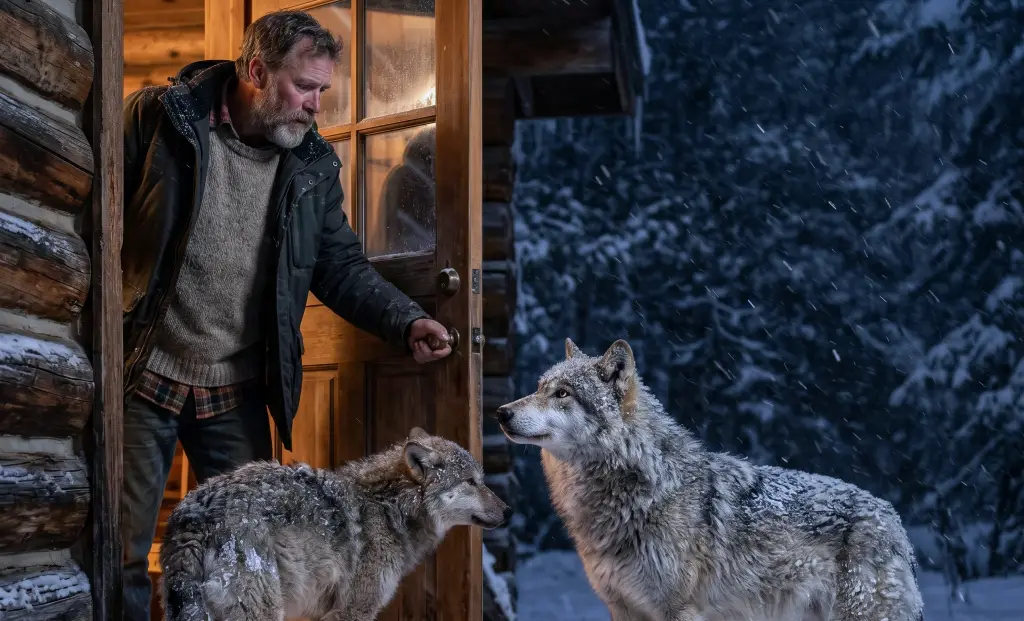
Then the sound came again.
Not a branch this time. Not ice loosening from the roof. It was low and deliberate, a scrape against the bottom of the front door, followed by a thin whine that moved through the cabin like a human breath.
Caleb stayed still for several seconds, listening. His cabin sat twelve miles from the nearest paved road and almost three from the closest neighbor, if you counted Martin Bell, who spent winters in Arizona and left his place shut up behind a chained gate. Stray dogs did not wander this far in January. People did not either unless something had gone badly wrong.
He eased his foot back into his boot and reached for the flashlight he kept by the stove.
The scratching stopped as soon as he stood. That made him pause. Animals heard movement, sure, but this felt different, as if whatever waited outside had gone quiet on purpose.
“Hello?” he called.
The answer was another whine, softer than the first.
Caleb crossed the room slowly. The cabin was small enough that six careful steps took him from the stove to the mudroom, where his winter coat hung beside a row of tools and snow-caked boots. He clicked off the lamp before lifting the edge of the curtain from the narrow window beside the door.
At first he saw only his own reflection and the blowing snow. Then the porch light caught two shapes pressed close to the cabin wall.
Wolves.
Caleb stopped breathing for a moment.
They were not standing proud and square the way he had seen wolves stand on ridge lines, all muscle and command. These two looked hollowed out by winter. Their coats were packed with frost, their sides drawn tight beneath the fur. One was taller, broad through the shoulders despite being painfully thin, with a torn edge to one ear and a dark scar curving along its muzzle. The other was smaller and lighter, its gray coat marked by a pale streak near one shoulder. It held its back leg slightly off the boards.
The larger wolf lifted its head and looked straight at the window.
Caleb had lived around predators all his life. Black bears tore through trash sheds in spring. Mountain lions left tracks along the creek. Coyotes screamed from the hills at night, sounding close enough to be under the bed. Wolves, though, were different. They belonged to the deep country, the timber and shadowed basins where a man felt his own smallness.
They did not come to doors.
The smaller wolf sank onto the porch as though its legs had finally given up. The bigger one nudged it once, then looked back at Caleb through the glass.
“Good Lord,” Caleb whispered.
He backed away from the window, thinking through every sensible thing he should do. He should leave the door shut. He should call Montana Fish, Wildlife and Parks, or the sheriff’s office, or anybody with training and equipment. But the landline had been dead since the previous afternoon, taken down somewhere by ice, and his cell phone only found service if he climbed the rise behind the shed. No animal would survive long enough for him to go for help and come back.
Another gust shoved snow across the porch. The smaller wolf curled tighter, trembling hard enough that Caleb could see it from inside.
He looked at the woodstove, at the square of orange light trembling on the floorboards, at the wool blanket folded over the back of his chair. For years the cabin had been built around keeping cold out. Now the cold had delivered something to him, something wild and half-dead, and stood there waiting to see what kind of man he was.
Caleb went to the mudroom and pulled on his heavy gloves. He took the fire poker from beside the stove, not because he thought it would help much, but because empty hands felt foolish. Then he opened the inner door and stood with his palm on the outer latch while the wolves shifted on the other side.
“Don’t make me regret this,” he said, though his voice was barely more than a murmur.
He opened the door six inches.
The wind hit him first, fierce enough to burn his eyes. The larger wolf did not lunge. It stepped back, lowering its head, while the smaller one lifted its face with visible effort. Its eyes were yellow-brown, glassy with pain and exhaustion.
Caleb kept his body sideways and opened the door wider. Warmth spilled past him into the night.
“Come on,” he said. “Easy.”
For a few seconds, neither animal moved. Then the smaller wolf dragged itself forward, claws clicking against the frozen porch boards. The larger wolf stayed pressed close to its flank, matching each uneven step, watching Caleb without blinking.
When the first paw crossed the threshold, Caleb felt the full madness of what he was doing.
He stepped back until his shoulders touched the wall. The injured wolf entered first, then stopped in the mudroom, trembling so hard its teeth chattered. The larger one slipped in after it, quick and silent, and turned at once to face the door, as if expecting the storm itself to follow.
Caleb closed the door.
The cabin fell into a quiet so complete he could hear snow sliding off the roof.
The wolves stood in the mudroom, noses working, bodies tense. The smaller one tried to shift weight onto its bad leg and nearly collapsed. The big one moved between Caleb and the injured animal, not threatening exactly, but clear in its meaning.
“I know,” Caleb said softly. “I see her.”
He did not know why he was certain the smaller wolf was female, only that the word came naturally. She looked young under the suffering, not a pup but not fully hardened either. The larger wolf had a steadier, older presence, though his ribs showed each time he inhaled.
Caleb retreated into the main room and tossed two more pieces of larch into the stove. The metal ticked and popped as flame took hold. Heat moved slowly through the cabin, and with it came a change in the wolves. Their ears eased. Their heads turned toward the stove. The female gave a sound that was not quite a whine and not quite a sigh.
“You’ve never seen one of those, have you?” Caleb murmured.
He kept his distance while they stepped out of the mudroom and into the room where he spent nearly all his winter evenings. The male sniffed the rug, the chair, the stack of kindling by the hearth. The female made it only as far as the old braided mat near the stove before lying down with a careful, painful lowering of her body.
Blood had dried into the fur above her hind leg. Not much, but enough.
Caleb watched her for a moment, then went to the freezer. He still had venison from a buck his nephew had taken in November, wrapped in white butcher paper and labeled in black marker. He pulled out two packets, set them in a pan of warm water just long enough to loosen the meat, then cut it into pieces with hands that were not quite steady.
He did not put the meat in his palm. Compassion was one thing; stupidity was another. He set it on an old baking sheet and slid it across the floor with his boot.
The male waited until Caleb stepped back. Then he came forward, sniffed once, and ate with a hunger that made Caleb look away. The female lifted her head but did not rise, so Caleb used a pair of tongs to place a few pieces closer to her. She ate lying down, swallowing without chewing, her eyes half-closed.
“How long have you two been out there like this?” he said.
The wolves gave him no answer, only the hard sound of survival.
After they ate, the cabin settled into an uneasy arrangement. Caleb sat in the chair nearest the stove but kept his boots on and the fire poker within reach. The male lay between Caleb and the female, his chin on his paws, his eyes tracking every movement. The female dozed in short bursts, waking whenever pain shifted through her body.
Around 10:00 p.m., Caleb tried the landline again. Nothing. He held the receiver against his ear until the dead silence became irritating, then set it back in the cradle.
The male lifted his head.
“Phone’s out,” Caleb told him. “Not that you care.”
The wolf blinked once, slow and solemn.
Caleb almost smiled.
He had not had a dog since childhood, and even that had been a shaggy mutt his father insisted belonged to the whole family, not to any one person. A wolf was not a dog. Caleb knew that down to his bones. Still, there was something about the animal’s watchfulness that made the room feel less empty. Not safe, exactly, but inhabited.
That was not nothing.
By midnight, the female’s trembling had lessened. Caleb unfolded two wool blankets and placed them near the stove, using the poker to push them across the floor. The male rose at once, alert, but he did not growl. The female sniffed the blanket and rested her head on it with a small sound that went straight through Caleb.
“You’re welcome,” he said.
He slept badly in the chair, waking every twenty minutes to check that the wolves were still where they had been. They were. Once, near 3:00 a.m., the male whimpered in his sleep, legs jerking as if he were running across hard ground. The female woke and touched her muzzle to his shoulder. He quieted.
Caleb watched them until his eyes burned.
At dawn, the storm had weakened to a thin gray snowfall. The windows were rimmed with frost, and the cabin smelled of woodsmoke, wet fur, and meat. Caleb stood carefully, every joint stiff from the chair, and made coffee as quietly as he could.
The wolves were awake. The female had not moved far, but she seemed more aware, her ears following him around the room. The male rose when Caleb came too close, then settled again when Caleb stopped.
“I need to look at that leg,” Caleb said.
The words sounded ridiculous as soon as he spoke them. He had dressed cuts on horses, splinted a dog’s paw once for Martin Bell, and patched himself up more times than he could count, mostly from saw slips and barbed wire. None of that made him qualified to treat a wolf. But the wound was swollen, and the skin around it looked angry beneath the fur. Leaving it alone felt worse.
He set out what he had: antiseptic wash, gauze, vet wrap from a horse first-aid kit Martin had left behind years ago, clean towels, scissors, and a jar of ointment. The male watched every item land on the floor.
Caleb took off his gloves. Then he sat several feet from the female and rested his hands on his knees.
“I’m going to help,” he said. “That’s all.”
The female stared at him, sides moving fast. The male rose and stood over her.
Caleb waited.
The stove clicked. Snow ticked softly against the window. Somewhere in the wall, the old cabin made a settling sound as the heat worked through the logs. Caleb did not reach, did not lean, did not stare too hard. He had learned from horses that patience was sometimes the only tool worth anything.
After a minute, the male stepped back half a pace.
It was not permission. It was not trust. But it was space.
Caleb moved slowly onto his knees and slid the towel beneath the female’s injured leg. She flinched with a low rumble, and he stopped at once. The male’s lips lifted just enough to show teeth.
“Okay,” Caleb whispered. “Okay. I heard you.”
He waited again until the female’s breathing eased. Then he tried once more, touching only the fur above the wound. This time she trembled but allowed it.
The injury was worse than he had hoped and better than he had feared. No deep gash, no bone visible, but the skin was torn and inflamed, possibly from a trap jaw, a bite, or a hard fall through crusted snow. Her paw pads were cracked raw, and the fur between them was packed with ice. Caleb cleaned what he could, stopping each time her body tightened.
The male stood close enough that Caleb could feel his breath.
“I know you don’t like this,” Caleb said under his breath. “Neither do I.”
When the antiseptic touched the wound, the female snapped her jaws—not at Caleb’s hand but into the blanket beside her. Caleb froze. The male growled, a sound so low it seemed to come up through the floorboards.
Caleb wanted to back away. Instead he stayed still, eyes lowered.
The female released the blanket. Her head sank again.
“All right,” he said, though his voice came out rough. “We’re almost done.”
By the time he finished wrapping the leg, sweat had gathered under his shirt despite the cold cabin air near the floor. He sat back on his heels and lifted both hands where the wolves could see them. The female lay panting, but the leg was clean and covered. The male sniffed the bandage, then sniffed Caleb’s fingers.
Caleb did not move.
The wolf’s nose was cold against his knuckles.
Then the male stepped away and lay down beside his sister, his body pressed along hers like a shield.
Caleb exhaled, only then realizing he had been holding his breath.
The rest of the morning became a series of small negotiations. He gave them water in a wide metal bowl. He fed them more venison, smaller portions this time, worried too much food too fast might hurt animals that starved. He opened the door once to bring in firewood, and both wolves lifted their heads toward the white world outside but made no attempt to leave.
That, more than anything, troubled him.
Wild things did not stay indoors unless the outdoors had become unbearable.
By noon, the sky had brightened enough that Caleb decided to climb the rise behind the shed and try for cell service. He layered up, pulled on his gloves, and looked back at the wolves before opening the door.
“I’m not leaving leaving,” he said. “Just going up the hill.”
The female blinked, drowsy and fever-bright. The male stared at him as if measuring the truth of it.
Outside, the cold took hold of Caleb immediately. Snow had drifted against the porch steps and swallowed the path to the shed. He trudged through it with his phone held inside his coat to preserve the battery, passing the woodpile and the greenhouse he kept alive with a stubborn little propane heater.
Halfway to the rise, he stopped.
There were tracks near the shed.
Not the wide, wandering prints of deer or the tidy dots of a fox. Human tracks. Fresh enough that the wind had not filled them.
Caleb turned slowly, scanning the tree line. His property sloped down toward a creek bed and then up into lodgepole pine, the kind of timber thick enough to hide anything that wanted hiding. He saw only snow, trunks, and the pale winter sky.
“Hello?” he called.
No answer.
He took two more steps and saw where the tracks circled behind the greenhouse, paused near the back wall, then moved toward the woodpile. Whoever had made them had not come to the front door. That made Caleb’s shoulders tighten.
He abandoned the rise and followed the footprints instead.
Near the woodpile, a voice spoke from behind him.
“Are they inside?”
Caleb turned so sharply his boot slid on packed snow. A woman stood near the corner of the shed, bundled in a red parka gone white with frost. Her hood was cinched tight, and a dark knit scarf covered the lower half of her face. Only her eyes showed—tired, alert, and fixed on the cabin.
Caleb lifted both hands slightly. “You want to tell me who you are before you ask what’s in my house?”
The woman pulled the scarf down. She looked younger than he had expected, maybe mid-thirties, with windburned cheeks and a face drawn from lack of sleep.
“My name’s Maya Bennett,” she said. “I’m with High Divide Wildlife Recovery. We’ve been tracking two wolves from the Cedar Basin pack. One female, injured. One male traveling with her.”
Caleb did not lower his hands. “Tracking them how?”
“Trail cameras. Radio collar on the male, when it works. We lost the signal during the storm two nights ago.” She glanced toward the cabin again, and her composure slipped just a little. “Please tell me they’re alive.”
Something in her voice answered a question Caleb had not asked.
“They’re alive,” he said. “One’s hurt pretty bad.”
Maya closed her eyes for half a second, as if accepting relief in the only amount she could afford. “Is the smaller one gray with a pale mark across the shoulder?”
“Yes.”
“And the male has a torn ear?”
Caleb nodded.
“That’s them.” She rubbed one gloved hand over her forehead. “I’ve been following sign since before daylight. I saw blood in the snow about a mile east of here and thought I’d lost her.”
“Why didn’t you knock?”
Maya looked embarrassed, but she did not dodge the question. “Because I didn’t know who I was walking up on. Some people see wolves and think trophy. Some think threat. Some panic. I needed to know what happened before I made myself known.”
Caleb studied her. The explanation was not flattering to him, but it was honest enough to sound true.
“They came to my door last night,” he said. “Scratched like dogs.”
Maya’s face changed. Not disbelief exactly, but grief mixed with wonder. “They must have been desperate.”
“They were freezing.”
“I know.”
“No,” Caleb said, more sharply than he meant to. “I mean freezing. The little one could hardly stand.”
Maya accepted the correction with a small nod. “Can I see them?”
Caleb looked toward the cabin. Through the frosted window, he could just make out movement near the stove. “You move slow. If the big one thinks you’re here to hurt her, I don’t know what he’ll do.”
“I’ll follow your lead,” Maya said.
That surprised him. Professionals usually did not say things like that to men with no training and two wolves in their living room. It made him trust her a little more.
They walked back together, Caleb first. Inside the mudroom, he held up a hand, and Maya stopped without being told twice. The male wolf was already standing in the main room, ears forward, body angled between the door and the injured female. The female lifted her head but did not rise.
Maya lowered herself into a crouch just inside the doorway. She took off her hood slowly, then her gloves. Her voice, when she spoke, had changed into something low and steady.
“Hey, big man,” she said. “I know. I smell like snow and people and a whole lot of trouble.”
The male growled.
Maya did not flinch. She only turned her face slightly away, making herself smaller. “I’m not here to take her from you. I just need to help.”
Caleb watched the wolf. The animal’s body stayed tense, but he did not charge. Maya waited nearly a full minute before easing forward on one knee. Then another.
“You know them?” Caleb asked quietly.
“I know the pack,” she said. “Not the way you know a dog. But I’ve watched this family for months. The male stayed with her after she was hurt. That’s why we were so worried. He wouldn’t leave her, and she couldn’t keep up.”
The female whined when Maya reached the edge of the blanket. Maya stopped and looked at Caleb’s bandage.
“You did this?”
“Best I could.”
“You may have bought her the day she needed.” Maya’s eyes flicked up to his. “Seriously.”
Caleb looked away, uncomfortable with the weight of her gratitude. “She let me.”
“That says something.”
“It says she was too tired to bite me.”
Maya gave a brief, humorless smile. “That too.”
She examined the injury with a care that made Caleb realize how crude his own work had been, though she did not make him feel ashamed of it. She checked the paw pads, the swelling, the warmth around the wound. The female shook but tolerated her touch, especially when Caleb sat nearby and spoke in the same quiet tone he had used that morning.
The male never stopped watching.
“She needs antibiotics, proper cleaning, pain management, and a warm enclosure,” Maya said when she finished. “The male needs food and rest. They both do. But she’s the urgent one.”
“Can you get them to your place?”
“That’s the problem.” Maya sat back on her heels. “My truck is stuck off Forest Road 18, about four miles from here. The road’s buried where the wind pushed snow through the cut. I came in on snowshoes.”
Caleb looked at the window. Snow moved in loose veils beyond the glass. “I’ve got a snowmobile.”
Her eyes lifted. “Running?”
“Old, ugly, loud, and stubborn. But running.”
“That might be enough.”
It should have been simple from there, but nothing in winter country ever was. Maya’s radio could reach her team only in broken pieces from the porch. She managed to get a message out, then waited in the cold for an answer that came back in fragments: two team members could meet them near Cedar Creek by late morning if the weather held. They would bring crates, medical supplies, and a transport van as far as the road allowed.
“If the weather holds,” Caleb repeated when she came back inside.
Maya shoved the radio into her pack. “That’s the part I don’t like.”
The sky had already begun to thicken again, the pale morning fading into a flat gray afternoon. Caleb knew that color. It meant more snow gathering behind the ridges.
“We could leave now,” he said.
“We could,” Maya replied, “but moving them at dusk with that leg, no proper crate, and a storm coming in would be asking for trouble. If we wait until first light, we can build a sled bed, keep her warmer, and hopefully meet my people before the worst of it.”
The word hopefully sat between them.
Caleb glanced at the wolves. The female had lowered her head again, exhausted by the exam. The male lay beside her, but his eyes remained open.
“One more night here,” he said.
“If you’re willing.”
“I opened the door, didn’t I?”
Maya looked at him then, really looked, and something softened in her expression. “Most people wouldn’t have.”
“Most people aren’t dumb enough.”
“No,” she said. “That’s not what this is.”
Caleb did not ask what she thought it was. He was afraid the answer might make the cabin feel even smaller.
That evening, the four of them settled into a strange kind of household. Caleb cooked beans and cornbread for himself and Maya while more venison thawed for the wolves. Maya gave instructions about portions, hydration, and stress, but she did it gently, respecting the fragile trust Caleb had already built. He appreciated that more than he said.
The wolves ate, drank, and slept in intervals. Maya recorded notes in a small waterproof notebook. Caleb fed the stove and went outside twice for wood, each time noticing how the male lifted his head until Caleb returned.
“He tracks you,” Maya said after the second trip.
“He tracks everybody.”
“Not like that.”
Caleb set the firewood down. “What’s that supposed to mean?”
“It means he’s decided you’re part of the safe space.”
He gave a quiet snort. “That sounds scientific.”
“It’s not. It’s just what I’m seeing.”
Caleb took off his gloves and warmed his hands near the stove. “Don’t make it more than it is.”
Maya leaned back against the wall, tired enough now that her professional edges had worn thin. “Why?”
He did not answer at once. Outside, wind pushed against the cabin in long, steady shoves. Inside, the female wolf slept with her bandaged leg tucked awkwardly, and the male watched the door.
“Because wild things leave,” Caleb said at last. “That’s usually the point.”
Maya was quiet for a while. Then she said, “Sometimes they come back healthy enough to leave. That’s the better ending.”
He knew she was right. He disliked how much.
Before bed, they prepared the sled. Caleb dragged an old utility sled from the shed, the kind he used for hauling firewood, and brought it into the mudroom to dry. They lined it with moving blankets, a foam sleeping pad, and a canvas tarp. Maya checked straps, adjusted padding, and planned how they might secure the injured female without making her panic.
The male watched the sled with open suspicion.
“Can’t blame you,” Caleb told him. “I wouldn’t trust it either.”
Maya smiled faintly from where she was kneeling over the straps. “Does he have a name yet?”
Caleb looked at her as if she had said something improper. “He’s not mine to name.”
“I didn’t say he was.”
“They’re wolves.”
“I know.”
“Then no.”
Maya’s smile grew smaller but warmer. “Good answer.”
They slept in shifts, though neither of them slept much. Caleb took the chair again, while Maya used a bedroll near the opposite wall. Around 2:00 a.m., he woke to the sound of the female whimpering. The male was standing over her, nudging her neck, unable to fix what hurt.
Caleb rose and added wood to the stove. Maya sat up, hair falling loose from its tie, eyes still heavy with sleep.
“She okay?” Caleb asked.
Maya checked from a distance. “Pain’s probably breaking through. I don’t want to sedate her until transport unless I have to.”
The female’s whimper faded as the heat strengthened. Caleb stood by the stove longer than necessary, watching the two animals pressed together on his floor. He had spent years thinking of his cabin as a refuge from people, from noise, from the obligations that collected around a life. Now it had become a refuge in the older sense of the word: a place where a living creature could reach the edge of death and be held back.
He was not sure what to do with that.
By morning, the snow had stopped, leaving the world sharp and blue-white beneath a thin winter sun. Maya stepped outside to try the radio and came back with urgency in her face.
“They’re moving,” she said. “Sam and Jenna can meet us at Cedar Creek before noon, but another front’s building from the west. We need to go.”
Caleb nodded once. The part of him that had known this was coming still tightened.
The wolves sensed the change before the humans touched the sled. The male stood, ears high. The female tried to rise and failed. Maya prepared a mild sedative, speaking under her breath as she worked, not to Caleb exactly and not only to the wolves.
“We’ll keep it light,” she said. “Enough to help with pain, not enough to compromise her in the cold.”
Caleb helped where he could. He opened doors, cleared the porch, started the snowmobile, and let the engine warm until it settled from a reluctant cough into a rough idle. The machine was older than some adults he knew, but it had never failed him when it mattered.
Coaxing the wolves into the sled took nearly half an hour. The female allowed Maya and Caleb to guide her because she had so little fight left. The male was harder. He circled the sled, sniffed every strap, then looked at Caleb with unmistakable accusation.
“I know,” Caleb said. “I wouldn’t like it either.”
The male did not move.
The female whined from the blankets. The sound changed him. He stepped into the sled and lowered himself beside her, curling protectively around her body.
Maya let out a breath. “That’ll do.”
They secured the tarp loosely around the sled to cut the wind without trapping the animals. Caleb climbed onto the snowmobile. Maya settled behind him with the radio clipped to her coat and one hand gripping the rear rail.
As the engine growled louder, Caleb looked back at his cabin. Smoke rose from the chimney in a straight gray ribbon. Through the frosted window, he could see the chair by the stove, the blanket on the floor, the scuffed place where wolf claws had marked the wood.
For a moment, he had the strange feeling he was not leaving home, but leaving behind the version of himself who had lived there alone.
Then he eased the throttle, and the snowmobile pulled the wolves into the white.
The first mile went smoothly enough that Caleb began to hope the weather might spare them.
The sled tracked well behind the snowmobile, gliding over powder and packed trail with only an occasional sideways tug. Maya kept turning to check the wolves, one hand braced on Caleb’s shoulder whenever the runners hit a hidden rut. The male stayed upright at first, head high beneath the tarp’s edge, but after several minutes he lowered himself beside the female and tucked his body against hers…
To read the rest of the story – CLICK the NEXT button 👇👇👇