


By the time Grant Hayes got the German Shepherd into the passenger seat, the dog had stopped shaking in a way Grant trusted. That was the thing about cold. People thought the trembling was the worst of it, the visible suffering. Grant knew better. Trembling meant a body was still arguing with the weather. When the shivers weakened and the muscles went quiet, the cold had moved from threat to possession.
He slammed the truck door against the wind and rounded the hood, boots grinding into hard-packed snow. The animal lay curled against the seat, too exhausted to lift his head, but his eyes followed Grant through the windshield. They were amber, alert, almost offended by weakness.
“You’re not done,” Grant said, climbing in and cranking the heat as high as the old truck would allow. “Not today.”
The dog’s ears twitched. He did not whine. He did not beg. He simply watched Grant with the solemn, guarded attention of something that had learned too much from people and very little of it good.
An hour earlier, Grant had been alone on an old Forest Service road above Tamarack, Idaho, doing a favor for Sheriff Ray Hollis. Ray had called the night before while Grant was cleaning his rifle on the kitchen table, his voice low enough to make the line sound bad.
“Folks up on Marrow Creek heard saws after midnight,” Ray had said. “Not firewood. Not anyone with a permit. Quick cuts, then trucks. You know that country better than any deputy I’ve got.”
Grant had almost told him no. He had built his life around no. No committees, no favors that grew legs, no late-night conversations at the diner about what he had done before he moved back to the mountains. At forty-one, he had earned his silence, and most people in Tamarack had enough sense not to ask a former Navy SEAL why he preferred the edge of town to the middle of it.
But Ray had been the one who pulled Grant out of a ditch seven winters ago when a blown tire and black ice nearly finished what war had started. Ray did not ask for help unless his options were thin.
So Grant had gone.
The morning had been clear in the way only deep winter could be clear, the sky washed pale and hard, the snow throwing back every scrap of light. Lodgepole pines stood under their white burden, straight and dark and patient. The road narrowed after the third switchback, snowbanks closing in until the truck brushed frozen branches on both sides.
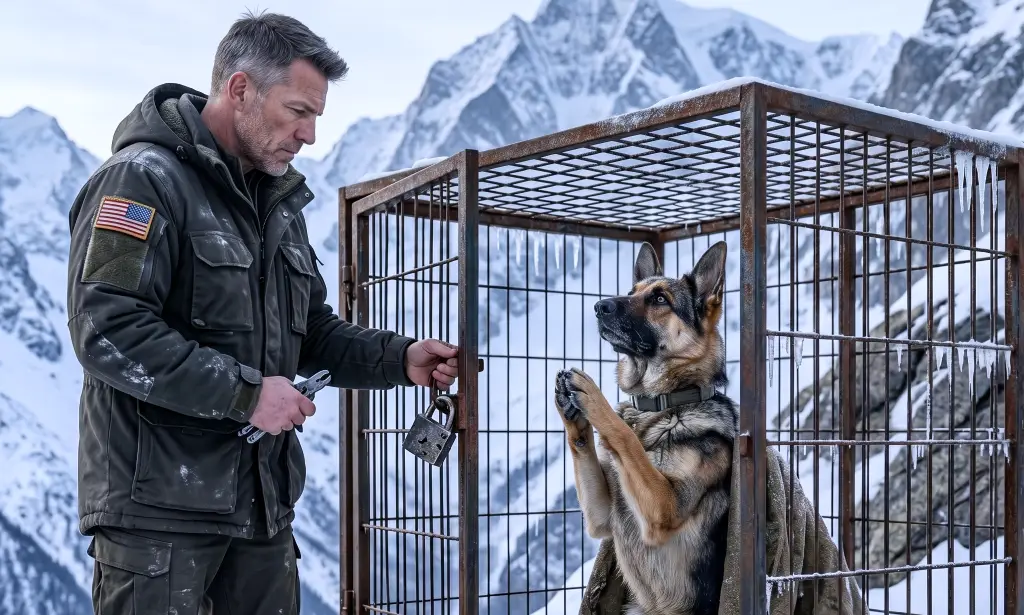
Grant was watching for tire tracks, sawdust, smoke—ordinary signs of an illegal cut—when he saw the cage.
It stood on a wind-scoured shelf above the tree line, raised on rough posts and braced with scavenged lumber. Steel bars, iced white. Padlock at the door. A cheap metal flue stuck crookedly from one corner, sending up no more than a thread of smoke from a useless little burner someone had set there to pretend warmth was possible.
For three seconds Grant did not move. His mind did what it had been trained to do: distance, approach, exposure, purpose. The cage was not accidental. It had been placed where the wind would have no mercy and the snow would cover tracks before noon.
Then the dog inside lifted his head.
Grant had been around military working dogs overseas, and he knew the difference between a stray and an animal with a job burned into his nervous system. Even half-frozen, the Shepherd tracked him with discipline. Black-and-tan coat crusted with frost. One front leg held wrong. Collar mark worn pale around the neck. No barking, no panic, no waste of strength.
Grant approached slowly, hands visible, voice quiet.
“Easy, boy. I see you.”
The dog’s eyes narrowed, not in fear but calculation. Grant respected that. Fear got loud. Training got still.
The lock was old and stubborn but not complicated. Grant broke it with a compact pry tool from his belt, shoulders angled against the wind, fingers numbing inside his gloves. When the cage door gave way, it shrieked on frozen hinges. The Shepherd flinched once, then steadied himself like he was ashamed the sound had reached him.
He did not come out at first.
Grant crouched in the snow, making himself smaller. “Your call,” he said.
For a long moment, the dog stood in the open doorway and stared at the world beyond the bars as if freedom were another trap with better lighting. Then he stepped down. His injured leg buckled, and Grant caught him before he hit the snow.
The dog should have fought. Most hurt animals would have. Instead, he went rigid in Grant’s arms, enduring rescue with the same grim restraint he had used to endure the cage. Grant stripped off his outer jacket and wrapped it around him, feeling ribs beneath muscle, the tremor hidden under the fur.
As Grant carried him toward the truck, the dog twisted his head toward the woods below the ridge. Not toward the cage. Not toward the road. Past both, into the timber.
Grant stopped.
The Shepherd’s ears stood high despite the cold, his gaze fixed on a black seam of pines where the slope fell away toward protected state land. Something down there mattered to him. Maybe a memory. Maybe a threat. Maybe both.
Grant had survived too many bad places to ignore a silent warning from something that had already survived one.
Now, as the truck crawled down the mountain road, the dog lifted his head again. The heater was finally warming the cab, fogging the lower corners of the windshield. Grant kept one hand on the wheel and the other near the dog’s shoulder, close enough to steady him, not close enough to crowd him.
They were three miles from the ridge when the Shepherd’s body changed. His head came up. His nostrils flared. A sound gathered low in his chest, not a bark, not quite a growl.
Grant glanced at the rearview mirror.
The road behind them was empty. Snow, trees, the gray curve of the last switchback. No headlights. No movement.
Still, the dog stared into the mirror as if something had followed them and then learned how not to be seen.
Grant eased off the gas. He scanned the ditch lines, the higher slope, the places a truck could tuck behind trees. Nothing. The dog held the growl for another few seconds, then lowered his head again, but he did not sleep.
Grant drove the rest of the way with his jaw tight.
His cabin sat north of Tamarack where the county road gave up and private gravel began. It was small, square, built of timber and stone by a man who had expected weather to be an adversary and had planned accordingly. Grant carried the dog inside and laid him on two wool blankets beside the wood stove. The Shepherd tensed when warmth reached him, his muscles shuddering under the jacket…
To read the rest of the story – CLICK the NEXT button 👇👇👇