


The leash went tight before Alex Mercer even saw the passenger. Ranger had been moving beside him with the calm, practiced rhythm of a working dog, shoulders level, ears forward, black-and-tan coat brushed clean for the afternoon shift. The security checkpoint at Pittsburgh International was doing what it always did before a string of evening departures: rolling bags thumped over tile, bins clattered against stainless steel, a toddler cried somewhere near the PreCheck lane, and a gate agent’s voice drifted over the speakers in a tone too cheerful for a rainy Monday.
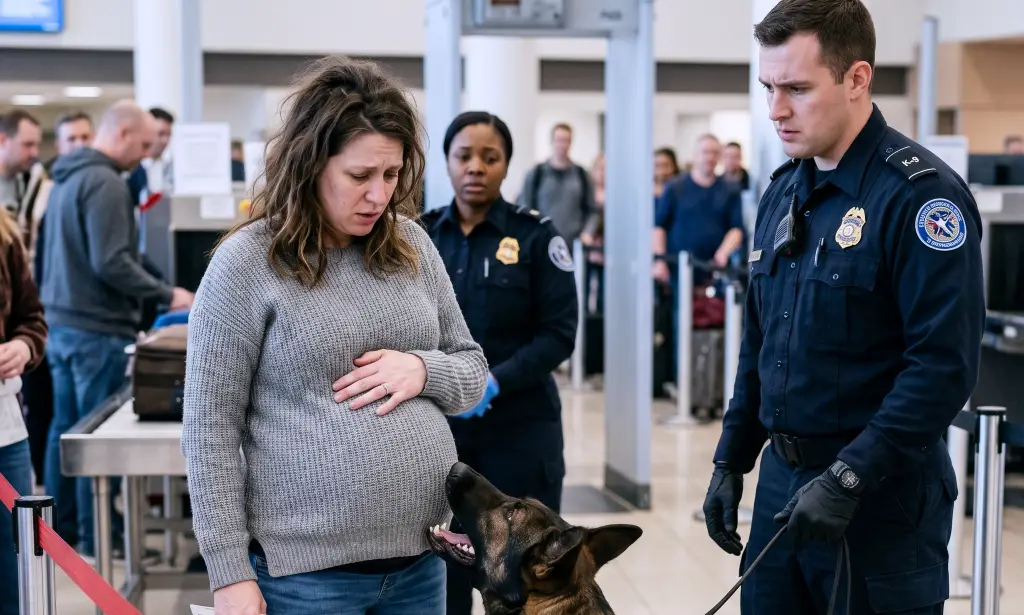
Then Ranger stopped.
Not slowed. Not glanced. Stopped.
Alex felt it through the leather lead first, that sudden change from trained movement to hard resistance. He turned his wrist automatically, expecting to see the dog’s nose angled toward a suitcase, a backpack, maybe a coat draped over someone’s arm. Ranger had done that hundreds of times. He was trained for it. He knew how to tell Alex when something was wrong.
But Ranger wasn’t looking at a bag.
He was staring at a woman in a gray maternity coat, one hand curved over the front of her stomach, the other gripping a boarding pass so tightly the paper had folded down the middle. She stood near the end of the screening lane, small and pale under the fluorescent lights, with damp brown hair tucked behind one ear and a canvas tote slipping from her shoulder.
Ranger gave one low bark.
The woman flinched as if the sound had struck her.
“Sir?” she said, taking a step back. “Can you please get him away from me?”
Alex tightened his grip, not because Ranger was lunging, but because the dog had shifted forward with a kind of urgency Alex did not recognize. His ears were up now, his body angled toward her, the hair along his shoulders lifting in a stiff ridge. It was not the clean, seated alert Alex had trained into him. It was not a mistake, either.
“Ranger,” Alex said quietly.
The dog did not take his eyes off her.
People began to notice. A man in a Steelers hoodie stopped feeding his belt through a bin. A college kid lifted his phone before his girlfriend tugged at his sleeve. Two business travelers paused mid-conversation, both of them turning with the same wary expression people wore in airports when they heard a dog bark and did not know whether to be afraid.
The woman looked from Ranger to Alex. “I’m pregnant,” she said, as if that explained why this could not be happening. “I haven’t done anything. I’m just trying to get to my gate.”
“I understand,” Alex said, keeping his voice level. “Ma’am, I need you to stay right where you are for a second.”
Her eyes widened. They were gray-green, glassy at the edges, not guilty-looking so much as exhausted. “No. No, please. My flight boards in twenty minutes. I can’t miss it.”
Ranger barked again, louder this time. The sound cut cleanly through the checkpoint noise. The toddler stopped crying. Somewhere behind Alex, a TSA officer said, “Phones down, please,” but not everyone listened.
Alex had worked with Ranger for nearly five years. He knew the difference between a dog distracted by food and a dog catching a trained scent. He knew when Ranger was bored, when he was irritated, when he was pretending not to see the tennis ball one of the newer officers had hidden in a break room as a joke. Ranger was steady in crowds. He had walked past screaming children, spilled coffee, dropped sandwiches, luggage wheels, perfume clouds, and passengers who were terrified of dogs.
He did not bark at pregnant women.
Mia Torres came up from the side of the lane, her blue gloves still on from screening. She was one of the few officers who never rushed frightened passengers into worse panic. She took in the woman’s face, Ranger’s posture, Alex’s hand on the lead.
“What do you need?” she asked him.
Alex did not answer right away. That was the problem. He did not know.
A standard alert would have made the next steps simple. Separate the bag. Call a supervisor. Follow protocol. Document everything. But Ranger’s focus was on the woman herself, not her tote, not her suitcase, not the small roller bag standing beside her knee.
The woman’s breathing had gone shallow. “Please,” she said, lower now. “I don’t like dogs. I mean, I don’t hate them, I just—please.”
“What’s your name?” Mia asked.
The woman swallowed. “Claire. Claire Bennett.”
“Okay, Claire. I’m Mia. This is Alex, and the dog’s name is Ranger. Nobody’s accusing you of anything. We just need to slow this down.”
Claire looked at the line of strangers staring at her. The humiliation was plain now, spreading over her face beneath the fear. One hand tightened over her belly as if she could shield the baby from the checkpoint, the dog, the phones, all of it.
“I have a letter from my doctor,” she said quickly. “I’m allowed to fly. I’m thirty-one weeks, but she said it was okay if I didn’t have any new symptoms. I’m going to Raleigh. My sister—she’s picking me up.”
Alex caught that detail and held on to it. Thirty-one weeks. Alone. Trying to board.
Behind him, his supervisor, Karen Holt, approached with the crisp walk of someone who had already seen enough to know paperwork was coming. “Mercer?”
Alex glanced at her, then back at Ranger. The dog’s body was still tight, his nose working the air in short bursts.
“It’s not his normal alert,” Alex said.
Karen’s jaw moved once. She understood what he had not said: that the dog was alerting anyway.
Claire heard enough of it to panic. “Normal alert? What does that mean? What do you think I have?”
“We don’t know anything yet,” Mia said, shifting slightly so her body blocked Claire from the nearest phone camera. “We’re going to take you to a private screening room, okay? Just for a few minutes.”
“No,” Claire whispered. “No, I can’t—”
Ranger whined.
That sound did what the barking had not. It stripped the moment of authority and procedure and left something rawer behind. Alex looked down at him. Ranger was still fixed on Claire, but his mouth had closed, and the whine came again, thin and strained, from deep in his chest…
To read the rest of the story – CLICK the NEXT button 👇👇👇