


Nolan Pierce had built his life by refusing to look away from weakness. In business, that habit made him feared. He could walk into a failing company, spot the wasted money in ten minutes, and make decisions before anyone else had finished explaining the problem. His competitors called him cold. His employees called him exacting. The newspapers, when they bothered with young private-equity millionaires, called him “mercilessly efficient,” which was a polite way of saying people rarely mistook him for gentle.
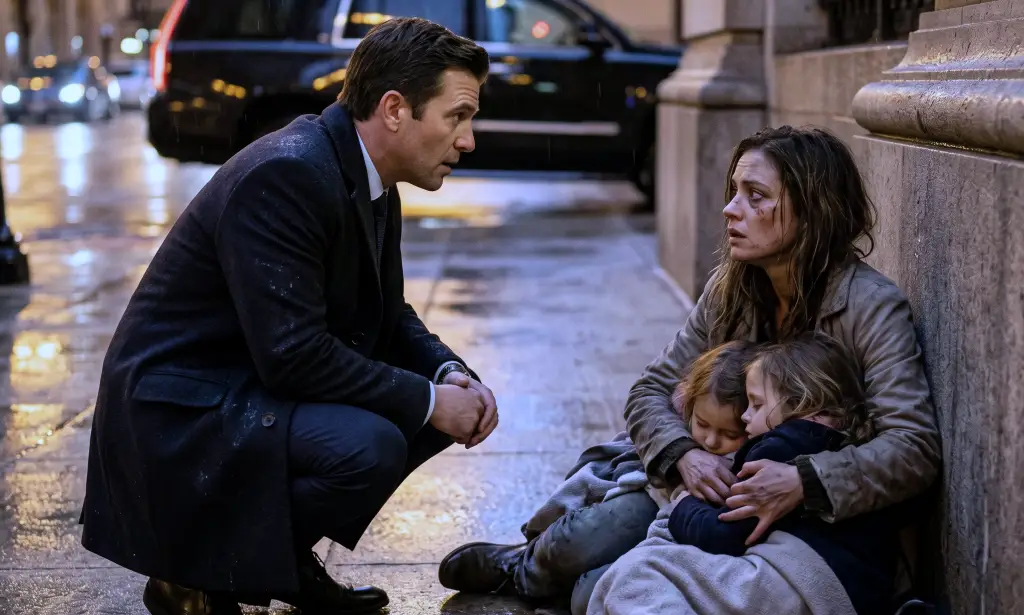
That November evening in downtown Chicago, Nolan was thinking about a contract, not mercy. Rain had been falling off and on all afternoon, leaving the sidewalks dark and slick beneath the traffic lights. He had just stepped out of a meeting on LaSalle Street, coat collar raised against the wind, when a child’s small, broken sob cut through the noise of buses, horns, and office workers hurrying toward the train.
He stopped at the corner.
A woman sat near the entrance of a closed bank, her back against the stone wall, one arm wrapped around two little girls who couldn’t have been more than four. Their coats were too thin for the weather. One child had her face pressed into the woman’s side, shoulders shaking. The other stared at the people passing by with the wary stillness of a child who had already learned not to ask too much.
“It’s okay, Maddie,” the woman whispered, smoothing a strand of hair away from the crying girl’s face. “Just a little longer, baby. We’re going to be okay.”
Her voice made Nolan turn fully toward her.
At first he saw only the dirt on her cuffs, the cracked skin of her hands, the exhaustion that had settled into her face like something permanent. Then she lifted her head, and the years folded in on themselves.
Maya Collins.
For a moment Nolan was seventeen again, standing at the edge of the gym after a high school dance, wearing a borrowed jacket that didn’t sit right on his shoulders, watching Maya laugh with the kind of effortless brightness that made every other person in the room seem unfinished. She had been pretty, yes, but that wasn’t what he remembered most. He remembered her confidence. The way she walked down the hall as if the world had already made room for her.
He also remembered the day she had smiled at one of his clumsy attempts to talk to her and said, not cruelly enough to count as cruelty, “You’re sweet, Nolan, but you try too hard.”
Half the hallway had heard. He had pretended not to care. At that age, pretending was all he had.
Now she sat on a cold sidewalk with two hungry children tucked against her ribs.
“Maya?” he said.
She went still before she looked up. Recognition moved slowly across her face, first confusion, then disbelief, then a shame so naked that Nolan wished he had approached more carefully.
“Nolan Pierce,” she said, and her voice sounded thinner than memory. “I didn’t— I mean, I didn’t think you still lived here.”
“I do.” He crouched a few feet from her, careful not to crowd the girls. “Are these your daughters?”
Maya’s arm tightened around them. “Yes.”
The crying child peeked at him through wet lashes. Her cheeks were flushed from cold, her little nose red. The other girl leaned closer to Maya but kept watching Nolan with solemn, gray-blue eyes.
“What are their names?” he asked.
Maya hesitated, as if even answering that cost her something. “Maddie and Ella.”
Nolan looked at the girls again. Their shoes were damp. One of them wore mismatched socks. There was a paper cup beside Maya with a few coins at the bottom, and the sight of it did something to him he couldn’t immediately name.
“Maya,” he said quietly, “you can’t stay out here tonight.”
Her eyes flashed, a trace of the girl she had once been cutting through the exhaustion. “We’re fine.”
“No, you’re not.”
She looked away. “I didn’t ask you for anything.”
“I know.”
That made her jaw tighten. “Then keep walking.”
A bus sighed to a stop at the curb. People moved around them, some glancing, most not. Nolan had spent years convincing himself he was not sentimental. Sentiment was messy. Sentiment made bad investments and worse decisions. But the little girl named Maddie rubbed her eyes with fists too small to be that dirty, and every clean, practical part of him failed.
“I’m not going to hand you money and leave you here,” he said. “Let me get you somewhere warm.”
Maya gave a small, bitter laugh. “Where? A shelter? We’ve tried. There’s a waiting list, unless you want to stand in line for hours and maybe still get turned away.”
“My house,” he said.
She stared at him.
He heard how it sounded only after he said it. Too sudden. Too intimate. Too much like power. He took a breath and lowered his voice.
“I have a housekeeper. A guest suite. Food. Heat. You and the girls can rest tonight, and tomorrow we’ll figure out what you want to do. Nothing else. No strings.”
Maya’s face changed at the word strings. She had learned to look for them.
“I can’t,” she said.
“Yes, you can. Not because you owe me. Because your daughters are cold.”
That reached her. Her gaze dropped to Maddie’s thin sleeves, to Ella’s shoes, to the damp edge of the blanket under them. Pride moved across her face, then fear, then a tiredness too deep to argue with. When Maddie coughed, Maya closed her eyes.
Nolan stood and took out his phone.
“My driver’s around the block,” he said. “Five minutes.”
Maya didn’t answer, but she didn’t tell him to leave again.
When the car pulled up, Nolan held the door while Maya gathered the girls and the small plastic grocery bag that seemed to contain everything they owned. Ella clutched a stuffed rabbit with one missing ear. Maddie had gone quiet in the boneless way of an exhausted child. Nolan offered to carry the bag, and Maya almost refused before handing it over without meeting his eyes.
During the ride north, the girls fell asleep against their mother. Maya sat rigidly between them, staring through the window at the city lights blurring across the wet glass. Nolan sat across from her in the back of the SUV, silent because every question he wanted to ask felt like a trespass.
He remembered her at eighteen with lip gloss and a debate trophy, her hair in a high ponytail, her future so loudly expected that everyone seemed to accept it as fact. He remembered himself standing near lockers with a stack of library books, too shy to speak unless he had rehearsed first.
She caught him looking.
“Don’t,” she said.
“I didn’t say anything.”
“You don’t have to.”
The driver turned onto Lake Shore Drive. The dark water moved beyond the railings, restless under the wind.
“I’m not judging you,” Nolan said.
Maya gave him a look that almost hurt. “People always say that right before they do.”
So he let the silence remain.
His house sat on a quiet street north of the city, not quite a mansion in the old storybook sense but close enough to make Maya shrink back when the gates opened. It was limestone and glass, built by someone with money and no desire to apologize for it. Warm light spilled from the windows. The hedges were trimmed. The front walk had been salted before the temperature even dropped low enough to freeze.
Maya looked at the house, then down at her sleeping daughters, and Nolan understood that for her the place did not look like rescue. It looked like another world with rules she did not know.
“This was a mistake,” she whispered.
“No,” he said. “It’s a house. That’s all.”
The front door opened before they reached it. Rosa Alvarez, who had run Nolan’s household for five years with more authority than anyone on his payroll, stood framed in the doorway. Her eyes widened at the sight of Maya and the children, but she recovered quickly.
“Mr. Pierce,” she said.
“Rosa, this is Maya and her daughters, Maddie and Ella. They’ll be staying in the blue guest room tonight. Could you warm something for them to eat? Something simple.”
Rosa looked from Nolan to Maya, and whatever questions she had stayed behind her composed face. “Of course. Come in, sweetheart. Let’s get these babies warm.”
The word sweetheart nearly undid Maya. Her mouth trembled, but she pressed it flat and stepped inside.
The house smelled faintly of cedar, coffee, and the fire Rosa had lit in the living room. Maddie woke when the heat touched her face. Ella blinked up at the tall ceiling and the staircase, her fingers tightening around the battered rabbit. Nolan stayed back while Rosa took over with the practical tenderness of a woman who knew when kindness needed to sound like instruction.
“Bathroom’s right this way,” Rosa said. “I’ll find towels and pajamas. Mr. Pierce, don’t stand there looking useless. Put their bag in the room.”
Nolan obeyed.
Later, after soup and bread and warm milk, after Maddie had eaten too quickly and Maya had murmured for her to slow down, after Ella had fallen asleep with a piece of buttered toast still in her hand, Nolan stood outside the guest room and listened to the quiet on the other side of the door. Not because he wanted to intrude, but because some part of him needed to know they were safe.
Maya opened the door before he could walk away.
She had washed her face. Without the street grime, she looked younger and more tired, her cheekbones too sharp, her eyes shadowed. She wore one of Rosa’s old cardigans over borrowed sweatpants. It should have made her look small, but instead it made the effort she was using to remain upright more visible.
“The girls are asleep,” she said.
“Good.”
“I’ll leave in the morning.”
Nolan leaned one shoulder against the hallway wall. “We can talk about that in the morning.”
“There’s nothing to talk about. I appreciate tonight. I really do. But I can’t move into your life because you felt sorry for me on a street corner.”
“That’s not what this is.”
“Then what is it?”
He could have said he didn’t know. That would have been partly true. He could have said he remembered her. That would have sounded like an accusation. Instead he looked past her, toward the room where her daughters slept under clean blankets.
“It’s one night,” he said. “Start there.”
Maya’s expression softened for half a second before she pulled it back. “You were always good at sounding certain.”
“I was terrified most of the time.”
That surprised her. For the first time all evening, she almost smiled. “You hid it well.”
“No, I didn’t.”
A small silence passed between them, less painful than the ones before it.
“Good night, Maya,” he said.
She nodded. “Good night, Nolan.”
He walked away before he could say anything else.
The next morning, Nolan was in his office before sunrise, sitting with an untouched cup of coffee while the city beyond the windows slowly turned gray. He had reviewed three contracts, answered twelve emails, and understood none of them. Every few minutes his mind returned to the same image: Maya on the sidewalk, her body curved around her daughters as if she could protect them from the whole world by making herself smaller.
Rosa appeared in the doorway without knocking. She only skipped that formality when she had already decided he needed managing.
“They’re awake,” she said. “The little one with the rabbit is shy. The other one asked if pancakes are allowed.”
Nolan rubbed a hand over his face. “Pancakes are allowed.”
“I assumed.” Rosa studied him. “What are you doing, Mr. Pierce?”
“I don’t know yet.”
“That’s the first honest thing you’ve said this morning.”
He looked up. “Do you think I shouldn’t have brought them here?”
“I think a woman with two children needed help, and you helped. What matters now is whether you remember she’s a person, not a project.”
The words landed cleanly because they were deserved.
“I know,” he said.
Rosa nodded once. “Good. Breakfast in ten.”
Maya came downstairs holding the girls’ hands. Rosa had found clean clothes from a donation box she kept for her church, and the twins looked almost startlingly different in soft leggings and sweaters that fit. Maddie ran her fingers over the sleeve as if she couldn’t quite believe it belonged to her. Ella kept one hand on Maya’s leg.
The dining room table was set with pancakes, eggs, fruit, juice, coffee. Maya stopped in the doorway.
Nolan saw the hesitation and understood too late that abundance could be its own kind of cruelty when someone had been living without choices.
“Sit wherever you want,” he said. “Or take plates into the kitchen. No ceremony.”
Maddie looked up at Maya. “Can we?”
Maya swallowed. “Yes, baby. Go ahead.”
The girls climbed into chairs, suddenly all appetite and wonder. Maddie whispered to Ella before taking syrup, and Ella solemnly offered half a strawberry to her rabbit. Maya sat beside them but barely touched her food. Nolan waited until the girls were busy, then said, “After breakfast, I can call a pediatric clinic. Just a checkup. They were cold last night.”
Maya’s shoulders tightened.
“I’m not calling anyone without your permission,” he added.
She looked at him then. “Thank you.”
“For asking?”
“For knowing you had to.”
It was a small sentence, but it told him enough. People had made decisions around Maya. Maybe for her. Maybe about her. Maybe both.
After breakfast, Rosa took the girls to the sunroom with crayons and a stack of printer paper. Maddie went willingly. Ella looked back twice before following. Maya remained at the table, hands around her coffee mug, eyes fixed on the dark surface as if it could answer for her.
Nolan sat across from her.
“You don’t owe me your story,” he said. “But I can’t help in any meaningful way unless I understand what happened.”
Maya laughed once, quietly and without humor. “Meaningful. That sounds like you.”
“I’ve gotten worse.”
“No,” she said, looking up. “You’ve gotten polished.”
He accepted that. “Maybe.”
She turned the mug between her palms. For a long while, he thought she wouldn’t speak. Then her shoulders lowered, not in surrender exactly, but in exhaustion.
“You remember Tyler Vance?”
Nolan did. Everyone remembered Tyler. Quarterback smile, rich-kid confidence without the rich-kid money, a boy who could charm teachers after skipping half their classes. He had been admired by people who mistook volume for strength.
“Yes,” Nolan said.
“I started seeing him after graduation. I thought it was love because I was eighteen and stupid and he looked at me like I was the only person in the room.” Maya’s mouth tightened. “When I told him I was pregnant, he asked if I was sure it was his.”
Nolan’s hand closed around his coffee cup. He made himself loosen it.
“He said he wasn’t ready,” she continued. “Then he said I was trying to trap him. Then he disappeared. Blocked my number, left town for a while, told people I was lying. By the time the girls were born, I had stopped trying to make him answer.”
“Your family?”
“My dad died when I was little. My mom helped as much as she could, but she was working double shifts at a nursing home and then her health started going bad. She died when the girls were two.” Maya said it plainly, which made it worse. “After that, it was me. Daycare cost more than I made. I cleaned rooms at a hotel, stocked shelves overnight, took shifts wherever I could. Then Maddie got sick, I missed work, and the manager said he was sorry but he needed someone dependable.”
The word dependable sat between them like a charge.
“I fell behind on rent,” she said. “I thought I could catch up. I sold my car. Sold my laptop. Sold everything that wasn’t tied to the girls. It bought us time, but not enough. We got evicted in March.”
Nolan stared at her, helplessly angry and aware that anger, at the moment, helped no one.
“Since then?” he asked.
“Motels when I could afford them. Shelters when there was space. A church basement for a while. Sometimes the train station until security moved us along.” She rubbed her thumb over a crack in the mug’s glaze. “People think homelessness is one big disaster. Sometimes it’s just a hundred small ones, and each one takes away another option.”
Nolan had negotiated bankruptcies. He had spoken about loss in spreadsheets, liabilities, liquidation values. He had never heard it described so simply or so accurately.
“Why didn’t you reach out to anyone from school?” he asked.
Maya looked at him then, really looked. “To say what? Hi, remember me? I used to think I was better than everyone, and now my children sleep in bus stations?”
“You weren’t that bad.”
“I was.” Her voice did not invite comfort. “Maybe not to everyone. But to you, sometimes. I knew you liked me, and I made jokes because it made me feel powerful. I have thought about that more times than you probably deserve.”
Nolan hadn’t expected the apology, not here, not now, not with pancakes cooling between them and her daughters drawing in the next room.
“We were kids,” he said.
“That doesn’t erase it.”
“No,” he agreed. “But it doesn’t have to decide everything either.”
Maya looked away, and he watched her fight the instinct to reject kindness before it could become debt.
“I can help you get documents replaced if you need them,” he said. “Doctors for the girls. Clothes. A safe place while you decide your next step. After that, we can talk about work, housing, whatever makes sense. You stay in control.”
She studied him with suspicion that had been earned by other people.
“Why?” she asked.
He could have hidden behind decency. He could have said anyone would do the same, though both of them knew that wasn’t true. He could have made it sound casual, clean, easy.
Instead he told the truth carefully.
“Because I remember you,” he said. “And because last night I saw two little girls who needed somebody to stop. That’s enough for now.”
Maya’s eyes lowered to her hands. In the sunroom, Maddie laughed at something Rosa said, a high, surprised sound that made Maya flinch before she realized it was joy.
“I don’t know how to accept this,” she whispered.
“Then don’t accept all of it. Accept breakfast. Accept a doctor. Accept one more night.”
Her eyes shone, but she blinked the tears back before they could fall. “One more night,” she said.
Nolan nodded, though he already knew one night would not be enough to repair what years had taken from her.
It was only a place to begin.
By the end of the first week, the blue guest room no longer looked untouched.
A pair of small sneakers sat crookedly by the door. Crayon drawings appeared on the desk: stick figures with long hair, a house with too many windows, a tall man standing beside two girls under a yellow sun. Rosa taped the drawings to the wall without asking, and the twins began adding more, as if the room were slowly giving them permission to exist inside it…
To read the rest of the story – CLICK the NEXT button 👇👇👇