


The first time I wrote the word embrace in Winston’s behavior log, I put it in quotation marks. By the end of the second week, no one at Redwood Mesa Primate Sanctuary found the word comforting anymore. Winston was not a sentimental animal, at least not in the way visitors liked to imagine. He was a twenty-nine-year-old western lowland gorilla with a silver back, a heavy brow, and the calm authority of a creature who understood exactly how much space he occupied in the world. He tolerated people he trusted. He accepted food, training, medical checks, and the careful routines of protected contact. But he had never begged for attention, and he had never wasted his trust on strangers.
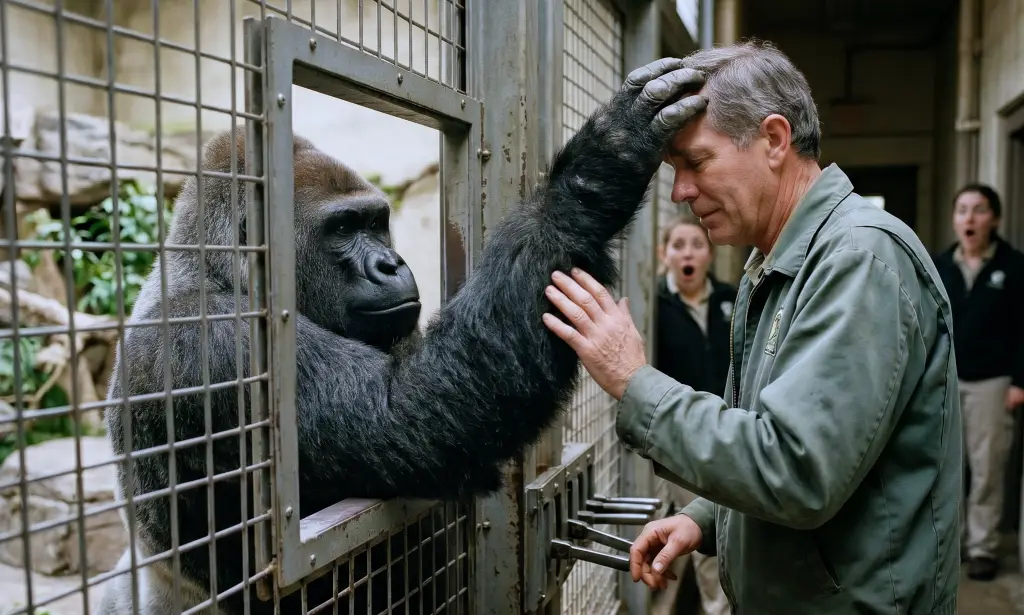
Then, late that summer, he began reaching for one man again and again.
Tom Barrett forgot the west corridor latch at 6:17 on a Tuesday morning.
It was the kind of mistake that would have meant nothing in a kitchen, a parking lot, or a grocery store. A man could pause in front of a cabinet and lose the shape of a familiar motion for a few seconds without anyone calling it a warning. But at Redwood Mesa, every gate had a sequence, and every sequence existed because a four-hundred-pound silverback lived on the other side of it.
I was standing in the observation booth with a paper cup of bad coffee cooling in my hand when Tom stopped in front of the latch plate. He had already checked the outer lock, set the red safety pin, and called clear to Miguel Reyes, who stood ten feet behind him with the morning chart. Then Tom looked down at the two levers as if someone had changed their order while he was blinking.
He touched the first lever. Stopped. Touched the second.
Across the steel mesh, Winston lifted his head from a pile of willow branches.
Nobody spoke. That was one of the first things I noticed. Miguel did not correct Tom, and Tom did not ask for help. The whole corridor seemed to hold its breath around a mistake small enough to deny and dangerous enough that no one should have been denying it.
Then Winston came to the training wall.
He did not charge. He did not display. He crossed the indoor dayroom with that heavy, deliberate grace gorillas have, each movement quiet until you remembered the strength inside it. He stopped at the mesh panel directly across from Tom and pressed both broad forearms against the steel, curving his body toward the man on the other side.
Tom looked up, and embarrassment moved across his face before he covered it with a tired smile.
“Not now, Win,” he said. “I’m trying to work.”
Winston stayed where he was. His dark fingers slipped through the protected-contact openings, not far enough to grab, only far enough to hook around the edge of Tom’s sleeve. It was not an embrace in the human sense. There was steel between them, two locks behind Tom, and a protocol sheet taped to the wall.
Still, when Tom stepped closer and let his shoulder rest against the mesh, Winston shaped his arms around him as much as the barrier allowed.
That was why we had started calling it an embrace. None of us had found a better word.
My name is Dr. Nora Whitcomb, and I had been consulting with Redwood Mesa for almost nine years by then, mostly on behavior plans for great apes who had outlived the people who first taught them how to survive captivity. I knew better than to turn every unusual gesture into a human emotion. People are quick to make animals into mirrors, especially animals with hands, faces, grief, patience, and eyes that seem to know too much. My job was usually to slow everyone down.
But Winston’s behavior was not casual affection. He was an old male with a limited tolerance for unnecessary contact, and his attention had always been selective. He would sit near certain keepers, accept a reward from others, and occasionally choose to station close to the mesh during a quiet morning, but he did not cling. He did not ask to be held.
For most of twenty-five years, the one exception had been Tom.
Miguel handed me the tablet without looking away from the corridor. On the screen was a behavior chart from the past three months, and even before I read the notes, the pattern told its own story. Two barrier holds in early July. Five by the end of that month. Eleven in August. Then, in the first two weeks of September, the marks rose so sharply they no longer looked like affection increasing.
They looked like an alarm.
“Only with Tom?” I asked.
Miguel nodded. He was thirty-two, careful, and too young to have learned how to hide worry gracefully. “He’ll sit near me. He’ll take food from Dana. He’ll train with Sasha if she keeps it short. But this?” He tipped his chin toward the mesh, where Winston’s fingers still rested on Tom’s sleeve. “Only Tom.”
Inside the corridor, Tom closed his eyes. He stayed that way for three seconds, maybe four, then opened them and patted Winston’s hand with the practiced gentleness of someone who had done a thousand difficult things without making a show of them.
“Okay,” he murmured. “I’m here.”
Winston made a low sound in his chest.
It was not loud enough to frighten anyone. It was not even dramatic. But Miguel’s shoulders tightened when he heard it, and I saw Tom’s hand pause on the mesh. Whatever that sound meant, they both knew it was not ordinary.
“How often is this happening now?” I asked.
“Yesterday we logged fourteen,” Miguel said.
“Fourteen contacts?”
“Fourteen holds. The small touches are constant.”
I studied the dayroom through the glass. The overhead lights had not fully warmed yet, leaving the concrete, climbing beams, and hanging ropes in a flat gray wash. Winston’s breakfast waited untouched in a stainless-steel bowl near the hay. Usually that would have bothered him. Today his attention stayed on Tom, fixed and quiet, as if the food could wait but the man could not. Tom finally stepped back. Winston let his sleeve go, but he did not leave the mesh. He watched Tom reset the latch, watched him complete the sequence correctly this time, watched him try to pretend he had not needed the extra moment…
To read the rest of the story – CLICK the NEXT button 👇👇👇