


The receipt from the post office was still folded behind my bus pass when the uniforms found me. It was barely after six on a gray September morning, the kind of morning when the city looked bruised before the sun had even cleared the rooftops. I had one arm halfway through my wrinkled cafeteria smock and a mug of instant coffee sitting untouched on the counter. When the knock came, hard and even and official, I froze with my hand still in the sleeve.
No one knocked like that unless they had the power to ruin your day.
For a second, I thought it was my landlord. Then I thought maybe it was the police. In my building, a fourth-floor walk-up with a broken buzzer and a stairwell that smelled like old mop water, a knock before sunrise never meant someone had brought good news.
I opened the door with the chain still on.
Three people stood in the dim hallway in dress uniforms so sharp they looked cut out of another world. The man in front had gray at his temples, silver eagles on his shoulders, and a face that had learned how to carry bad news without flinching. Behind him stood two younger officers, one woman and one man, both holding themselves like the cracked linoleum beneath their shoes was marble.
The colonel looked at the chain, then at me. “Nia Walker?”
My mouth went dry. “That’s me.”
“I’m Colonel Marcus Avery. This is Captain Park and Lieutenant Willis.” His voice was low, careful. “We’re here about Henry Mercer.”
The name hit me in the chest before I had time to prepare for it.
Henry Mercer had slept outside the boarded-up laundromat on Marion Avenue. Henry had taken his coffee black and his bananas bruised, because, as he liked to say, the brown spots were where the sweetness hid. Henry had been gone for two weeks, buried with almost no one there to say goodbye.
I gripped the edge of the door. “What about him?”
Colonel Avery lowered his voice. “General Hartwell received his letter.”
For a moment, the hallway tilted—not because I fainted or screamed or did anything dramatic, but because my body simply stopped trusting the floor. That letter had cost me five dollars and sixty cents to mail. I had watched a bored postal clerk toss it into a canvas bin with birthday cards, bills, coupons, and whatever else people were trying to send out into the world. I had walked home afterward certain it would disappear.
But it had not disappeared.
The colonel’s eyes moved over my face. He must have seen the fear there, because his expression softened by a fraction. “Ma’am, General Hartwell would like to speak with you. But first, we need to understand exactly what you did for Mr. Mercer.”
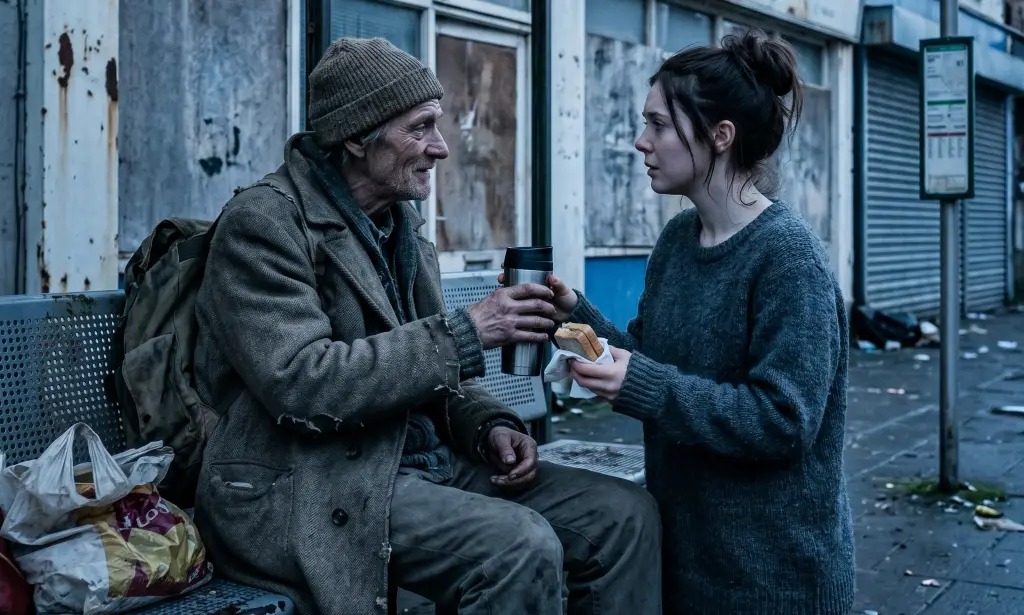
What I did for Henry was not grand. It did not feel heroic while I was doing it. It was peanut butter on store-brand wheat bread, a banana when I could afford one, and coffee poured from a dented thermos into a paper cup.
But to explain it, I have to go back to the first morning I saw him clearly.
By March, I had trained myself not to look too closely at people on sidewalks.
That sounds cruel. It was cruel. It was also one of the small, ugly ways poverty teaches you to survive. I was twenty-two, taking nursing prerequisites at Eastbrook Community College two nights a week and working two jobs the rest of the time. From six in the morning until two in the afternoon, I served eggs, oatmeal, and institutional coffee in the basement cafeteria at St. Anne’s Medical Center. From four until midnight, I stocked shelves at a SaveMore grocery store across town, hauling boxes of canned soup and detergent until my shoulders burned.
I lived in a studio apartment on Briar Street that should have been condemned before I ever signed the lease. The heat came and went depending on the mood of the boiler. The bathroom ceiling bloomed with black mildew no amount of bleach could kill. My kitchen had a hot plate, a microwave with one working button, and a refrigerator that hummed all night like it was complaining.
Every morning, I caught the number 34 bus at 6:30 from the stop outside Suds & Shine, a laundromat that had been closed so long the faded sign in the window still advertised wash-and-fold for ninety-nine cents a pound. Henry slept under the awning, on cardboard flattened against the brick, his body curled around a black trash bag that seemed to hold everything he owned. He had a dark green army blanket, a knit cap pulled low, and hands so weathered they looked carved.
For two weeks, I walked past him.
I told myself I didn’t have anything to give. I told myself stopping would invite trouble. I told myself the city was full of people who needed help and that if I let myself see all of them, I would split open from the weight of it. So I kept my eyes on the cracked sidewalk, tightened my cheap coat against the cold, and stood ten feet away from him while I waited for the bus.
Then one Thursday morning, I had an extra sandwich.
That was all it took to break the little wall I had built around myself. I had packed two peanut butter sandwiches the night before because my schedule had changed twice, and I knew I would not get a real break at either job. By the time I left my apartment, I realized I would be running from St. Anne’s to SaveMore with no place to sit long enough to eat both. One would turn soft and sad in my locker.
Henry was awake when I reached the stop. He sat with his back against the brick, shoulders straight, eyes clear and watchful beneath the brim of his cap. People often describe homeless men as if they are blurred shapes in a landscape, but Henry was not blurred. He was painfully specific. The lines beside his mouth. The careful way he kept one hand on the trash bag. The proud lift of his chin when a woman in a wool coat stepped around him like he was something spilled.
I stood there longer than I meant to. Then I reached into my canvas tote.
“Sir?” My voice sounded too thin in the cold. “Would you want this?”
He looked at the plastic-wrapped sandwich in my hand, then looked at me. Not at the sandwich again. At me. He took in my cafeteria smock under my coat, the student ID clipped crookedly to my pocket, the dark half-moons under my eyes.
“You sure you don’t need it?” he asked.
His voice surprised me. It was rough, but not weak. There was a steadiness in it, the kind you hear in people who have spent a lifetime refusing to beg even when life has put them on their knees.
“I’ve got another one,” I lied.
He knew I was lying. I saw it in his eyes. But he did not embarrass me by saying so. He accepted the sandwich with both hands, like I had handed him something breakable.
“Thank you, Miss Walker.”
I blinked, then remembered my badge. “Nia,” I said.
He nodded once. “Henry Mercer.”
The bus groaned around the corner then, brakes squealing, exhaust rolling dirty and warm over the curb. I could have climbed on and made the moment small. Instead, I looked down at the paper cup wedged beside his bag.
“Coffee?” I asked. “Black or sugar?”
Something like amusement moved through his face. “Black, if you’re offering.”
The next morning, I brought a second cup. The morning after that, I brought another sandwich, and then a banana, and then an apple with a soft spot I cut around before leaving my apartment. By the end of the week, it had become a routine so simple and certain that it embarrassed me to realize how much I depended on it.
At 6:15, Henry would already be sitting up. I would hand him breakfast, pour the coffee, and sit beside him on the low concrete ledge beneath the laundromat window if the ground was dry enough. We only had ten minutes before my bus came, sometimes eight if traffic ran early, but those minutes began to feel like the only part of my day that belonged to me.
Henry asked about my classes. He wanted to know what I was studying, which instructor was hardest, whether I had learned how to take blood pressure manually instead of trusting a machine. When I complained about anatomy, he listened with his head tilted, as if the brachial plexus were a matter of national importance.
In return, he gave me stories.
Not ordinary stories. Not the kind of stories a person could tuck into polite conversation. Henry talked about flying at night with all the lights killed, about landing in places “the maps were instructed not to remember,” about men in suits who did not use their real names and women with more power than anyone in the room suspected.
“Helicopters are honest machines,” he told me one morning, both hands wrapped around his coffee. “They tell you right away if they don’t like what you’re asking.”
I smiled because I thought that was what he needed from me. “You flew helicopters?”
“A long time ago.”
“For the Army?”
He looked out toward the empty intersection. “Sometimes.”
Another day, he said, “Never trust a man who says something doesn’t exist. Most things that don’t exist have budgets.”
I laughed then, not cruelly, but because I did not know what else to do. Henry did not laugh. He only lifted his coffee and watched the traffic with eyes that seemed to be measuring something I could not see.
I thought he was confused. Maybe not all the time, but enough. I had seen men on the street talk to people who were not there. I had watched loneliness twist itself into memory until nobody could tell the difference. Henry was cold, hungry, and old. Maybe giving himself a grand past was the only way he could sit on that concrete with any dignity left.
So I never challenged him. I never asked for proof. I let him talk, and I brought him breakfast, and when my bus came, he always tipped two fingers toward his cap like I was somebody important.
The first time I saw another person humiliate him, I was standing at the curb in freezing rain.
It was early April, the kind of wet cold that slips past wool and finds your bones. Henry had tucked the army blanket around his knees, trying to keep the cardboard beneath him dry. A man in a charcoal overcoat came down the sidewalk with an umbrella angled low, phone pressed to his ear. He saw Henry. I know he did, because he shifted his stride…
To read the rest of the story – CLICK the NEXT button 👇👇👇